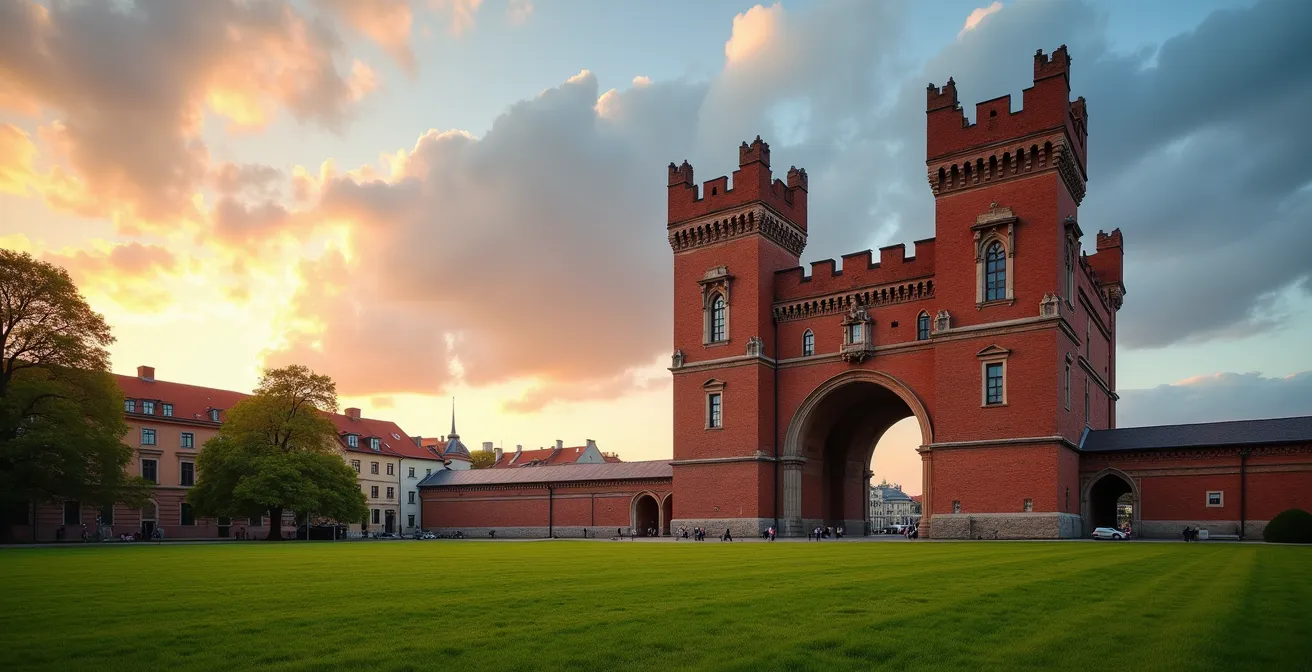
Contrary to the assumption that the tilt of the Holstentor is merely a construction defect, it is in truth the visible record of an engineering drama. It tells the story of the ambition of the Hanseatic League, which erected a symbol of its power on a geologically unyielding foundation. The lean is not a flaw, but physical proof of the constant struggle between human will and nature – a lesson in structural engineering carved in stone.
Every visitor to Lübeck knows the image: the mighty Holstentor, icon of the Hanseatic League and UNESCO World Heritage site, seems to be sinking gently into the ground. The towers lean toward each other as if they wanted to share a burden after centuries of watch. The usual explanation – “it stands on swampy ground” – only scratches the surface. As a structural engineer and historian with a deep connection to this city, I see more than just a crooked building. I see a living document that tells of the bold dreams of Hanseatic merchants, the limits of medieval engineering, and the geological reality of the Trave Valley.
The fascination of the Holstentor lies not only in its Brick Gothic aesthetics or its historical significance as a fortified city gate. It lies in its imperfection. The visible settlement differences are not a disgrace, but a chronicle. They reveal the story of a building that was a gamble from the very beginning. Instead of accepting the quick, superficial answer, we will peel back the layers of the problem in this article – from the geological structure of the subsoil to the structural challenges of the construction and the endless efforts for its preservation. We will understand why this gate is such a strong symbol for Lübeck’s character not despite, but precisely because of its tilt: resilient, proud, and inseparably connected to its foundation.
This article guides you through the various facets of our landmark. We decode its military genius, examine its family-friendliness as a museum, and compare its unique architecture. In the end, you will no longer see the Holstentor merely as a postcard motif, but as what it truly is: a masterpiece in constant dialogue with the earth on which it stands.
Table of Contents: The Holstentor from an Insider’s Perspective
- Why was this gate an insurmountable warning to all enemies in the Middle Ages?
- Is the exhibition in the Holstentor worth it for children or is it too text-heavy?
- What makes Lübeck’s Brick Gothic so unique compared to South German city gates?
- The mistake in choosing the location for the photo that makes the gate look smaller than it is
- How to connect the Holstentor and Niederegger Café without unnecessary detours?
- Why is the Cathedral almost always covered in scaffolding and what does its preservation cost?
- Why Munich in winter and Hamburg in summer offer two completely different experiences
- How to experience the best of Cologne or Hamburg in just 48 hours without burnout?
Why was this gate an insurmountable warning to all enemies in the Middle Ages?
The sheer mass of the Holstentor today conveys an impression of stability and power. In the Middle Ages, however, it was much more than a symbol – it was a state-of-the-art defense facility and a psychological weapon. Its deterrent effect was based not only on the thick walls but on an intelligent interplay of architecture and firepower. While the land-side walls offered physical protection with a thickness of up to 3.5 meters, the city-side facade was deliberately kept thinner. From a structural perspective, this was a compromise; from a military perspective, it was a stroke of genius: in the event of an enemy takeover of the gate, it could have been quickly “blasted ready for storming” from the city side.
The actual arsenal was impressive. Historical records prove that up to 30 cannons were housed inside, ready to put any attacker to flight. Although no shot was ever fired from these cannons in an actual emergency, their mere existence was an unmistakable message to anyone approaching the free city of Lübeck. It was, as a chronicler put it, a demonstration to “give Lübeck’s desire for peace the necessary weight.”
Case Study: The Staggered Defense System
The Holstentor did not stand in isolation. It was the final and strongest part of a multi-stage fortification system. An attacker coming from the west first encountered an outer gate flanked by side walls. The access road was deliberately curved to prevent direct artillery fire through the gate passage. Anyone who overcame this first obstacle found themselves on open ground – a deadly field of fire completely controlled by the walls of the actual Holstentor and the cannons lurking behind them. This strategic depth made a frontal attack practically a suicide mission.
Thus, the gate was less of a wall than a trap. Its construction embodied the self-confidence of the Hanseatic League: the primary focus was on trade and prosperity, but anyone who disturbed this peace would encounter a technologically superior and uncompromising defense.
Is the exhibition in the Holstentor worth it for children or is it too text-heavy?
The idea of a museum in a medieval building often raises concerns for parents that their children might get bored among dusty exhibits and long text panels. For the Holstentor, as a local expert, I can give the all-clear. The exhibition “The Power of Trade” was deliberately designed to bring history to life rather than just explain it. It is far from a text-heavy presentation.
The key to success with young visitors lies in interactivity and vivid representation. Instead of just reading, children can experience the Hanseatic era with multiple senses here. As one visitor aptly noted:
Historical armor, models of merchant ships, and interactive stations bring the past to life – an exciting place to discover, especially for families with children.
– One Million Places
The exhibition is cleverly divided into seven thematic rooms. These manageable units prevent sensory overload and allow families to focus on individual aspects. Especially the tangible elements make the visit an adventure:
- Experience Hanseatic goods: Children are allowed not only to look at historical trade goods such as pepper, salt, and precious fabrics but also to touch and smell them.
- Marvel at ship models: Detailed models of cogs and other merchant ships vividly convey how wealth came to Lübeck.
- Spooky thrills: The exhibition also shows instruments of torture, which provides a creepily fascinating change and often leads to exciting questions.
- Thematic tours: Special pirate tours are offered for families, conveying history in a playful and adventurous way.
The exhibition manages to bridge the gap between pure knowledge transfer and an exciting experience. It is not a playground, but a living history book that can also captivate young explorers.
What makes Lübeck’s Brick Gothic so unique compared to South German city gates?
Anyone traveling through southern Germany admires city gates made of light sandstone or massive rubble stone. When you come to Lübeck, you enter another world: that of Brick Gothic. The difference is fundamental and rooted in geology, economics, and the Hanseatic self-image. While natural stone was available as a building material in the south, the people of Lübeck had to rely on the raw material their land provided: clay.
Yet out of this necessity grew a unique art form. The brick was not just a substitute; it became a means of expression. Unlike coarse natural stone, the standardized brick allowed for precise, almost graphic lines. The Holstentor is the prime example of this mastery. What makes it so special is the conscious use of decor as a demonstration of power. They were not content with simple red bricks. Instead, black, glazed bricks were used to create complex patterns. These glazed bricks were more expensive to produce and signaled the city’s wealth from afar.
The crowning glory of this ornamental splendor is the two circumferential terracotta friezes. As the German Foundation for Monument Protection notes, the gate is adorned with bands of square terracotta tiles, each with an impressive edge length. An analysis of the details shows that the artistic decoration in the 55-centimeter tiles was executed with motifs such as the lily – a symbol that is unexpected in a defensive structure and shows pure design will.
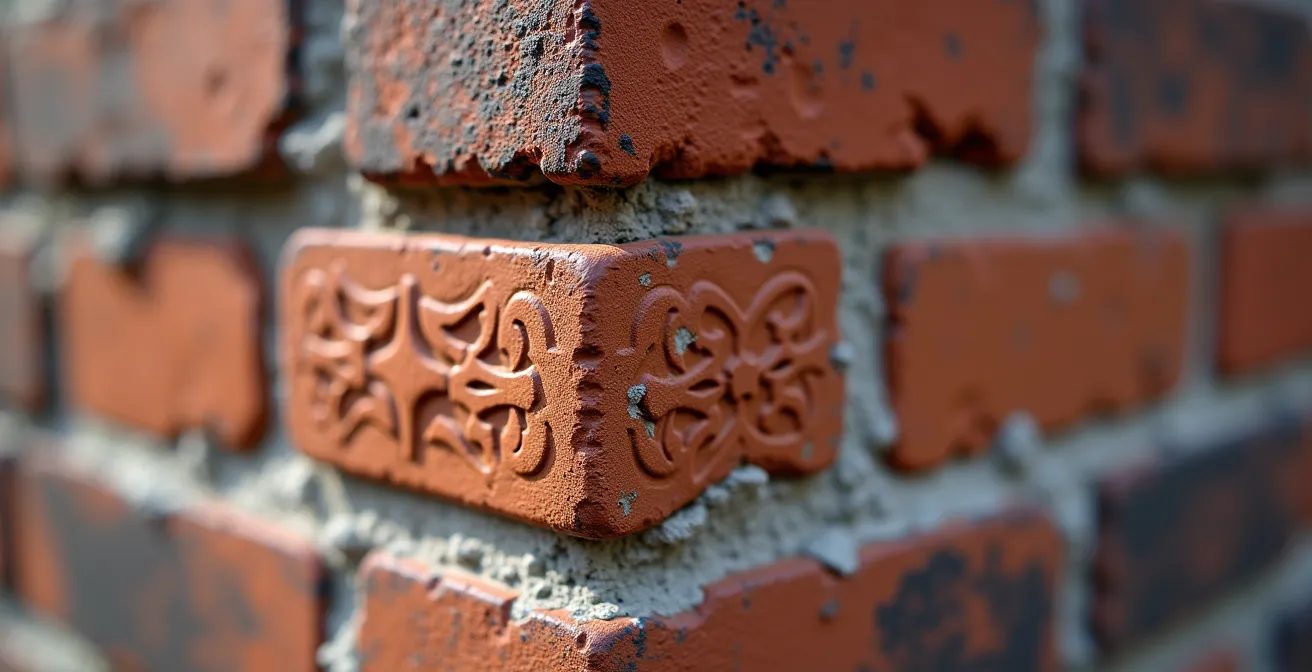
This combination of a massive, defensive basic form and delicate, costly decor is what distinguishes Lübeck’s Brick Gothic from its southern German counterparts. It is architecture that says: “We can defend ourselves, but we do it with style and wealth.” The Holstentor is not a purely functional building, but a representative work of art that cemented Lübeck’s status as the “Queen of the Hanse.”
The mistake in choosing the location for the photo that makes the gate look smaller than it is
Almost every visitor pulls out their smartphone in front of the Holstentor, but many of the resulting photos do not do justice to the monumentality of the building. The most common mistake is intuitively understandable: people get close to capture the gate full-frame and photograph it from eye level. The result is a flat, compressed perspective where the mighty towers lose their sublime effect. The slanted lines are overemphasized, and the scale is lost.
As someone who has viewed this building countless times from all angles, I can assure you: the choice of perspective is crucial. A good photo of the Holstentor captures not just the building, but its dominant presence. Professionals use specific techniques to convey the true dimension and drama of the gate. Instead of standing frontally in front of it, it is worth taking a deliberate position and playing with the perspective.
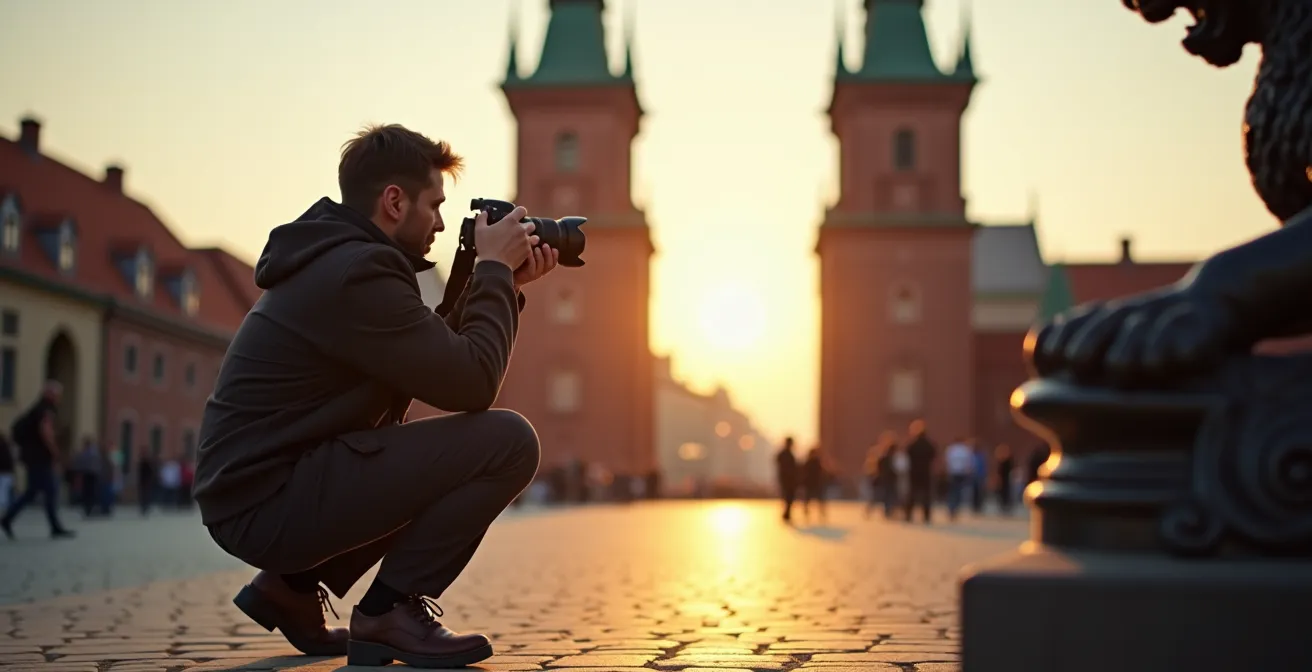
Capturing an impressive image is not a coincidence but the result of targeted decisions. The following checklist summarizes the most important points to avoid the typical photo mistake and instead create an image that captures the majesty of the Holstentor.
Your Plan for the Perfect Holstentor Photo
- Choose your standpoint: Go onto the green area and find a low standpoint. A frog’s-eye perspective makes the towers soar dramatically into the sky.
- Use the foreground: Position the iron lion statues or the edge of the lawn as a compositional element in the foreground. This creates depth and a sense of scale.
- Wait for the light: Photograph during the Golden Hour (early morning or late afternoon). The soft, lateral light models the brick structure and creates sculptural shadows.
- Adjust focal length: Use a slight wide-angle lens (approx. 24-35mm) to capture the entire structure without heavy distortion. Position the gate slightly to the side in the image (rule of thirds).
- Control the lines: Make sure that the converging lines of the towers are either used deliberately as a stylistic device or corrected in post-processing to achieve a majestic effect.
How to connect the Holstentor and Niederegger Café without unnecessary detours?
After the impressive confrontation with the stone power of the Hanseatic League at the Holstentor, the desire for a sweet reward often arises. The world-famous Niederegger Café, home of Lübeck marzipan, is the logical next destination. But how do you best get from the symbol of the salt trade to the symbol of the sweet almond art? There are basically two possibilities: the fast, direct path and the atmospheric experience route.
The direct path is simple: you cross the Puppenbrücke, walk straight up Holstenstrasse, and after a few minutes, you are in front of the town hall and the Niederegger building. This path is practical but leaves out some of Lübeck’s most beautiful impressions. For the visitor who really wants to feel the city, I therefore warmly recommend the experience route, a kind of “Salt and Marzipan Path.” It is a walk through the economic history of Lübeck. This path first leads you left along the banks of the Trave to the historical salt warehouses (Salzspeicher). These crooked brick giants were the foundation of Lübeck’s wealth before marzipan became the sweet icon.
The following table compares both options to help you decide. The data is based on the official recommendations of the City of Lübeck.
| Route Type | Duration | Distance | Highlights along the way | Accessibility |
|---|---|---|---|---|
| Direct Way | 5 minutes | 400m | Holstenstrasse, Market Square | Good (paved) |
| Experience Route | 25-30 minutes | 1.2km | Salt Warehouses, Trave banks, St. Mary’s Church, small alleys | Limited (cobblestones) |
The experience route is more than just a path from A to B. It is a small journey through time that bridges the gap from the medieval salt trade to modern-day indulgence. It leads past St. Peter’s Church, through small alleys and courtyards, and lets you experience the unique atmosphere of the Old Town island first-hand. It is the path a local would choose to show a guest the heart of their city.
Why is the Cathedral almost always covered in scaffolding and what does its preservation cost?
The sight of scaffolding on the Lübeck Cathedral is a familiar image for many visitors and also for us locals. It symbolizes an uncomfortable truth: the preservation of our monumental brick buildings is a Sisyphus task – an endless struggle against time, weather, and the pitfalls of the building ground. The question of costs is as justified as it is difficult to answer globally. Each scaffold represents a specific renovation measure, the scope and cost of which can vary immensely.
To understand the dimensions, it helps to take a comparative look at another jewel of our city, whose renovation costs are well documented: the Holstentor. Although it is smaller than the Cathedral, the figures give an impression of the financial challenge. Monuments like these are insatiable in their maintenance. As the official city website reports, a massive amount of material was needed just for the re-roofing of the Holstentor: between 2004 and 2006, the 1,000-square-meter roof of Lübeck’s landmark was completely re-covered with 30 tons of Mosel slate.
Such measures are extremely expensive. A single restoration can quickly reach six- to seven-figure sums. An example illustrates this: The enormous preservation costs are shown in the figures for the restoration of the Holstentor in 2002. Of the 500,000 euros total cost, the German Foundation for Monument Protection alone contributed 150,000 euros. If you apply these proportions to a building of the size and complexity of the Cathedral, it becomes clear that it involves millions of euros that must be raised over decades.
The reasons for the constant need are manifold: acid rain that decomposes the mortar, frost damage to the brick, and not least the continuous settlements in the unstable subsoil, which repeatedly lead to new cracks in the masonry. Scaffolding on the Cathedral is therefore not a sign of decay, but on the contrary: it is the visible symbol of the tireless effort to preserve our invaluable heritage for future generations.
Why Munich in winter and Hamburg in summer offer two completely different experiences
City trips are often dictated by the seasons. Munich unfolds its charm in winter with snow-covered beer gardens and Christmas markets, while Hamburg attracts visitors in summer with maritime joie de vivre at the port and on the Alster. These cities live on seasonal atmospheres. Their character changes significantly with the weather. As a convinced citizen of Lübeck, I see in this the fundamental difference to our city. Lübeck’s appeal is not bound to a season – it is carved in stone and defies the calendar.
The charm of our Hanseatic city lies in its timeless substance. While elsewhere life flees indoors in winter, it continues to pulse in the historical alleys and courtyards of Lübeck. The smell of marzipan from the cafes mixes with the cold, clear Baltic air. The red Brick Gothic of the churches and gates develops an almost mystical, melancholic beauty under a gray winter sky. The seven towers watch over the city, whether in sunshine or snow flurry. That is the core of Lübeck: a weatherproof beauty.
Of course, Lübeck also has its summer magic. The described atmosphere of a North German Hanseatic city in summer, where people picnic on the banks and enjoy the long evenings, can be found here in its purest form. On the banks of the Trave, with a direct view of the historical salt warehouses or the backdrop of the Old Town island, a picture unfolds that is at least as idyllic as on the Elbe or Isar. But this magic is a bonus, not the foundation of the experience.
The true value of Lübeck lies in the fact that a walk through Königstrasse, a visit to the Buddenbrook House, or the view from the tower of St. Peter’s Church in February is just as intense, if different, an experience as in July. The city does not rely on the weather, but on the unchanging power of its thousand-year history, which is in every brick. Munich and Hamburg offer wonderful seasonal moments. Lübeck offers a year-round constant: the feeling of traveling through time.
Summary in Brief
- The tilt of the Holstentor is not a construction defect, but the result of the struggle between Hanseatic ambition and Lübeck’s unstable subsoil.
- Lübeck’s Brick Gothic is unique through the combination of massive defensiveness and costly, delicate decor such as glazed bricks and terracotta friezes.
- The preservation of Lübeck’s monuments is a permanent financial and technical task that requires the constant use of resources.
How to experience the best of Cologne or Hamburg in just 48 hours without burnout?
The question of how to capture a metropolis like Cologne or Hamburg in just 48 hours is symptomatic of modern travel: a race against time that often ends in exhaustion. You rush from sight to sight, spend time in crowded public transport, and in the end, you feel like you’ve seen everything but experienced nothing. As an advocate of decelerated enjoyment and as a Lübeck local patriot, I would like to suggest a provocative alternative: forget the urban marathon. Experience the true essence of the Hanseatic League – concentrated, profound, and without burnout – in 48 hours in Lübeck.
Lübeck’s Old Town island is a compact masterpiece, an open-air museum where the highlights are reachable on foot. Here you don’t have to commute between districts; you can simply let yourself drift. The change from monumental churches to hidden alleys and from busy squares to quiet riverbank promenades happens organically and without stress. Instead of a checklist of attractions, you experience a coherent historical atmosphere. The following plan is not a must, but an inspiration of how two days in Lübeck can become a deep and relaxed experience:
- Day 1 Morning: Start at the Holstentor to feel the power of the Hanseatic League. Then a walk across the Trave into the historical core of the Hanseatic city.
- Day 1 Afternoon: Visit St. Mary’s Church, the mother church of Brick Gothic, and climb one of the seven towers for an overview.
- Day 1 Evening: Relaxation on the banks of the Wakenitz, often called the “Amazon of the North,” for example in the historical natural pool Falkenwiese.
- Day 2 Morning: Lose yourself deliberately in the famous Lübeck “Gänge und Höfe” (alleys and courtyards), the hidden residential quarters behind the magnificent facades.
- Day 2 Afternoon: A visit to the European Hansemuseum for more depth, and as a grand finale, a marzipan cake in the famous Café Niederegger.
This rhythm allows you to absorb the soul of the city instead of just photographing its surface. It is the smart alternative to big-city stress: maximum historical density with minimal logistical effort.
Start planning your visit today and discover why Lübeck is the perfect answer to the hustle and bustle of modern metropolises. Experience history that you can conquer on foot.
Frequently Asked Questions about the Holstentor
Can I visit the Holstentor without paying museum admission?
Yes, the Holstentor can be visited and photographed from the outside at any time free of charge. You need a valid museum ticket to access the exhibition “The Power of Trade” inside the towers.
Is the Holstentor accessible for people with disabilities?
Unfortunately, the exhibition inside the Holstentor is not accessible for wheelchair users due to the historical building substance with its narrow stairs. However, the outdoor facilities, the ramparts, and the green areas around the gate are accessible and offer excellent photo opportunities.
When is the best time for a visit without the tourist crowds?
To avoid the largest crowds, a visit early in the morning before 10:00 AM or in the late afternoon from 4:00 PM is recommended. Generally, the months of January to March are the least crowded and offer the opportunity to enjoy the landmark in peace.