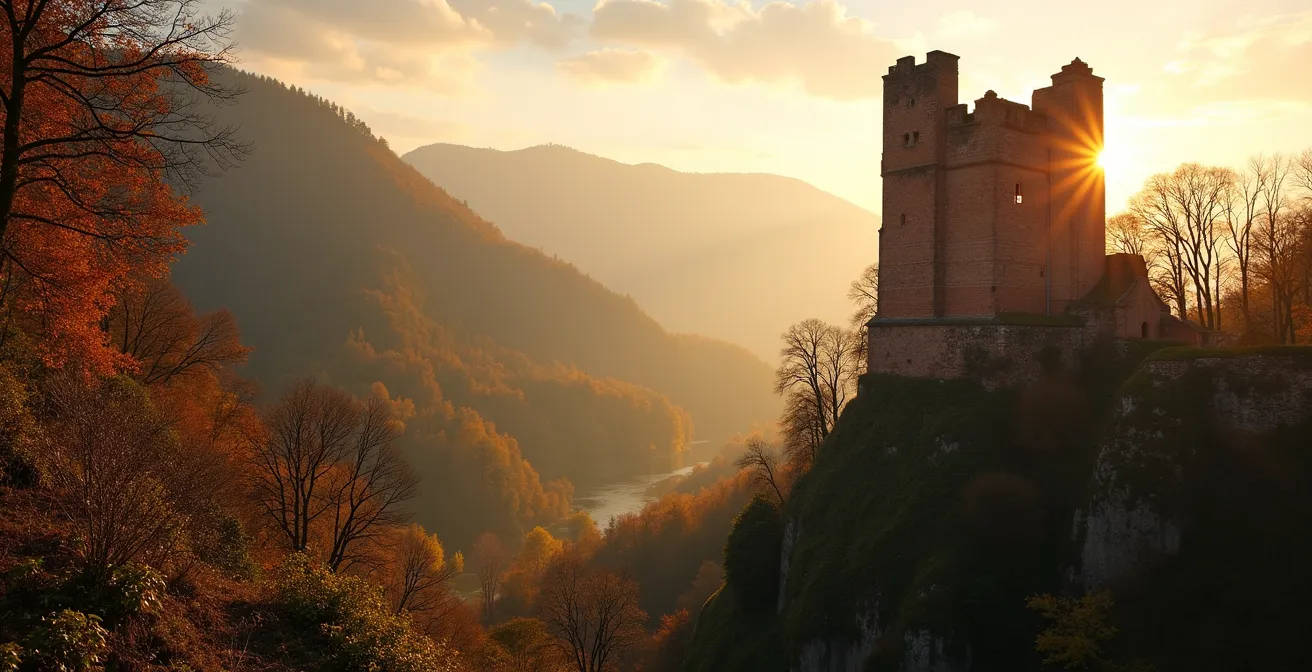
Contrary to the assumption that Heidelberg Castle became famous *despite* its destruction, this article reveals the paradoxical truth: it was only through the decay caused by lightning and war that it became an immortal icon of Romanticism. Its incompleteness became the perfect projection screen for the longing of an entire era and established an aesthetic that continues to fascinate to this day.
When the first morning mist rises from the Neckar Valley and bathes the rusty-red sandstone walls of Heidelberg Castle in a soft, almost ethereal light, an inevitable question arises. It is not a question about the former inhabitants or the magnificent feasts. It is the question of why this majestic wound, this stone scar above the city, possesses such a magnetic pull—a power that the intact castle in its completed splendor probably could never have unfolded.
The common narrative is simple: a magnificent Renaissance castle, destroyed during the War of the Palatine Succession by the troops of Louis XIV. But this explanation falls short. It overlooks the subtler forces at work and the deeper truth slumbering within the broken walls. What if the destruction was not an end, but a beginning? What if the decay was not a loss, but a metamorphosis? This article presents the thesis of productive destruction: Heidelberg Castle had to become a ruin to mature into an immortal legend. It became a projection surface, a perfect soulscape for the burgeoning era of Romanticism.
We will explore how an act of nature sealed the castle’s fate and why even poets like Victor Hugo celebrated this state. We dive into the practical and philosophical decisions that cemented its preservation as a ruin and draw comparisons to other mythical places in Germany to understand the unique phenomenon of Heidelberg. This is the story of how imperfection became the highest form of beauty.
For those who prefer a visual journey through the architectural phases of the castle, the following video offers an excellent overview of its building history. It serves as a fact-filled foundation for our poetic exploration of its decay and its rebirth as a myth.
To illuminate the multifaceted aspects that contributed to the immortality of the ruin, this article follows a clear structure. Each section is dedicated to a piece of the puzzle of the great myth, from its dramatic destruction to its role in modern cultural heritage.
Table of Contents: The Immortal Soul of Germany’s Most Famous Ruin
- Who really destroyed the castle: The French or the lightning strike?
- Is the funicular & castle combo ticket worth it, or is the walk more beautiful?
- Why is the world’s largest wine barrel in the castle cellar, and was it ever filled?
- When is the best time to enjoy the famous view of the Old Bridge without the crowds?
- Where do you get the best view of the fireworks during the Heidelberg Castle Illumination?
- Why Ludwig II never finished Herrenchiemsee Palace and what that reveals about his psyche
- Why is the Cathedral almost always covered in scaffolding and how much does its preservation cost?
- How to secure tickets for Neuschwanstein Castle when everything seems booked out online?
Who really destroyed the castle: The French or the lightning strike?
The destruction of Heidelberg Castle is often broadly attributed to French troops in the 17th century. However, this narrative, dramatic as it is, overlooks the actual, more poetic final act. The French left behind a damaged but still habitable residence. The true death blow, which transformed the castle from a mere fortress into a symbol, came from a higher power: nature itself. It was a frozen moment of elemental force that changed its destiny forever.
On June 24, 1764, while Elector Karl Theodor was already making plans for reconstruction, the unthinkable happened. As a study of the castle’s history details, two lightning bolts struck in quick succession on that day. The fire that subsequently broke out raged mercilessly and finally rendered the already damaged buildings uninhabitable. This act was more than just destruction; it was a dramatic intervention that snatched the castle away from the human will to restore it and handed it over to the realm of myths. It was the birth of the Romantic ruin.
This fateful turn was not felt as a tragedy by later Romantics, but as a kind of aesthetic salvation. The great French poet Victor Hugo captured this feeling in a letter from Heidelberg in 1840 in inimitable words while musing on the lightning strike:
One could say that heaven intervened. For if Karl Theodor had spent his thirty years there, the austere ruin we admire today would surely have been adorned with a terrible Pompadour decoration.
– Victor Hugo, Letter from Heidelberg, October 1840
The lightning strike was thus not a pure act of destruction, but an act of conservation. It saved the castle from a banal restoration and instead gave it an aura of melancholic sublimity that continues to captivate poets, thinkers, and dreamers today. The French had wounded it, but heaven gave it its immortal soul.
In this way, the destruction itself became the founding myth of a new aesthetic.
Is the funicular & castle combo ticket worth it, or is the walk more beautiful?
The question of how to get to Heidelberg Castle is much more than a logistical decision. It is a choice between two fundamentally different ways of approaching this place: the quick, panoramic revelation and the slow, contemplative conquest. The funicular offers comfort and an immediate, breathtaking view. The walk, on the other hand, is a dialogue with history and the landscape, a gradual immersion into the atmosphere that surrounds the castle.
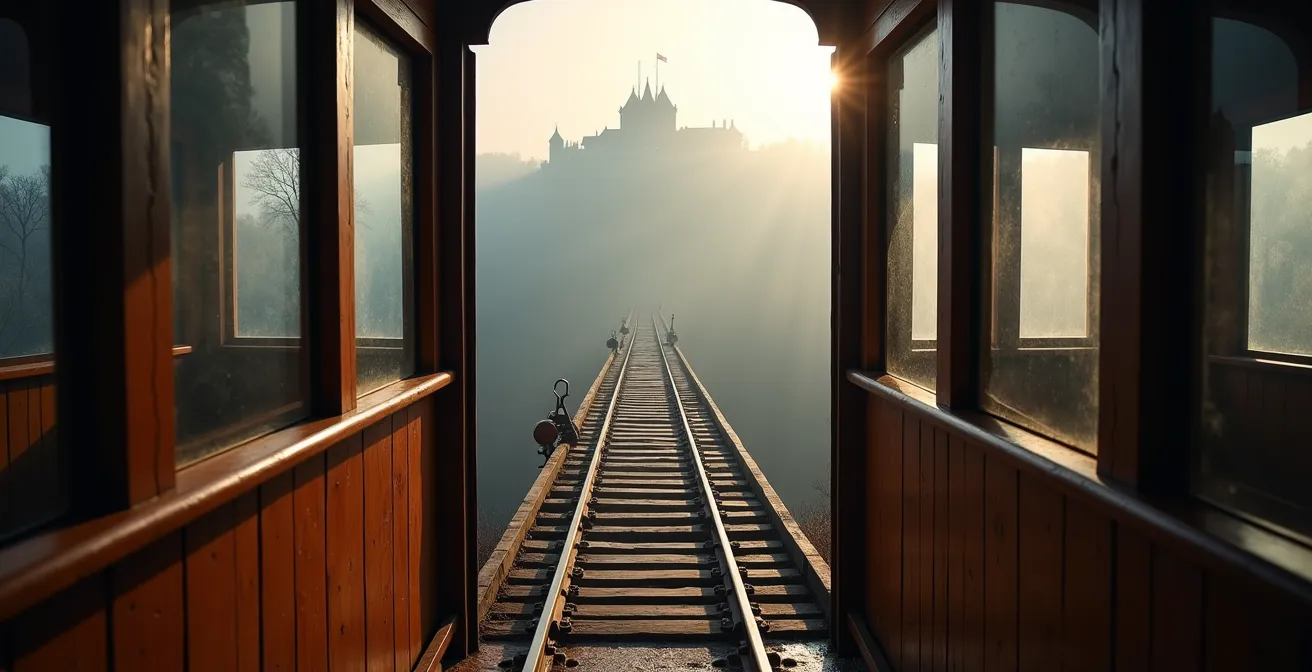
As the ride on the historic funicular impressively shows, you quickly gain altitude and the castle unfolds like a theatrical backdrop. You experience the building from a bird’s-eye view, as part of a larger urban panorama. This is the view of the pragmatist who wants to grasp the grandeur of the whole quickly. For the Romantic, however, seeking a personal soulscape, the true magic lies in the ascent on foot. On the old paths, such as the Burgweg or the Kurzer Buckel, the castle reveals itself step by step. Every new glimpse through the leaves, every unexpected perspective on a tower or a wall, becomes a personal discovery.
The walk is an exercise in the aesthetic of the unfinished. You do not approach a finished image, but collect fragments that only come together in your mind. It is the experience of the wanderer who does not just look at the landscape but moves through it, making it their own. The effort of the climb is rewarded by the silence, the rustling of the leaves, and the feeling of having approached the myth through one’s own power. The funicular takes you to the castle; the walk lets you arrive at the castle.
Ultimately, there is no right or wrong choice, only different scripts for the personal encounter with the ruin.
Why is the world’s largest wine barrel in the castle cellar, and was it ever filled?
Deep in the cool, damp cellars of the castle, where light only sparsely penetrates the thick walls, rests a monument of superlatives: the Great Tun. It is so massive that it seems less like a container and more like an architectural element, a wooden heart in the stone breast of the ruin. Its existence is no coincidence, but an eloquent testimony to electoral power and the joy of living in the Baroque era—an era that paid homage to pathos and grandeur before the melancholy of Romanticism took over.
Today’s barrel, built in 1751 under Elector Karl Theodor, is already the fourth of its kind and holds an incredible 221,726 liters of wine. But was it ever truly filled to the brim? Yes, but its primary function was less about storage and more about the demonstration of wealth and the collection of taxes. The winegrowers of the Electoral Palatinate had to deliver a portion of their harvest, the so-called “tithe,” to the Elector in the form of wine. The barrel served as a gigantic collection vessel for these tributes, a symbol of the ruler’s liquid power over his land.
Inseparably linked to the barrel is the legend of its guardian, the court dwarf Perkeo. As castle lore tells it, Clemens Perkeo, originally from South Tyrol, was famous for his capacity for drink. When asked if he could empty the entire barrel alone, he reportedly replied in Italian: “Perché no?” – “Why not?”. This saying became his name and his legend. Perkeo embodies the playful, almost grotesque side of Baroque court life, a human counterpoint to the monumental size of the barrel. His statue, which still watches over the barrel today, reminds us of a time when intoxication and representation went hand in hand.
Today, mostly empty and still, it acts in its monumental uselessness as another symbol of the transience of power and pomp—and thus fits perfectly into the melancholic overall composition of the ruin.
When is the best time to enjoy the famous view of the Old Bridge without the crowds?
From the castle’s large terrace, the Altan, a world-famous view opens up that has inspired countless paintings, poems, and photographs: the harmonious composition of the Old Bridge, the gently flowing Neckar, and the densely built alleys of the Old Town. It is a sight of such perfection that it almost looks like a staged landscape. Johann Wolfgang von Goethe was deeply moved by this panorama and noted in his diary in 1797:
I saw Heidelberg on a completely clear morning, which was at once cool and refreshing thanks to a pleasant air. The city in its position and with its entire surroundings has, one might say, something ideal about it.
– Johann Wolfgang von Goethe, Diary entry from 1797
Experiencing this “ideal” today requires a strategy. The magic of the place can easily be broken by the sheer volume of visitors who also want to capture this iconic moment. Finding the perfect moment, that moment of silent contemplation that Goethe experienced, is an art in itself. It is about understanding the rhythms of tourism and finding the niches where the true soul of the place reveals itself. It is the search for a personal moment with a view shared millions of times.
Your plan for an undisturbed moment: The best time windows
- The Early Window: Be there right when the castle courtyard opens to enjoy 15 minutes of silence before the first funicular load arrives.
- The Lunch Gap: Use the time between 12:30 PM and 2:00 PM, when most tour groups are in the restaurants of the Old Town.
- The Post-Rain Glow: Venture out onto the terrace after a brief summer rain. The wet sandstone glows in the returning sun, and most visitors avoid the uncertain weather.
- The Blue Hour: Stay after sunset when the day visitors leave. The deep blue of the sky and the first lights of the city create an incomparably magical atmosphere.
- The Quiet Season: Plan your visit on a weekday between November and February. In the off-season with few tourists, you often share the view with only a few others.
In these quiet moments, the view from the terrace becomes more than just a photo—it becomes a deep, personal encounter with Romanticism.
Where do you get the best view of the fireworks during the Heidelberg Castle Illumination?
Three times a year, on summer evenings in June, July, and September, a spectacle is repeated that celebrates the productive destruction of the castle in a spectacular way: the Heidelberg Castle Illumination. This event is far more than an ordinary firework display. It is a historical drama in two acts that reenacts the destruction of 1689 and 1693. First, Bengal fires bathe the castle in a deep red glow, symbolizing the devastating fire. This is followed by a brilliant firework display over the Neckar, representing the cannonade and demolition by French troops.
This ritual turns destruction into an aesthetic experience and reinforces the myth of the ruin. However, to optimally experience this total work of art made of light, smoke, and history, the choice of location is crucial. Each spot offers its own unique dramaturgy of the event, as an analysis of the historical symbolism suggests. The perspective changes the experience from an immersive confrontation to a sublime panorama.
The following table compares the most common vantage points and helps you find the perfect place for your personal experience.
| Location | Experience Type | Pros | Cons |
|---|---|---|---|
| Neckar Bank/Old Bridge | The immersive view | In the middle of the action, perfect acoustics | Very crowded, early arrival necessary |
| Philosopher’s Walk | The panoramic view | Entire city backdrop, fewer crowds | Long climb, limited space |
| Königstuhl/Vineyards | The insider-tip view | Hardly any tourists, unique perspective | Difficult to reach, local knowledge needed |
The view from the Philosopher’s Walk opposite offers perhaps the most classic, postcard-perfect perspective. From here, the burning castle, the fireworks, and the lights of the city blend into a harmonious overall picture. You are an observer of a great theater. On the Neckar bank or the Old Bridge, on the other hand, you are in the middle of the action. You feel the energy of the crowd, hear the echo of the exploding fireworks bouncing off the slopes, and are part of the collective awe. This is the emotional, immediate experience.
Regardless of the chosen location, one becomes witness to a rare moment in which destruction is not mourned, but celebrated as the founding act of an immortal legend.
Why Ludwig II never finished Herrenchiemsee Palace and what that reveals about his psyche
The fascination with the unfinished is a central motif of German Romanticism, but it manifests in different ways. While Heidelberg Castle became an icon of the fragment through external violence, Herrenchiemsee Palace tells a different, more personal story of imperfection. It is the monument to a dream that was so grandiose it had to break under its own ambition. The unfinished copy of Versailles, built by King Ludwig II of Bavaria, reveals much about the psyche of a monarch who lived more in his fantasy worlds than in reality.
Ludwig II did not just want a palace; he wanted to create a private, walkable utopia, a homage to the Sun King Louis XIV, whom he worshipped. But completion was never the actual goal. The process of building, the constant refining and expanding of his vision, was more important to him than the final result. When he ran out of money and died under mysterious circumstances in 1886, 50 of the 70 rooms remained unfinished. These empty shells, frozen in their raw state, are perhaps the most honest rooms of the palace today. They are no longer a copy of Versailles, but an authentic testimony to Ludwig’s inner turmoil between omnipotence fantasies and failing reality.
Herein lies the crucial difference to Heidelberg. Heidelberg is an *accidental* ruin whose myth was shaped from the outside, by poets and nature. Herrenchiemsee is an *intentional* ruin, a direct reflection of its creator’s psyche. Nevertheless, both share a similar pull. Heidelberg Castle, which attracts about 1.1 million visitors annually according to a survey by the Karlsruhe Institute of Technology, fascinates through its dramatic history. Herrenchiemsee fascinates through its psychological drama. Both places are projection surfaces: Heidelberg for the longing for a heroic past, Herrenchiemsee for sympathy with a tragic dreamer.
It teaches us that a ruin does not always have to tell of war and decay, but can also speak of the unfulfillable nature of human dreams.
Why is the Cathedral almost always covered in scaffolding and how much does its preservation cost?
At first glance, Cologne Cathedral, this masterpiece of Gothic architecture, seems to be the exact opposite of Heidelberg Castle: here the celebrated ruin, there the structure tirelessly trimmed for completion and perfection. Yet upon closer inspection, the Cathedral, often hidden behind a veil of scaffolding, reveals a deep connection to Heidelberg’s history. For the decision to preserve Heidelberg as a ruin was the birth of modern monument protection, whose principles still govern the handling of Cologne Cathedral today.
Around 1900, a fierce dispute broke out over the future of Heidelberg Castle. The architect Carl Schäfer had magnificently rebuilt the Friedrichsbau in the style of Historicism, which triggered a fundamental debate. Should the castle be returned to an idealized original state or should the historically grown traces of destruction and decay be accepted as part of its identity? It was the art historian Georg Dehio who coined the decisive principle in this debate:
Conserve, do not restore!
– Georg Dehio, Castle Building Conference around 1900
This principle states that the authentic state of a monument, grown over centuries, is more valuable than a speculative reconstruction. Exactly this principle is applied today at Cologne Cathedral. The constant scaffolding is not a sign of endless new construction, but of permanent conservation. The porous sandstone suffers from environmental influences and must be continuously secured and repaired to preserve the original substance. The Cathedral Workshop (Dombauhütte) does not fight for a final completion, but against decay—an eternal struggle that costs millions annually.
Heidelberg and Cologne are thus two sides of the same coin. In Heidelberg, the Romantic idea won—to leave the ruin as an authentic witness of history. This decision created the paradigm by which Cologne is managed today: the preservation of the existing. Heidelberg Castle is a monument to accepted decay; Cologne Cathedral is a monument to the struggle against it. The scaffolding on the Cathedral is thus a direct consequence of the philosophical battle won in Heidelberg.
The sight of scaffolding on the Cathedral reminds us that the preservation of history is a never-ending task.
The essentials in brief
- The true fame of the castle lies in its destruction, which made it a projection surface for Romanticism (productive destruction).
- A lightning strike in 1764, not just war, sealed its fate as a ruin and was celebrated by Romantics as an aesthetic salvation.
- The principle “Conserve, do not restore,” which arose during the debate over Heidelberg, continues to shape German monument protection today.
How to secure tickets for Neuschwanstein Castle when everything seems booked out online?
The journey to the soulscapes of German Romanticism, from the melancholic sublimity of Heidelberg to the tragic fantasy of Neuschwanstein, often ends before a very modern hurdle: the sold-out ticket counter. The myth we seek—the silence, the personal reflection, the encounter with history—has developed a pull that paradoxically threatens to swallow it. Neuschwanstein Castle, Ludwig II’s ultimate Romantic dream, is the most striking example of this. Online, tickets are often sold out weeks in advance.
The hunt for a ticket thus becomes a kind of modern quest itself. It requires strategy, patience, and sometimes the willingness to change the original plan. The most common tactic is to arrive very early in the morning directly at the Ticket Center in Hohenschwangau to hope for one of the limited remaining contingents for the same day. Another possibility is to ask for single free spots in otherwise fully booked tours that may arise due to last-minute cancellations.
Yet perhaps the most Romantic solution lies in bypassing the system. Instead of joining the queue, one can redefine the experience. A hike to Mary’s Bridge (Marienbrücke) offers the iconic view of the castle without any ticket at all. This perspective, which embeds the castle in the dramatic Alpine landscape, is perhaps even more authentic than the guided tour through the interior. You experience the castle as Ludwig dreamed it: as a distant, almost unreal apparition, a mirage made of stone. Alternatively, bus tours from larger cities like Munich often offer guaranteed entry tickets as part of a package—a pragmatic solution to a Romantic problem.
Armed with this new perspective, your next visit to these places will not just be a journey into the past, but a conversation with the soul of Romanticism itself. Start now to discover the stories behind the stone.