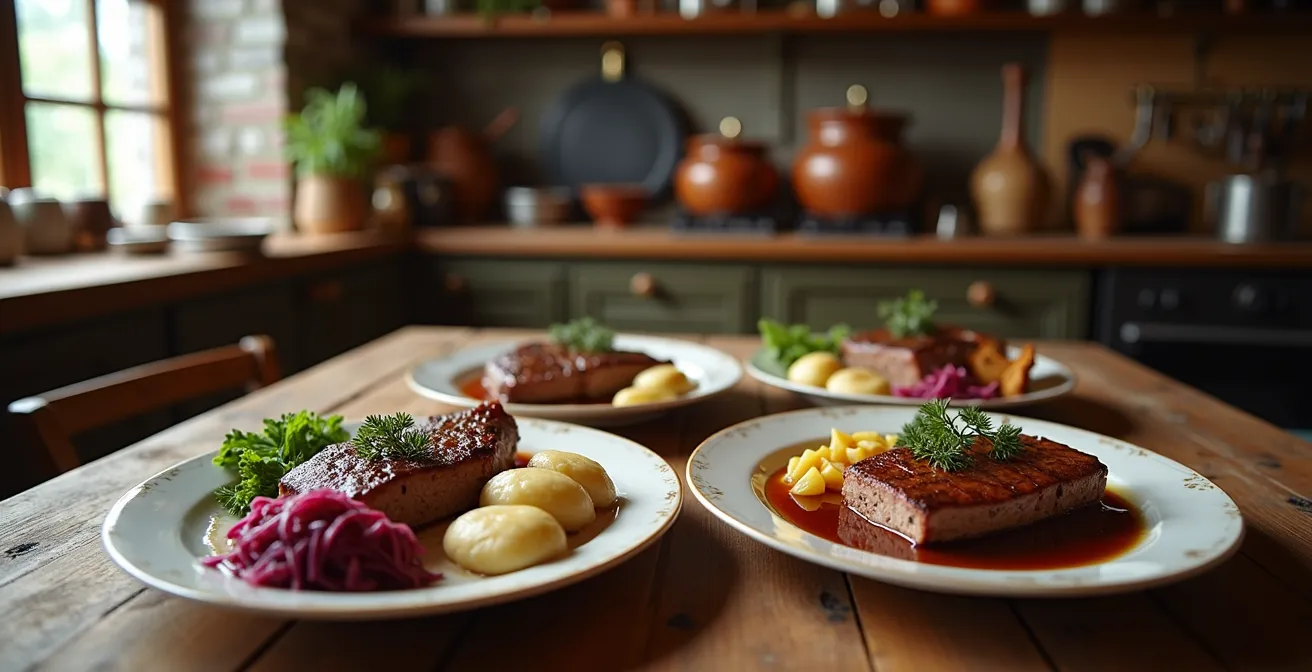
The regional differences of a Sauerbraten are far more than just a list of ingredients; they are an expression of history, chemistry, and culinary terroir.
- The duration and composition of the marinade chemically alter the meat structure and define the base flavor.
- Sweetening elements like raisins or gingerbread are not mere ingredients but a historical “flavor bridge” to balance the acidity.
Recommendation: Pay attention to the specified marinating time on the menu—it is often the first indication of a handcrafted, authentic Sauerbraten instead of a convenience product.
Anyone taking a journey through German cuisine will inevitably encounter it: the Sauerbraten. A national dish, or so it seems. But anyone who thinks they know everything about it just by placing an order is greatly mistaken. A Sauerbraten in the Rhineland is a completely different revelation than its namesake in Franconia or Saxony. Often, the debate is reduced to a simple question: with or without raisins? This is a gross simplification that does not do justice to the soul of this dish.
One might think the secret lies solely in the family recipe. But that is only half the truth. The true magic, the culinary signature of a region, arises from an interplay of local history, available ingredients, and a deep understanding of chemical processes passed down through generations of cooks. It’s about the right meat, the perfect acid balance, and the harmonious accompaniment on the plate. The differences are not a whim, but the result of centuries of culinary evolution.
But what if the true dividing line is not the raisin, but the way the acid breaks down the proteins in the meat? What if the side dishes are not just companions, but an integral part of the regional flavor composition? This article takes you behind the scenes of the Sauerbraten kitchen. We decode the secrets of the marinade, clarify the “raisin dispute” from a historical perspective, and show you how to recognize a real, homemade Sauerbraten. Forget superficial comparisons; we are diving deep into the heart and soul of this German classic.
To fully grasp the fascinating facets of this dish, we have divided this article into clear sections. Each part highlights a specific aspect that accounts for the regional differences and provides you with a deeper understanding of German culinary tradition.
Table of Contents: The Secrets of Regional Sauerbraten
- Why must the meat rest in marinade for at least 3 days to become tender?
- Why do raisins in Rhenish Sauerbraten divide the nation and how do you handle it?
- Which side dish traditionally belongs to which regional Sauerbraten variant?
- The menu feature that reveals whether the Sauerbraten is homemade or convenience
- Where can you find the oldest inns that still prepare Sauerbraten according to original recipes?
- Why can a “Nuremberg Roast Bratwurst” only be called that if it was produced in the city area?
- Helles or Wheat Beer: What harmonizes better with a pretzel and what with Obazda?
- How to succeed with a classic German pot roast without the meat becoming dry as a shoe sole?
Why must the meat rest in marinade for at least 3 days to become tender?
The marinade (the “Beize”) is the heart, the soul of every Sauerbraten. It is far more than just a marinade; it is an alchemical process that requires patience and understanding. The common opinion is that the meat simply becomes “tender.” In truth, a profound chemical transformation happens here. The acid from vinegar and wine slowly penetrates the muscle tissue and begins to break down the tough collagen—the connective tissue that turns meat into a shoe sole if prepared incorrectly—and convert it into soft gelatin. This process cannot be rushed.
One or two days are simply too short. The acid only acts superficially; the inside of the roast remains untouched and tough. Only after three days does the true magic begin. Traditional recipes know this, and so it is no coincidence that according to traditional recipes, the meat should rest in the marinade for at least 4-6 days. During this time, the meat not only absorbs the flavors of bay leaf, juniper, and cloves, but its entire structure changes.
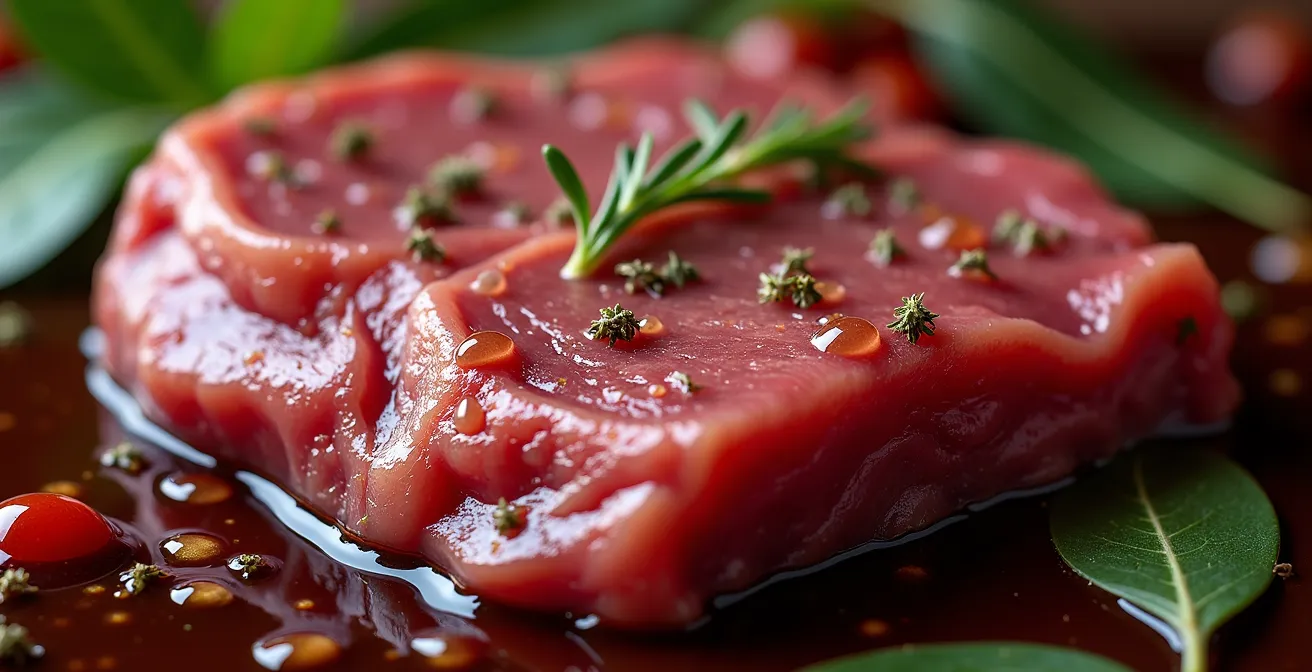
As you can see in this shot, the change is almost visible to the naked eye. The meat takes on a darker color and a more tender texture long before it even sees the roasting pan. This acid alchemy is the foundation for the subsequent melt-on-the-tongue experience. A cook who cuts corners on time here cuts corners on taste and quality. It is the ultimate test of patience and respect for the product.
Why do raisins in Rhenish Sauerbraten divide the nation and how do you handle it?
Hardly any ingredient polarizes German cuisine as much as the raisin in Sauerbraten. For some, it is a culinary sacrilege; for others, it is the epitome of Rhenish enjoyment. But this debate is not a pure dispute of taste; it is a deeply rooted piece of culinary terroir and cultural history. The sweet-and-sour flavor profile typical of Rhenish Sauerbraten was a sign of wealth and cosmopolitanism in the Middle Ages and early modern period. Raisins, almonds, and other exotic spices came into the country via the trade routes of the Rhine and were expensive. Those who could afford it showed it in their kitchen.
In the Rhineland, a wealthy trading region, raisins and often sugar beet syrup became a kind of “flavor bridge” to elegantly balance the intense acidity of the marinade. In other regions, more rural or differently influenced like Baden or Franconia, different methods were used, and the sweet addition was felt to be inappropriate. There, gingerbread or “Printen” (spiced cookies) provide the binding and a spicy, but not primarily sweet, note. These regional preferences are thus a mirror of history and local identity.
The following table illustrates how differently the regions handle the balance of sweet and sour, as a comparative analysis of recipes shows.
| Region | With Raisins | Sweet Component | Characteristics |
|---|---|---|---|
| Rhineland | Yes | Raisins, sugar beet syrup | Sweet-sour balance |
| Franconia | No | Gingerbread/Printen | Spicy-savory |
| Baden | No | Only sauce gingerbread | Traditionally hearty |
| Saxony | Optional | Plum jam possible | Regionally variable |
As a cook, my advice is: approach the matter with an open mind. A Rhenish Sauerbraten without raisins is like a Bavarian Leberkäse without marjoram—it lacks something characteristic. If you don’t like raisins, try a Franconian or Baden variant. But do not judge the tradition, for it tells a story.
Which side dish traditionally belongs to which regional Sauerbraten variant?
A perfect Sauerbraten can be ruined by the wrong side dish. Side dish harmony is no coincidence, but a composition perfected over generations, tailored to the specific consistency and taste of the regional sauce. The sauce is the star, and the side dish is its most important supporting actor, making it shine. It is primarily about how well the side dish can absorb the delicious, complex sauce.
In the Rhineland, with its often slightly velvety, sweet-and-sour sauce, large potato dumplings (Kartoffelklösse) are the classic choice. Their soft, slightly mealy consistency soaks up the sauce like a sponge. Apple compote is often served alongside, its fruity acidity providing a wonderful counterpoint to the sweetness of the raisins. In Franconia, where the sauce is often darker and spicier, you will frequently find bread dumplings (Semmelknödel). Their airier structure fits the savourier sauce excellently. In Swabia, Spätzle are naturally the first choice, their shape being ideal for holding plenty of sauce. And in Saxony? There, they often swear by Bohemian dumplings, which are sliced and offer a huge surface area for the sauce.
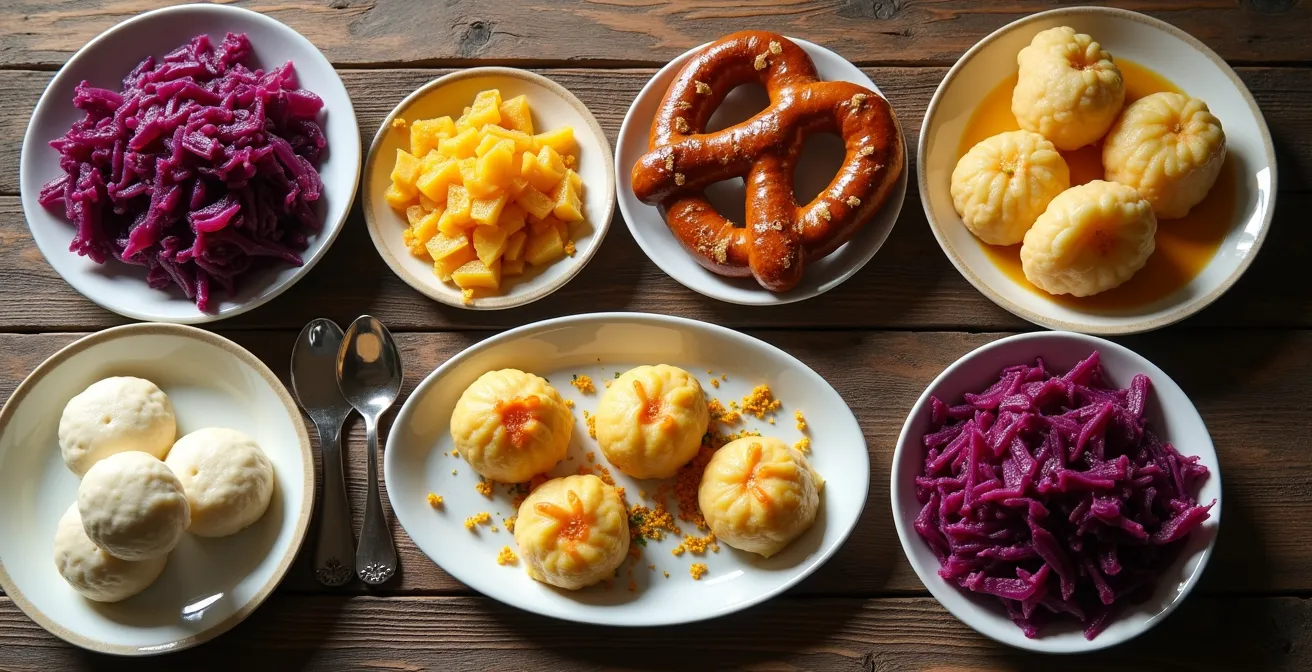
This visual arrangement shows how deeply side dish culture is rooted in the regions. Every type of dumpling has its own raison d’être. Red cabbage (Rotkohl or Blaukraut) is a nearly universal companion, but even here there are subtle differences: sometimes it is prepared with apple, sometimes with vinegar, sometimes with a touch of clove, to perfectly complement the respective sauce.
Here is an overview of the classic pairings:
- Rhineland: Potato dumplings and apple compote.
- Franconia: Bread dumplings or potato dumplings with red cabbage.
- Swabia: Hand-scraped Spätzle and red cabbage.
- Saxony: Bohemian dumplings to optimally absorb the sauce.
- Bavaria: Pretzel dumplings or bread dumplings with red cabbage.
The menu feature that reveals whether the Sauerbraten is homemade or convenience
For a gourmet, there is hardly a greater disappointment than a Sauerbraten that comes out of a bucket. Handcrafted authenticity is everything with this dish. But how do you recognize it before the plate is on the table? There are telltale signs that we professionals look for. The most obvious is time. As we already know, a real Sauerbraten requires at least 3-7 days of preparation. A restaurant that takes pride in its craft will often subtly note this on the menu, e.g., with phrases like “After 5 days of marinating, grandmother’s style.”
Be suspicious of vague descriptions like “Sauerbraten house style.” This can mean anything and nothing. Another warning sign is a constantly low price. Traditional production is time- and labor-intensive, which must be reflected in the price. If a Sauerbraten is available at a bargain price as a daily special, there is a high probability that it is convenience goods.
Also, pay attention to the sauce once it is served. A real, homemade sauce has a natural, deep gloss that comes from the reduced collagen of the meat and the binding from sauce gingerbread. It is never dull. Convenience sauces, on the other hand, often have an almost pudding-like, unnaturally homogeneous consistency and a less complex taste, as they lack the depth of the long marinating time. Another indicator is the meat fiber: in a real Sauerbraten, the meat can be easily pulled apart with a fork but still has bite and a recognizable fiber structure. With inferior goods, it is often mushy or rubbery.
Where can you find the oldest inns that still prepare Sauerbraten according to original recipes?
The search for the “original recipe” is a journey into the past, as what we perceive as classic today has changed significantly over time. Many inns that are proud of their family recipes passed down through generations consider their variant to be the “original.” This diversity is the actual cultural heritage of Sauerbraten. Every family has perfected the spice blend, acid balance, or sauce binding over decades. These inns, often family-run and slightly off the beaten tourist path, are the true guardians of tradition.
To find these gems, you should look for guesthouses that value regional products and whose menu tells a story. Often there is a small reference to a long family tradition. Especially in the Rhineland, but also in rural areas of Franconia and Saxony, there are still establishments where the recipe comes from the great-grandmother and is held sacred. Ask the host or hostess about the history of their Sauerbraten—the answer will tell you a lot about the authenticity.
Interestingly, the “original recipe” was historically often not made with beef. As culinary historians point out, the original Sauerbraten was frequently prepared with horse meat, as it was tougher and benefited particularly from the long marinating time. This tradition has almost disappeared today, but a few, very tradition-conscious inns still dare to offer this historical variant. As a publication on domestic tourism states:
The true original recipe was often prepared with horse meat. A few tradition-conscious inns, especially in the Rhineland, still offer this historical variant.
– Culinary Historians, Traditional German Cuisine – Inlandstourismus
The search for the oldest recipe is thus also a search for culinary archaeology. An inn that has horse Sauerbraten on the menu is almost certainly a place where tradition is taken very seriously.
Why can a “Nuremberg Roast Bratwurst” only be called that if it was produced in the city area?
This principle of regional identity, which we see on a cultural level with Sauerbraten, is even legally anchored for other specialties. The Nuremberg Roast Bratwurst (Nürnberger Rostbratwurst) is the perfect example of this. It’s not just about a recipe, but about a protected cultural heritage. Since 2003, it has carried the EU “Protected Geographical Indication” (PGI) seal. This seal is a promise of quality and origin and protects traditional products from imitation.
The rules are strict and precise, as the Protection Association for Nuremberg Bratwurst e.V. explains:
The Nuremberg Roast Bratwurst has been a protected geographical indication (PGI) since 2003. It must be 7-9 cm long, weigh a maximum of 25g, and have a dominant marjoram note. The grinding of the meat, the mixing with spices, and the filling of the sausages must take place in Nuremberg.
– Schutzverband Nürnberger Bratwürste e.V., EU Regulation for the Protection of Geographical Indications
This regulation ensures that every “Original Nuremberg” meets high quality standards and has its unique flavor characterized by marjoram. It is protection for the consumer against inferior copies and simultaneously an important urban marketing tool for Nuremberg. The Nuremberg Bratwurst is just one of over 50 Bavarian specialties protected by the EU from imitation. This protection ranges from Allgäu Bergkäse to Bavarian beer.
The importance of this protection was recently made clear in a 2024 court ruling, when the Munich District Court decided that the name “Mini Roast Bratwürstchen” does not violate trademark protection as long as the geographical reference “Nuremberg” is missing. This underlines: the name is not just a designation, but a seal for authenticity and origin that preserves the culinary identity of an entire city.
Helles or Wheat Beer: What harmonizes better with a pretzel and what with Obazda?
The art of food pairing, which we saw with the Sauerbraten side dishes, continues in Bavarian beer garden culture. Choosing the right beer for a hearty snack (Brotzeit) is not a minor matter, but crucial for the taste experience. Helles and Wheat Beer (Weissbier) are the two most common companions, but they play very different roles. The question is not which beer is “better,” but what harmony or contrast one wants to create.
A Helles fits a dry, salty pretzel perfectly. It is a complementary pairing: the mild, malty notes of the Helles complement the taste of the lye pastry without overpowering it. The gentle bitterness cleanses the palate, and the moderate carbonation refreshes. A Wheat Beer would often be too dominant here with its fruity and spicy aromas.
With Obazda, a creamy, spicy, and very high-fat cheese preparation, the world looks quite different. Here, the Wheat Beer shines in a contrast pairing. Its high carbonation and slight acidity literally cut through the fat of the cheese and lighten the palate. The yeasty, often banana-like notes of the Wheat Beer provide an exciting counterpoint to the piquant spice of the Obazda. A Helles would rather get lost here.

The following table summarizes the most important harmonies that play a role in Bavarian beer culture:
| Beer Style | Dish | Pairing Type | Flavor Harmony |
|---|---|---|---|
| Helles | Pretzel | Complementary | Mild malt complements lye pastry |
| Wheat Beer | Obazda | Contrast | Carbonation cuts through fat |
| Märzen | Obazda | Supplementary | Smoky note creates depth |
| Zwickelbier | Pretzel | Complex | Unfiltered for more flavor |
Key Takeaways at a Glance
- The quality of a roast depends crucially on patience: low temperature and long resting phases are more important than searing.
- Choosing the right cut of meat with sufficient connective tissue (collagen) is the foundation for a juicy roast.
- Precise temperature control with a meat thermometer prevents drying out and ensures a perfect result.
How to succeed with a classic German pot roast without the meat becoming dry as a shoe sole?
The principles that make an excellent Sauerbraten—patience, the right cut of meat, and temperature control—are universal and also apply to classic German pot roast (Rinderbraten). Many home cooks fail because they believe in old kitchen myths. The biggest misconception is that searing at high heat “closes the pores” and keeps the meat juicy. This has been scientifically debunked. Searing serves solely to create delicious roasted aromas through the Maillard reaction. It seals nothing.
The key to juiciness lies in two things: the choice of the right cut of meat and the low-temperature cooking method. Use pieces with sufficient connective tissue and fat marbling, such as “false filet” (falsches Filet), top round (Oberschale), or a piece of chuck/thick rib. Lean tenderloin is not suitable for braising. Then cook the roast slowly at a low temperature (80-90°C in the oven is ideal) over several hours. During this time, the tough collagen transforms into tender gelatin, which keeps the meat juicy from the inside.
Control with a meat thermometer is indispensable. Do not exceed a core temperature of 75-80°C, otherwise the protein becomes firm and squeezes all the juice out of the meat. And perhaps the most important step, which is often forgotten: the resting phase. Let the roast rest for at least 10-15 minutes after cooking before slicing it. During this time, the meat juices that have collected in the center can redistribute throughout the entire roast. Anyone who skips this step will be punished with a dry disappointment.
Your 5-Point Audit for the Perfect Pot Roast
- Meat selection: Are you using a cut suitable for braising? (e.g., top round, false filet) Check the marbling.
- Cooking method: Are you cooking at a low temperature (under 100°C) or frying with too much heat?
- Temperature control: Do you use a meat thermometer to precisely control and not exceed the core temperature?
- Resting phase: Do you plan a resting phase of at least 10 minutes after cooking before slicing the meat?
- Sauce base: Do you use the pan drippings and high-quality stock as a base for a flavor-intensive, natural sauce?
Now that you know the deep secrets of regional German cuisine and the artisanal basics for perfect roasts, it is time to apply this knowledge. Specifically look for authentic inns on your next trip or dare to try one of the traditional Sauerbraten variants yourself—with the respect and patience this dish deserves.