In summary:
- Understand that a beer garden is not a restaurant, but a place of conviviality with historical rules.
- Bringing your own “Brotzeit” (snack) is a historical right, but drinks must always be purchased from the host.
- Always politely ask “Is do no frei?” (Is this seat free?) before sitting at a table, but avoid tables with pennants (Stammtisch).
- Treat the “Masskrüge” (liter mugs) with respect and understand the deposit system as part of the community order.
- Accept regional food cultures: No ketchup with Thuringian bratwurst, and appreciate the diversity of German cuisine.
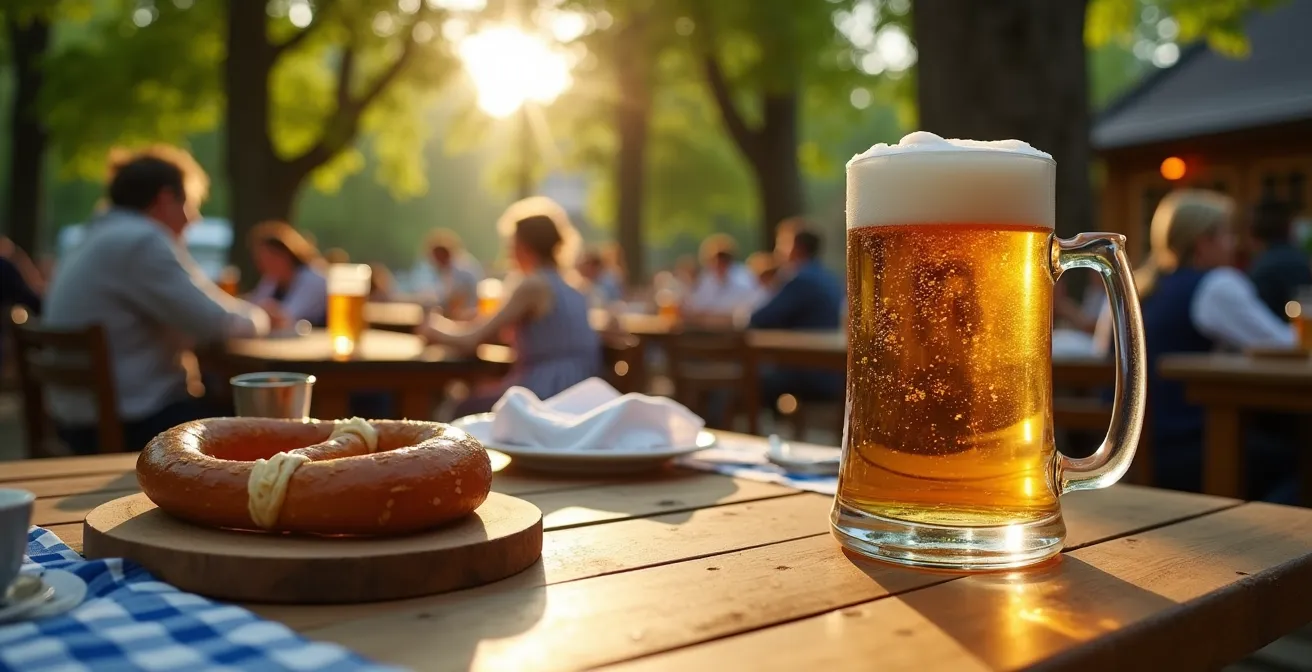
Servus and Griass Gott! Imagine the sun is shining, the chestnut trees provide shade, and a cool liter mug of beer stands before you. Wonderful, isn’t it? But then you notice the locals’ eyes resting on you. Without knowing it, you have broken an unwritten law. Many guidebooks tell you what to order, but few explain the soul of the Bavarian beer garden. You read about pretzels and beer, but that is only the surface. The true magic lies in the lived tradition, the “Gemütlichkeit” (coziness/conviviality), which turns a simple get-together into a piece of the Bavarian way of life.
Most tourists do not make mistakes out of malice, but out of ignorance. They treat the beer garden like an ordinary restaurant and are surprised by the subtle but firm reactions. But what if the true art is not ordering the right beer, but understanding the house rules of Bavaria’s “public living room”? It is not about rigid rules, but about a social ballet that has been danced for over 200 years. Those who know the steps turn from a stranger into a welcome guest.
This article is your personal “cheat sheet” from the host. I will not only show you the rules but also explain why they exist. We will dive into the history, the etiquette at the beer table, and the culinary commandments that go far beyond Bavaria. By the end, you will not only know how to spend a perfect beer garden afternoon but also feel like you belong. Pack ma’s an (Let’s get to it)!
To help you navigate the world of German beer and food culture like a true connoisseur, we have summarized the most important unwritten laws for you. The following overview will guide you through the central aspects, from Bavarian snack etiquette to regional specialties.
Table of Contents: The Unwritten Laws of German Culinary Culture
- Why can you bring your own food to a beer garden in Munich, but not drinks?
- Helles or Weissbier: Which pairs better with a pretzel and which with Obatzda?
- When should you prefer to sit inside and when is the garden the only true option?
- The mistake of simply sitting at an empty table without checking for the “Reserved” sign
- How does the mug deposit system work smoothly in the self-service area?
- Why you should never order ketchup with a bratwurst in Thuringia to avoid being looked at sideways
- Why visiting only one region gives a false impression of Germany
- Why does Sauerbraten in the Rhineland taste so different from that in Franconia or Saxony?
Why can you bring your own food to a beer garden in Munich, but not drinks?
This is perhaps the most fundamental rule and the greatest misunderstanding for outsiders. You see, a real Bavarian beer garden is traditionally divided into two areas: the service area with tablecloths and the self-service area with the classic wooden tables. In the latter, the sacred Brotzeitrecht (snack right) applies. This is not a friendly gesture from the host, but a historically anchored privilege based on a royal decree.
Historical Context: The Beer Garden Edict of 1812
It was King Max I Joseph who, on January 4, 1812, allowed breweries to sell their beer directly “from the cellar.” To protect the surrounding innkeepers who feared for their customers, the brewers were strictly forbidden from selling food in return. As a historical ordinance confirms, the beer cellars were allowed to serve beer, but serving food and other drinks remained explicitly forbidden. So, anyone who wanted to enjoy their beer in the shade of the chestnuts had to bring their own snack. This edict is the birth certificate of the unique Bavarian beer garden tradition.
This right signifies freedom and self-determination. You are allowed to bring your own Obatzda, radish, sausage salad, and even your own tablecloth. This is lived Gemütlichkeit. But beware: this right ends with the drinks. Water, lemonade, and of course, the beer must be purchased from the host without exception. To challenge this would not just be a faux pas, but a disregard for the entire tradition. It is an unwritten contract: the host provides the space and the beer; the guest provides the snack and the good mood.
Helles or Weissbier: Which pairs better with a pretzel and which with Obatzda?
“A gscheide Brotzeit braucht as passende Bier” (A proper snack needs the right beer)—that is an unshakeable law. The choice between Helles and Weissbier is more than just a matter of taste; it is a question of harmony. Think of it like a wine tasting: certain flavors complement each other, while others cancel each other out. The art lies in finding the perfect balance for the palate.
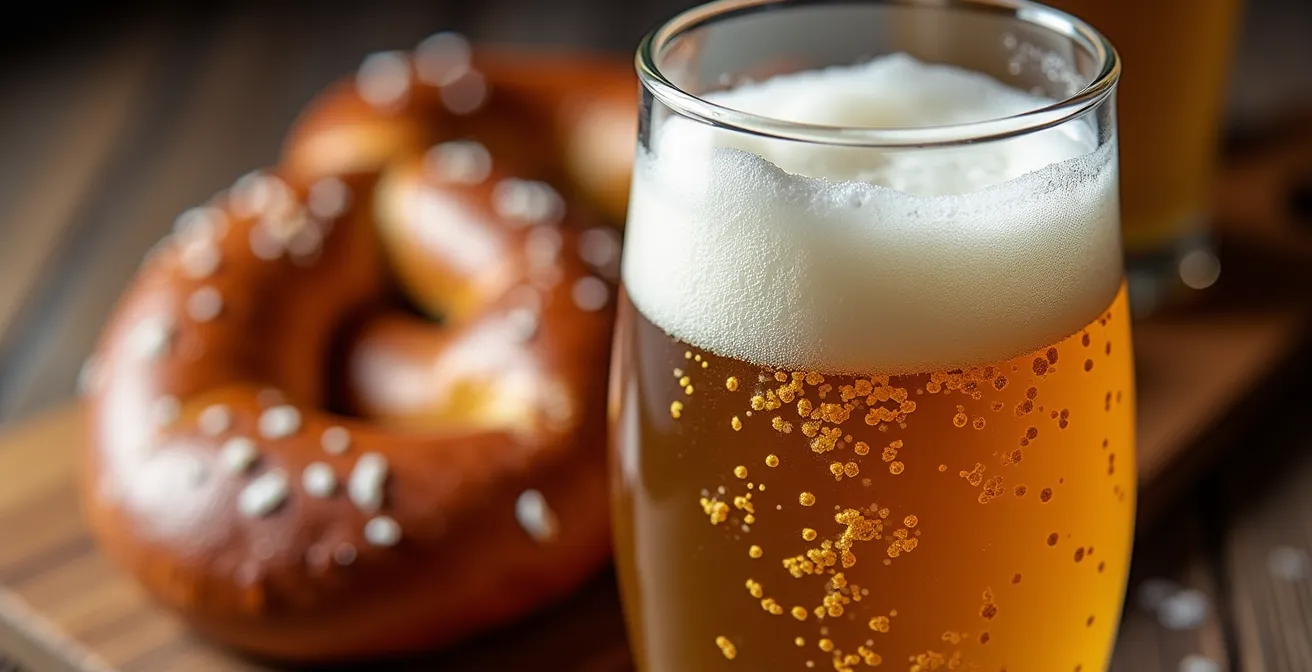
The textures and aromas of the beer and food must interact. A creamy, savory Obatzda, for example, needs a partner that cuts through its fat and refreshes the palate. A yeasty pastry like the pretzel demands a beer that brings its own fruity-spicy notes. The right combination turns a simple meal into a feast for the senses. Here is a small guide straight from the taproom:
- Helles + Obatzda: The lean, crisp Helles is the perfect counterpoint to the creaminess and spice of the cheese. It cleanses the palate and makes you want the next bite.
- Weissbier + Pretzel: The fruity notes of Weissbier, reminiscent of banana and clove, harmonize wonderfully with the malty, slightly sweet aroma of the pretzel. A classic and unbeatable combination.
- Weissbier + Weisswurst: This is the holy grail of the Bavarian “Frühschoppen” (early drink). The mild spice of the sausage and the fizzy freshness of the Weissbier are made for each other. But remember: traditionally only until 12 noon!
- Radler + Wurstsalat: On hot days, the mix of beer and lemon soda is a lighter alternative. The sweetness of the Radler perfectly balances the acidity of the sausage salad.
When should you prefer to sit inside and when is the garden the only true option?
The question “Inside or outside?” is not purely practical in Bavaria; it is an almost philosophical decision. The beer garden is not just the terrace of an inn. It is its own cosmos. As the official reasoning for the Bavarian Beer Garden Ordinance states, it has an important social function.
The conviviality and the get-together in the open air counteract signs of isolation in everyday life.
– Bavarian Beer Garden Ordinance, Official Reasoning for the Ordinance
Sitting outside means being part of a large, colorful community. It is loud, it is lively, and you get into conversations with strangers. This is the place for a quick after-work beer, an informal first date, or simply to enjoy life. The indoor area, the “Wirtsstube,” is by contrast the place for more structured occasions. This is where the Stammtisch (regulars’ group) meets, where grandma’s milestone birthday is celebrated, and where one seeks refuge when the weather turns. During “Föhn”—the notorious Alpine wind that causes headaches—or a sudden thunderstorm, the “Stube” is the wiser choice. But sitting inside on a mild Indian summer evening would be close to a sin.
Here is a small decision guide on when each location is the better choice, based on an analysis of common situations:
| Situation | Beer Garden | Indoor Area |
|---|---|---|
| Quick after-work beer | ✓ Ideal | Too formal |
| Family celebration/Birthday | Only in good weather | ✓ Preferred |
| Stammtisch meeting | Too open | ✓ Traditional |
| First dates | ✓ More casual | Too intimate |
| During Föhn wind | Avoid | ✓ Better choice |
| Indian summer evenings | ✓ Mandatory! | Wasted opportunity |
The mistake of simply sitting at an empty table without checking for the “Reserved” sign
Ah, the empty table. An invitation? Not always. The most obvious trap is, of course, ignoring a “Reserved” sign. But the true art for connoisseurs lies in recognizing a Stammtisch, even if there is no sign pointing it out. A Stammtisch is more than just a reserved table; it is the sanctuary of a fixed group that has been meeting here for years or decades. Settling there without permission is a serious violation of Stammtisch honor.
These tables are often only subtly marked. Recognizing these signs separates the tourist from the connoisseur. It is about showing respect for established social structures. But don’t worry, there are telltale signs. And if you want to sit at one of the long, unmarked tables, a simple but crucial social rule applies: you ask, even if it is more of a rhetorical formality. A friendly “Griass God, is do no frei?” with a short nod toward the free seat is good manners. The answer is almost always a nod, as conviviality is the top priority. It is the starting point for a possible conversation and shows that you have understood the rules of the game.
Checklist: How to recognize a Stammtisch
- Check for club symbols: Look for small pennants, club flags, or other special decorations placed on the table.
- Inspect the tabletop: Look for engraved names, years, or symbols directly in the wood of the tabletop. This is a clear sign.
- Notice table ornaments: A special tin ashtray, a private beer mug stand, or other unusual table decorations indicate a Stammtisch.
- Tablecloth as an indicator: Tables with tablecloths usually belong to the service area. The self-service and “joining in” principle does not apply here.
- Ask the right question: Always ask “Griass God, is do no frei?” and wait for a nod before taking a seat. This is the golden key.
After you have taken a seat, it is customary to toast your table neighbors with a hearty “Prost!” upon your first sip. After that, decency dictates waiting to see if a conversation develops. Do not push yourself; the “Gemütlichkeit” comes all by itself.
How does the mug deposit system work smoothly in the self-service area?
The deposit for the beer mug is not an attempt to take money out of your pocket. It is a system based on trust and shared responsibility. The mug made of glass or stoneware is a valuable asset and the heart of the beer garden. The deposit ensures that it returns to where it belongs: the taproom. It ensures order and reduces the workload for the staff, which in turn reflects in fair beer prices. Anyone who understands and respects the system shows themselves to be part of the community.
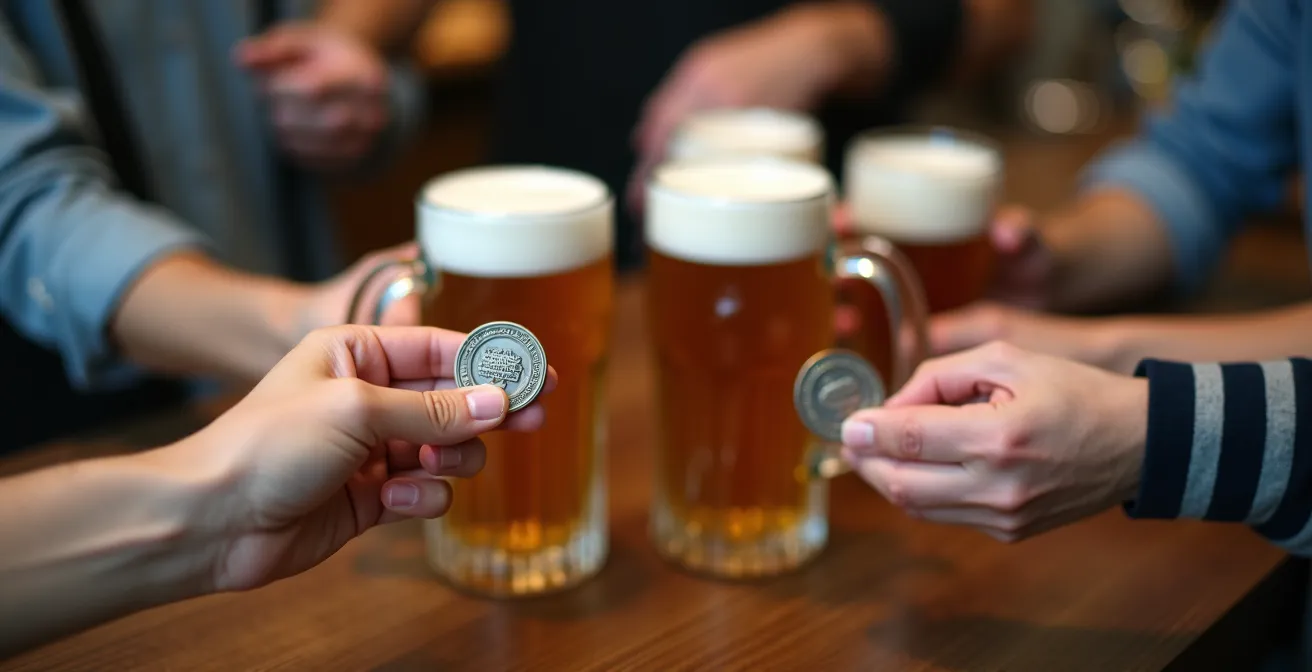
When ordering in the self-service area, you will receive a Pfandmarke (deposit token) along with your full mug. This little token is your ticket to getting your deposit money back later. Do not lose it! For groups, this can quickly become confusing. The key to success is organization. Designate one person to collect the money and manage the deposit tokens. This prevents chaos and ensures that everyone gets their money back at the end.
When you return your mug, make sure it is empty and contains no food scraps. In some beer gardens, like the famous Hirschgarten in Munich, there are even special wash basins where you can briefly rinse your mug before returning it. This is a small act of respect that is highly appreciated. And if a token should get lost: speak to the staff politely. Often a lenient solution can be found, because in the beer garden, togetherness counts.
- Step 1: Collect the money for the beer and deposit from your group before heading to the taproom.
- Step 2: Designate a “Deposit Token Manager” who keeps all tokens safe.
- Step 3: Always return the mugs empty and without trash.
- Step 4: Hand in the empty mugs and the tokens together at the taproom to receive your deposit back.
Why you should never order ketchup with a bratwurst in Thuringia to avoid being looked at sideways
Now we take a little trip beyond the Bavarian “Weisswurst equator.” Because unwritten food laws are not a purely Bavarian phenomenon. Every region in Germany has its own culinary sanctuaries. A perfect example is the Thuringian Rostbratwurst. If you are standing at a bratwurst stand in Thuringia, you commit a cardinal sin if you ask for ketchup. This is not just a question of taste; it is a cultural sacrilege.
The Thuringian Rostbratwurst has been a product with a “protected geographical indication” (PGI) from the EU since 2003. This means its recipe and origin are strictly defined. Its unique seasoning mix of marjoram, caraway, and garlic is its pride and joy. For locals, the idea of masking this fine aroma with sugary ketchup is a horror. As one connoisseur aptly put it: it is a desecration to defile the wonderfully fragrant, shiny, fatty sausage with ketchup, according to a glossary on the Thuringian national dish. The only true and accepted accompaniment is spicy mustard, traditionally the Born brand from Erfurt.
The mustard does not mask the spices but highlights them. Its sharpness forms a contrast to the fat content of the sausage and elevates the flavors. Asking for ketchup signals not only that you are an outsider but also that you do not understand the value and tradition of this cultural carrier. It is like going to an expensive steakhouse and drowning the filet mignon in soy sauce. You just don’t do it. So, if you are in Thuringia, do yourself and the locals a favor: order your bratwurst with “a dollop of spicy mustard.”
Why visiting only one region gives a false impression of Germany
Anyone who believes they know all of Germany after a visit to a Munich beer garden is gravely mistaken. Germany is a patchwork quilt of countless regional cultures, dialects, and traditions. The beer garden culture we have discussed so far is a deeply Bavarian phenomenon. Travel just a few hundred kilometers north, and the world already looks very different. The cozy, loud, and communal atmosphere of a Bavarian beer garden often gives way to a more intimate and reserved pub culture.
These differences are historically grown and shape the mentality to this day. The idea of bringing your own snack is unthinkable outside of Bavaria. Clinking glasses with strangers is also not a given everywhere. To illustrate the cultural diversity, here is a small comparison between beer culture in the South and the North:
| Aspect | Southern Germany (Bavaria) | Northern Germany |
|---|---|---|
| Drinking Venue | Open beer gardens under chestnuts | Enclosed pubs |
| Greeting | ‘Griass God’ – cozy-traditional | ‘Moin’ – pragmatic-direct |
| Social Behavior | Communal, joining others | More private, individual tables |
| Snack (Brotzeit) | Bringing your own is allowed | Only from the host |
| Atmosphere | Loud, social, spontaneous | Quieter, more intimate |
How deeply beer garden culture is rooted in the Bavarian soul is shown by an event from 1995: the so-called Beer Garden Revolution. When a court ruling attempted to move up the closing time in a popular Munich beer garden to protect residents from noise, people took to the barricades. According to reports, around 25,000 Munich citizens took to the streets in a demonstration organized by breweries to fight for the preservation of their culture. Such an event would be unthinkable in Hamburg or Berlin and shows that the beer garden in Bavaria is more than just a place to drink—it is a piece of identity.
The most important points at a glance
- Respect the tradition: Beer garden rules are not harassment, but historically grown traditions that ensure “Gemütlichkeit.”
- Know the zones: In the self-service area, you may bring your own snack, but never drinks. In the service area, you order everything from the waiter.
- Social competence is everything: Always ask before joining a table (“Is do no frei?”) and recognize the sacred Stammtische to avoid them.
Why does Sauerbraten in the Rhineland taste so different from that in Franconia or Saxony?
To conclude, here is culinary proof of Germany’s incredible regional diversity: Sauerbraten. For many, it is the epitome of German cuisine. But anyone who thinks Sauerbraten is just Sauerbraten is in for a surprise. A Sauerbraten in the Rhineland tastes fundamentally different from one in Franconia or Saxony. These differences are not random whims of the chefs, but the result of centuries of regional history and different trade routes.
Rhenish Sauerbraten is the perfect example of the influence of trade routes on cuisine. Cologne was a significant trade metropolis, and this is reflected in the recipe: the sauce is refined with raisins and sweet Aachener Printen (gingerbread) or sugar beet syrup. The result is a characteristic sweet-and-sour taste. In contrast is the Franconian Sauerbraten. Here, in the inland, people relied on what was locally available. The marinade is more bitter, more acidic, and gets by without sweet ingredients. The sauce is often thickened with gingerbread, giving it a spicy depth. Every roast thus tells a story about the economic and cultural past of its home.
To better understand these regional variants, here is a brief overview:
- Rhenish Sauerbraten: Recognizable by the sweet-and-sour sauce, often with raisins and Printen. A heritage of the trading city of Cologne.
- Franconian Sauerbraten: More bitter and acidic, without sweetness. More rustic in taste, often thickened with gingerbread.
- Saxon Sauerbraten: Here, vinegar often dominates the marinade even more strongly than in other regions.
- Westphalian Sauerbraten: Another variant where the sauce is sometimes thickened with Pumpernickel, which gives it an earthy note.
This diversity shows that German cuisine is far from being uniform. It is a mosaic of local specialties waiting to be discovered. Every bite is a piece of lived history.
If you keep these unwritten laws in your heart, you will not just visit every beer garden and traditional tavern in Germany, but truly experience it. Prost and an Guadn!