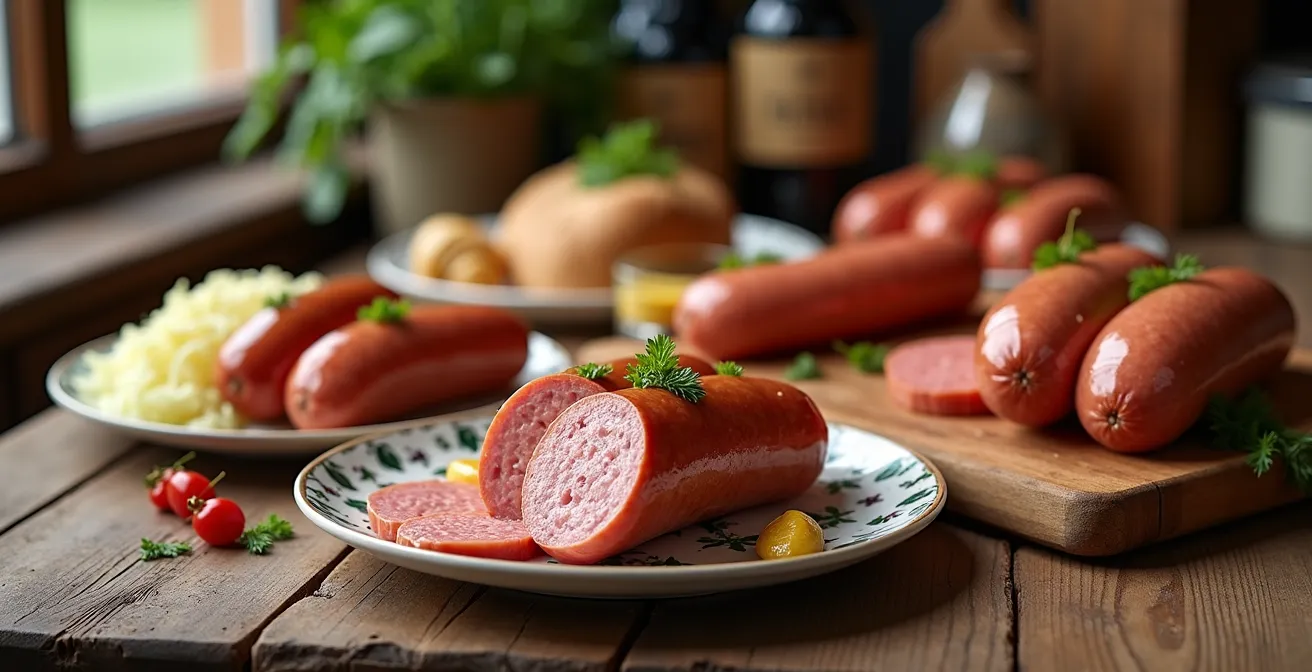
German bratwurst is far more than just a snack – it is a regional passport whose rules every foodie must know to truly taste the culture.
- The identity of a “Nuremberg” or “Thuringian” sausage is defined not only by taste but by EU law and centuries-old traditions.
- The choice of side dish (classic mustard, never ketchup!) and even the wood used under the grill are deeply rooted cultural statements.
Recommendation: Learn to recognize the subtle quality markers. Only then can you distinguish authentic, artisanal flavor from generic mass-produced goods and experience Germany’s true sausage identity.
Imagine standing in Berlin, biting into a juicy Currywurst, and thinking: “So this is the famous German sausage culture.” Think again! While delicious, that is only the tip of a massive, savory iceberg. To truly understand Germany culinarily, you have to dig deeper – straight into the soul of the regional bratwurst. Because here, it’s not just about meat and spices. It’s about local pride, laws that are stricter than many traffic regulations, and unwritten rituals that can instantly expose you as an clueless tourist.
Most guides tell you what to eat. But what if the true key to enjoyment lies not in *what* you eat, but in *why* it is eaten exactly this way and no other? What if the real seasoning is in understanding the stories, the traditions, and the small, fine differences? This guide is your decoder for German sausage identity. We dive into a world where size matters, color is a quality marker, and the choice of sauce can be a matter of honor.
Forget superficial top-ten lists. We decode the secrets behind the most famous sausages so that you don’t just leave full, but also a bit wiser. Get ready for a journey that will expand your palate and your horizon – a tour de force through the heart of German street food culture.
Contents: Your Guide Through German Bratwurst Culture
- Why can a “Nürnberger Rostbratwurst” only be called that if it was produced within the city limits?
- Why you should never order ketchup with your bratwurst in Thuringia to avoid being looked at askance
- Do the pine cones under the grill in Thuringia really make a difference in taste?
- How can you recognize a low-quality bratwurst before you even bite into it?
- Is a trip to the 1st German Bratwurst Museum worth it for non-butchers?
- Helles or Wheat Beer: Which pairs better with a pretzel and which with Obatzda?
- Why visiting only one region gives a false picture of Germany
- How to safely transport German sausage specialties in flight luggage without customs issues?
Why can a “Nürnberger Rostbratwurst” only be called that if it was produced within the city limits?
Welcome to the world of culinary sovereign territories! The answer is simple yet fundamental to understanding German specialties: it’s about honor, tradition, and a hard-hitting law. The Nuremberg Rostbratwurst is not a generic name, but a Protected Geographical Indication (PGI) of the EU. This means only what is produced according to the strictest rules within the city limits of Nuremberg may bear this prestigious name. As a recent ruling by the Munich I Regional Court confirmed, the Nuremberg Rostbratwurst has been protected as a PGI throughout the EU since 2003, and it jealously guards its identity.
This protective measure is not red tape; it is a seal of quality. It guarantees that every “authentic” Nuremberg sausage meets the same high standards that have been maintained for over 700 years. The rules are precise and define the sausage identity down to the last detail:
- Size and Weight: A real Nuremberg sausage is only 7 to 9 cm long and weighs a maximum of 25 grams. Small but mighty!
- Ingredients: It consists exclusively of coarsely defatted pork. The characteristic seasoning comes from a secret marjoram blend, guarded like a treasure by every butcher shop.
- Production: The mincing, mixing, and stuffing into the narrow sheep casing must take place within the city limits of Nuremberg.
This strict protection has even led to curious legal developments. In a legal dispute in June 2024, it was decided that the designation “Mini Rostbratwürstchen” (Mini Roast Sausages) did not violate trademark protection since the name “Nürnberger” was not used. This shows how seriously the Franconians take their sausage. For you as a foodie, this means: where “Nürnberger” is written on the label, a piece of authentic, strictly controlled food culture is inside. Enjoyment with a seal of approval.
Why you should never order ketchup with your bratwurst in Thuringia to avoid being looked at askance
If the Nuremberg bratwurst is protected by laws, the Thuringian Rostbratwurst is defended by an even more powerful set of rules: unwritten tradition. Here in central Germany, the heart of bratwurst culture, asking for ketchup is not just a question of taste, but a potential faux pas. It is a violation of “Bratwurst Etiquette,” which will earn you at best a pitying look and at worst a short lecture on being a cultural philistine. The Thuringians are proud of their sausage, whose tradition is deeply rooted. Its first documented mention dates back to January 20, 1404, when a monastery account noted “1 groschen for bratwurst casings” – a historical document proving the long lineage of this specialty.
But why this aversion to the red sauce? For Thuringians, ketchup’s dominant sweetness masks the fine, spicy flavor of their bratwurst. A real Thuringian is characterized by a blend of salt, pepper, marjoram, caraway, and garlic. This complex aroma profile is further refined by the process of grilling over charcoal. The only acceptable accompaniment that complements rather than destroys this taste is medium-hot mustard, preferably from local production like the famous “Born Senf.”
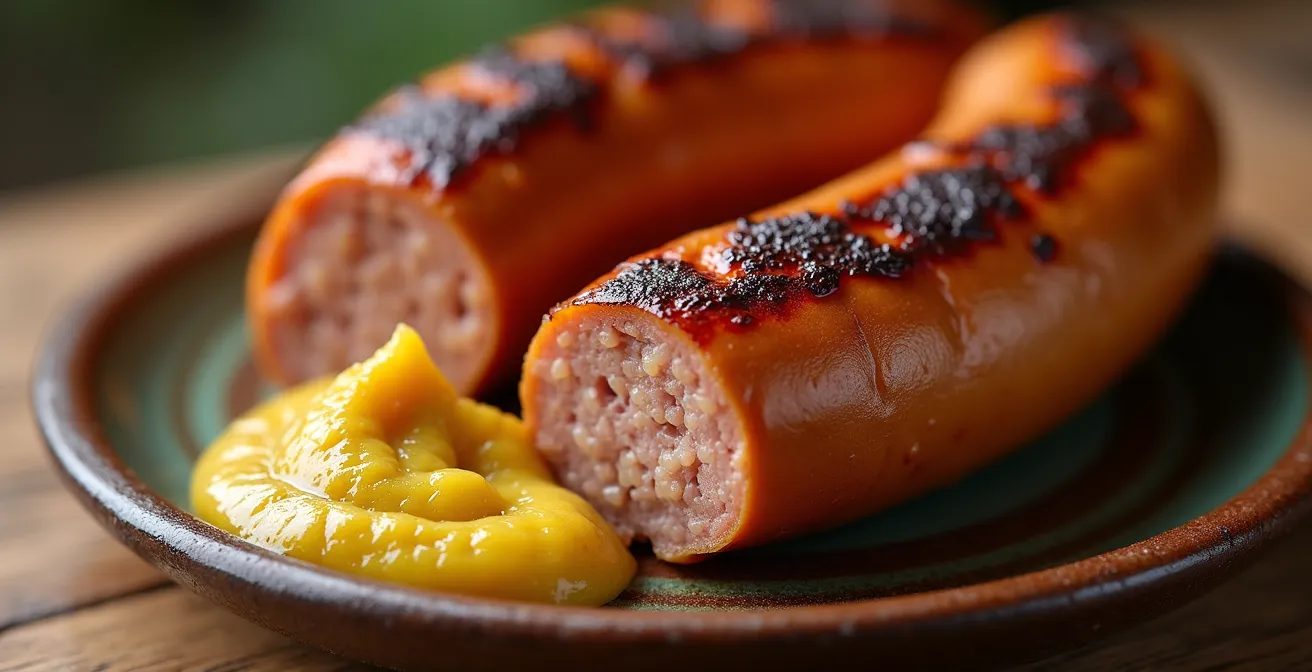
The whole thing is classically served in a sliced bread roll (Brötchen). This serves not only as a holder but also to catch the delicious meat juices. The sausage should speak for itself. Ketchup would distort this honest, pure flavor. It’s like mixing a fine wine with cola. So, when you stand at a grill stand in Thuringia, do yourself a favor: order “Eine mit Senf” (One with mustard) and you will not only get a delicious sausage but also the respect of the locals.
Do the pine cones under the grill in Thuringia really make a difference in taste?
Yes, absolutely! What might seem like rustic folklore to outsiders is actually a crucial part of the “flavor terroir” of certain German bratwurst regions. While the classic Thuringian is usually sizzled over charcoal, there is a famous variant that owes its unique character to a very special fuel: the Coburg Bratwurst. As Wikipedia aptly describes, this specialty from the Franconian town of Coburg, on the border with Thuringia, is traditionally grilled over pine cones and served in a roll.
But what do these cones – known in the local dialect as “Kühle” – actually do? When burned, they release essential oils that produce an unmistakable, slightly resinous and sweet-spicy smoke. This smoke permeates the meat during grilling and gives the sausage an aroma that cannot be achieved with any other method. It is a form of flavoring that comes directly from nature and deeply connects the sausage to its native landscape. The scent alone, wafting over the Coburg marketplace, is an olfactory invitation that is hard to turn down.
This method is a perfect example of how regional availability has shaped culinary tradition. In the forested areas of Franconia and Thuringia, pine cones were an easily accessible fuel. What began out of necessity became a trademark. The following table shows how this traditional method differs from others.
| Smoking Method | Region | Flavor Profile |
|---|---|---|
| Pine Cones | Thuringia/Coburg | Resinous, sweet-spicy aroma |
| Beech Wood | Northern Germany | Mildly smoky, balanced |
| Charcoal | Supra-regional | Neutral, classic grilled |
For a foodie, this is the essence of travel: discovering how local conditions produce a unique flavor that is not replicable. So the next time you eat a bratwurst, pay attention not only to what is *in* the sausage, but also what is *under* the grill. It might make the decisive difference.
How can you recognize a low-quality bratwurst before you even bite into it?
As an international foodie, you want the real, authentic thing. Nothing is more disappointing than biting into a tasteless, watery, or greasy sausage disguised as a regional specialty. Fortunately, there are clear signs to distinguish a real treasure from a tourist trap – following the “Purity Law of the Sausage.” You just have to know what to look for. One of the most important rules of thumb concerns the color: a grayish, matte color in a raw bratwurst is often a quality marker. It shows that no nitrite curing salt was used for reddening, which is common in handcrafted, coarse bratwursts. A bright pink, on the other hand, often indicates industrial additives.
Another important indicator is the fat content, which is precisely balanced in high-quality sausages. A good bratwurst should be juicy but not dripping with fat. For example, EU specifications for the Thuringian Rostbratwurst dictate that its fat content is only 25%, compared to up to 60% in some cheap products. This difference is noticeable not only in taste but also in mouthfeel.
To turn you into a bratwurst connoisseur who recognizes quality at first glance, we have put together a practical checklist. Use this plan during your next visit to a German sausage stand.
Your Quality Check Plan: Identifying Real Bratwurst
- Visual Check: Look at the color. Is it a natural gray-white (a good sign for raw, coarse sausage) or an unnatural pink? Check the casing: a real natural casing has slight irregularities and is never perfectly smooth like plastic.
- Assortment Analysis: Take a look at the display. A stand that concentrates on 2-3 regional specialties is often a sign of a specialist. A counter with 20 different sausage varieties from all over Germany screams industrial mass production.
- Ask About Origin: Be curious! Ask the vendor where the sausage comes from. A passionate butcher or griller will proudly tell you about their local supplier. An evasive answer is a red flag.
- The Scent Test: Trust your nose. Does it smell like real charcoal smoke or just old grease? The scent of freshly grilled meat and spices should be dominant.
- Observe the Grill Master: How is the sausage handled? Is it lovingly turned until it has the perfect browning, or has it been sitting on a warming rack for hours? Freshness is everything.
With these simple steps, you sharpen your eye for quality and ensure that every bratwurst you try on your journey is a true culinary highlight.
Is a trip to the 1st German Bratwurst Museum worth it for non-butchers?
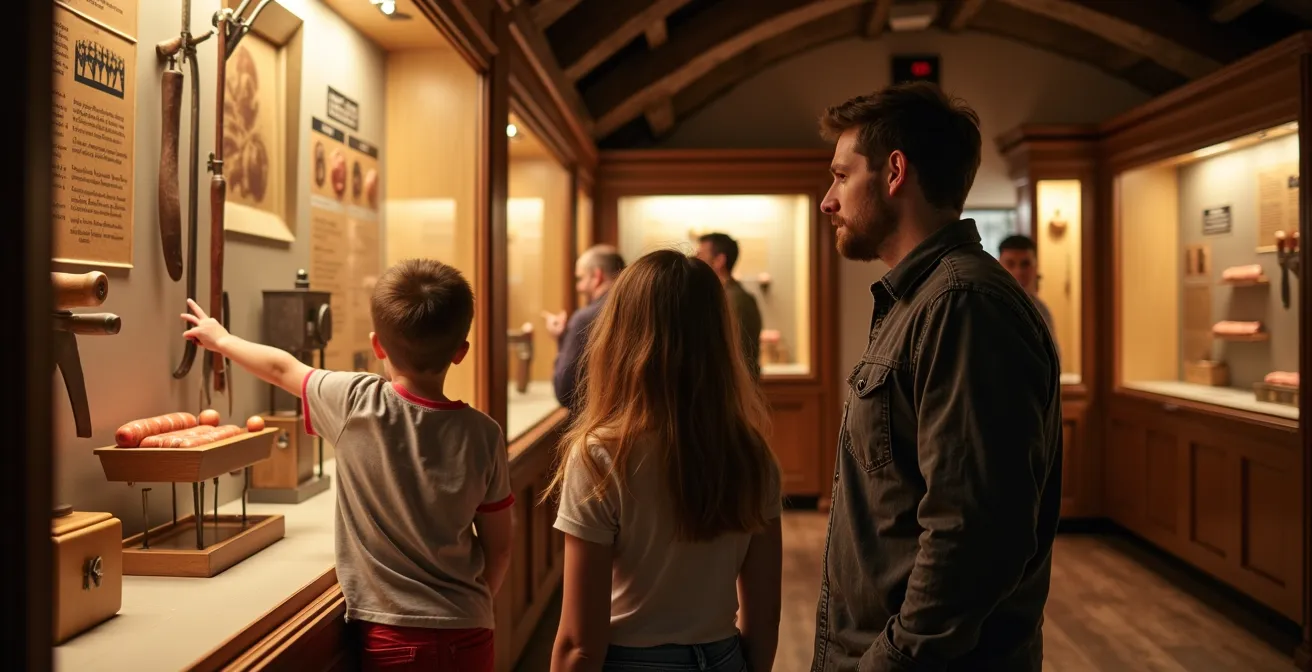
A whole museum just for a sausage? It might sound absurd to some, but the answer is a clear yes! The 1st German Bratwurst Museum in Mühlhausen, Thuringia, is far more than a tribute to fried minced meat in a casing. It is a surprisingly entertaining and informative cultural center that celebrates the bratwurst for what it is: a carrier of German culture. The numbers speak for themselves: in the first year after its reopening alone, over 150,000 bratwurst fans visited the museum, proving that the subject holds broad interest.
Especially for non-butchers or families, the museum is a worthwhile destination. The exhibition goes far beyond pure butchery and sheds light on the role of the bratwurst in art, culture, and history around the globe. You learn in a playful way why the Thuringian Rostbratwurst has been protected EU-wide since 2003 and discover curious exhibits from all over the world. The concept combines education with a high entertainment factor, making the cultural history of the sausage tangible and amusing.
Case Study: The Bratwurst Museum as a Cultural Experience
The German Bratwurst Museum proves that food is culture. It doesn’t limit itself to dry facts but creates an experience world. The extensive outdoor area with funny sculptures, themed gardens, and display enclosures with native animal breeds such as the Thuringian Donkey offers a charming insight into rural idyll. Visitors can experience the bratwurst not only historically but also with their senses. This approach makes the museum an excursion destination for the whole family that goes far beyond the topic of meat and shows the connection between agriculture, craftsmanship, and enjoyment.
The highlight is the interactive and humorous design. Instead of just lining up display cases, there are oversized mustard tubes for photos, a “Bratwurst Theater,” and many witty installations. It is a place that doesn’t take itself too seriously and, because of that, conveys its message all the more sympathetically: the bratwurst is a piece of joy for life. And of course, enjoyment is not neglected – a freshly grilled Thuringian Rostbratwurst on-site is the perfect conclusion to the visit.
Helles or Wheat Beer: Which pairs better with a pretzel and which with Obatzda?
After we have grilled our way through the sausage landscape, we take a detour to Bavaria, where the culinary trinity of beer, pretzel, and hearty snacks reigns supreme. As a foodie, you know: perfect harmony only comes from the right pairing. The question of which beer fits which dish is not a minor detail here, but a science in itself. The two Bavarian beer icons, Helles and Wheat Beer (Weissbier), have completely different character profiles and unfold their magic in combination with the right partners.
Wheat Beer, with its typical aromas of banana and clove originating from the special yeast, is the ideal companion for the pretzel. The fruity and slightly spicy notes of the beer perfectly complement the mild, yeasty aroma of the lye pastry without overpowering it. It is a harmonious interplay that evokes a sunny day in a beer garden.
Helles, on the other hand, is a golden, malt-accented, and less bitter type of beer. Its strength lies in balancing strong and fatty foods. It is the perfect partner for creamy and spicy Obatzda. The gentle sweetness of the malt and the sparkling carbonation cut through the richness of the cheese and cleanse the palate, making every bite a fresh delight. The following table summarizes the optimal combinations.
| Dish | Recommended Beer | Flavor Harmony |
|---|---|---|
| Pretzel | Wheat Beer (Weissbier) | Fruity esters and phenol notes (banana, clove) harmonize with yeast dough aroma |
| Obatzda | Helles | Malty sweetness and light bitterness cut through fat and spice |
| Bratwurst | Bock Beer (dark) | Strong contrast between the beer’s sweetness and the sausage’s spice |
But the world of food pairing is not limited to beer. For a non-alcoholic but equally regional alternative, a handcrafted, cloudy apple spritzer is an excellent choice. And for those who like to experiment, you should definitely try the Würzburg bratwurst with a dry Silvaner wine from Franconia – a surprisingly elegant combination that shows how versatile German culinary culture is.
Why visiting only one region gives a false picture of Germany
Anyone who believes they know German bratwurst after a trip through Thuringia is making the same mistake as someone who claims to have understood Italian cuisine after visiting Naples. Germany is culinarily extremely federal. Every region has its own pride, its own recipes, and its own sausage identity. A single experience, however delicious, is always just one piece of the large puzzle. The diversity is simply overwhelming: a current overview shows that there are 46 different types of bratwurst in Germany alone, and those are only the officially recognized ones!
The differences are by no means only superficial. Let’s look again at the two giants: Nuremberg Rostbratwurst and Thuringian Rostbratwurst. One is tiny (7-9 cm), finely seasoned with marjoram, and often served in sets of six or twelve. The other is a stately giant (at least 15 cm), coarse in texture and strongly seasoned with caraway and garlic. They represent two completely different philosophies of sausage making, both perfected over centuries.
But the journey doesn’t end there. Go north and you will find the finer, often parboiled bratwurst. In Franconia, you will discover the “Franconian Bratwurst,” often served as a meter-long coil (“Bratwurstgehäck”), or the aforementioned Coburg style over pine cones. In the southwest, there is the red “Rote Wurst,” a type of scalded sausage that is a staple at every festival. Each of these variants tells a different story about the region, its agriculture, and its culinary preferences. Restricting yourself to only one variety would be like judging a book after reading the first page. The true beauty of German bratwurst culture lies in its impressive diversity.
Summary
- More than just sausage: German bratwursts like the Nuremberg or Thuringian are cultural assets protected by EU law and centuries-old traditions.
- The devil is in the details: The right side dish (mustard!), the grilling method (charcoal or pine cones), and the color of the sausage are crucial quality and cultural markers.
- Diversity is everything: With over 46 varieties, every region of Germany offers a unique sausage identity that must be discovered to get a complete picture.
How to safely transport German sausage specialties in flight luggage without problems when going through customs?
After a culinary discovery tour through Germany, the desire is strong to take a piece of this hearty culture home. A few vacuum-packed Nuremberg or Thuringian sausages are the perfect souvenir for any foodie. But how do you transport these treasures safely in flight luggage without experiencing a nasty surprise at customs upon arrival? With the right preparation, it’s easier than you think. The Federal Ministry of Agriculture points out that many of these products enjoy special protection status:
Swabian Spätzle, Nuremberg Gingerbread, Allgäu Mountain Cheese, Thuringian Rostbratwurst or Beelitz Asparagus – these products are not only known beyond their regions, their names are also specially protected.
– Federal Ministry of Agriculture, Protected Geographical Indications
The first and most important step is packaging. Buy the sausages from a butcher who can professionally vacuum-seal them. This not only prevents liquid from leaking but also significantly extends the shelf life and minimizes odors in the suitcase. Raw bratwursts are more sensitive than parboiled ones. Be sure to transport them in checked baggage, where it is cooler during the flight than in carry-on luggage. A small insulated bag with a few cold packs in the suitcase can additionally secure the cold chain.
Customs regulations are the second decisive point. Within the European Union, importing meat and dairy products for personal use is generally problem-free. So, you don’t need to worry here. It looks different for travel to non-EU countries (e.g., USA, Canada, Australia). These countries often have very strict regulations regarding the import of animal products to prevent the introduction of diseases. Raw meat is almost always prohibited. Therefore, be sure to inform yourself about the specific regulations of your destination country before your departure. In case of doubt, a pre-cooked and original-packaged sausage from the supermarket is the safer, if less romantic, option. This ensures that your culinary souvenir actually ends up on your home plate and not in the customs bin.
So, what are you waiting for? Pack your curiosity and your appetite and set off on your own personal bratwurst discovery tour through Germany. Explore the regional differences, talk to the butchers, and find your personal favorite. It is the most delicious way to experience German culture!