
The common opinion that pretzel-style baked goods are generally unhealthy falls short; in truth, it is a system whose health value depends on the quality of ingredients and preparation.
- The sodium hydroxide lye, which provides the typical crust, is completely neutralized during baking and is harmless in the finished product.
- The high salt content is a conscious choice, not a necessity. The amount of water you drink with it is crucial for balance.
Recommendation: Do not view pretzel pastries as the enemy, but learn to recognize the quality features of an artisanal pretzel and consciously choose spelt variants for a real nutrient bonus.
The scent of fresh pretzel pastries wafting from a bakery is one of the cozy childhood memories for many. The shiny brown, salt-sprinkled pretzel is a cultural asset, a quick filler, and a staple of everyday life for many. However, in the age of conscious consumption, the question inevitably arises: does this classic still fit into a healthy diet? Familiar concerns quickly surface: too much salt, empty calories from white flour, and the mysterious “lye” that somehow sounds dangerous.
These concerns are not unfounded, but they only tell half the story. They often lead to a blanket avoidance that does not do justice to the product. Because pretzel pastry is much more than just a salty white flour loop. It is the result of a fascinating chemical process, a play of textures, and a food whose health value depends significantly on the details of its production. Instead of answering the question with a simple “yes” or “no,” the key lies in a deeper understanding.
What if the true art lies not in abstinence, but in knowledgeable enjoyment? If, by understanding the physical-chemical transformations, you can separate the wheat from the chaff and take the levers for healthier consumption into your own hands? This article takes exactly that path. We dive into the science of lye-dipping, compare the various pastry shapes for their practical utility, and give you concrete tools to recognize quality and optimize enjoyment.
This guide leads you through the crucial aspects that turn pretzel pastries from a simple calorie source into a conscious moment of enjoyment. Discover the diversity and hidden potentials that go far beyond the classic pretzel.
Summary: Pretzel Pastries in the Health Focus: Myths, Facts, and Smarter Enjoyment
- What exactly happens during “lye-dipping” and is sodium hydroxide lye dangerous for the stomach?
- Pretzel stick or pretzel roll: Which is better for a filling sandwich?
- Can you taste the difference in spelt pretzel pastries, or is it just marketing?
- How do you effectively remove coarse salt without ruining the taste of the pastry?
- How do you make soggy day-old pretzel pastries crispy again in 5 minutes?
- Why is drinking German tap water the underrated booster for your skin?
- Why do most hobby bakers fail at using sodium hydroxide lye at home?
- How do you distinguish a real, hand-twisted baker’s pretzel from industrial frozen goods?
What exactly happens during “lye-dipping” and is sodium hydroxide lye dangerous for the stomach?
The concern regarding the term “sodium hydroxide lye” is understandable, as it is a strongly alkaline solution. In the context of baking, however, this concern is unfounded. The process of “lye-dipping” is a precisely controlled chemical process that is essential for the characteristic color, taste, and crust of the pastry. The dough pieces are dipped for only a few seconds into a diluted, 3-4% sodium hydroxide (NaOH) solution with a pH value of 13-14. This brief contact fundamentally changes the surface of the dough.
The real magic only happens in the oven. Due to the high alkalinity, the so-called Maillard reaction – the browning reaction between amino acids and sugars – is massively accelerated and intensified. It occurs even at lower temperatures and provides the deep brown, shiny crust and the typical lye aroma. During this baking process, something crucial happens: the heat and the carbon dioxide contained in the dough completely neutralize the lye. The finished pastry has a neutral pH value of about 7 and no longer contains any free lye. For the stomach, it is therefore absolutely harmless.
Another often overlooked issue, however, is the quality of the baking trays. Particularly when using aluminum trays, problems can arise because the lye attacks the metal. A study by the Bavarian State Office for Health and Food Safety found that in some cases, limit values for aluminum were exceeded. This is a problem of the manufacturing process, not the pretzel pastry itself, and highlights the importance of buying from quality-conscious bakeries that use stainless steel trays.
The fear of lye is therefore a myth. The real quality question lies in the baker’s care and the equipment used.
Pretzel stick or pretzel roll: Which is better for a filling sandwich?
The choice between a pretzel stick and a pretzel roll seems at first glance to be a pure matter of taste. From a nutritional and practical point of view, however, there are clear differences that predestine them for different purposes. The decisive factor is the ratio of crust to crumb (the soft interior of the pastry), which significantly influences structural stability and moisture absorption capacity.
A pretzel stick, due to its long, thin shape, has a significantly higher proportion of crust. This makes it crispier and structurally more stable – ideal for dry toppings like sausage or cheese. Its dense, firm crumb prevents it from getting soggy quickly. The pretzel roll, on the other hand, is bulbous in shape. Its interior is looser, airier, and has a higher proportion of crumb. This soft, porous structure can absorb moisture excellently, making it the perfect choice for juicy toppings such as tomatoes, cucumbers, remoulade, or cream cheese.
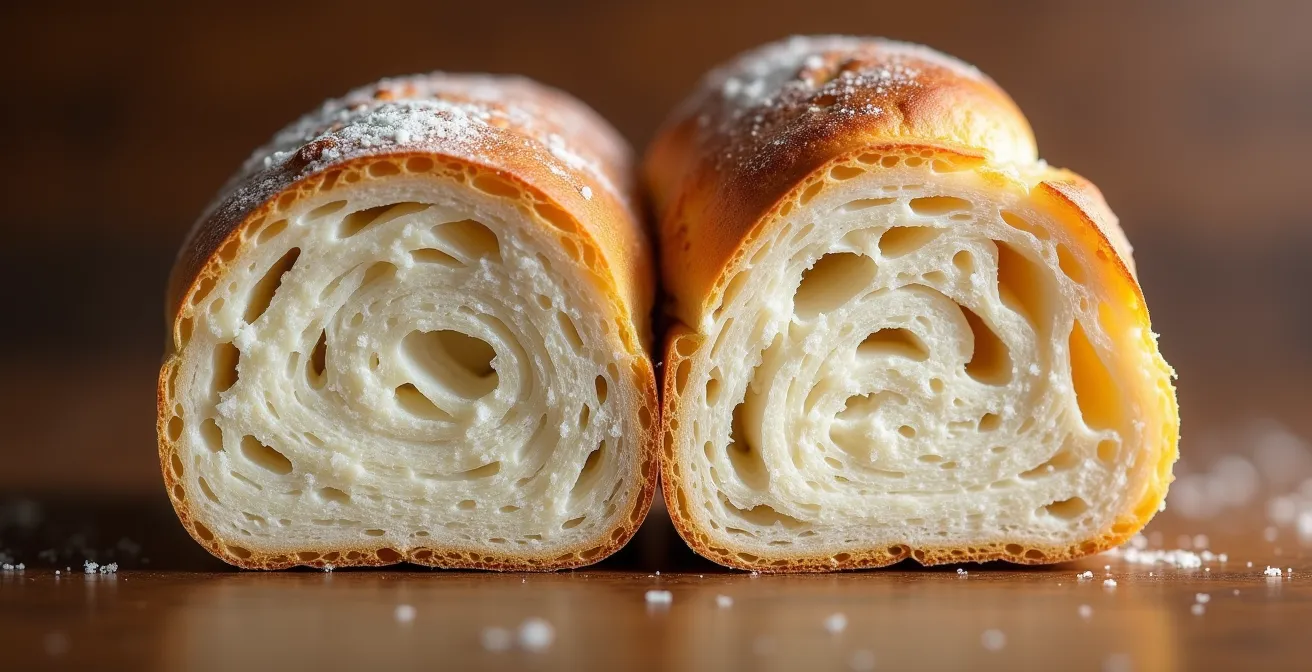
These structural differences are also reflected in the nutritional values. The roll tends to have a higher carbohydrate density, as the crumb makes up the largest part of the volume. The following table illustrates the contrasts and helps with the strategic choice for your perfect sandwich.
| Property | Pretzel Stick | Pretzel Roll |
|---|---|---|
| Crust Proportion | 35-40% | 25-30% |
| Carbohydrates/100g | 44-50g | 52-56g |
| Moisture Absorption | Low | High |
| Structural Stability | Very Good | Medium |
| Suitability for Juicy Toppings | Limited | Optimal |
For a filling, richly topped sandwich that doesn’t get soggy, the pretzel roll is clearly at an advantage, while the stick shows its strengths as a purist snack or with simple toppings.
Can you taste the difference in spelt pretzel pastries, or is it just marketing?
The increasing presence of spelt variants on bakery shelves raises the question of whether this is a real health and taste added value or just a clever marketing trend. The answer is clear: the difference is both measurable and tasteable. Spelt is not a modern breed but an ancient grain that differs significantly from modern wheat in its nutrient matrix and protein structure.
From a nutritional science perspective, the advantage is significant. As nutritional science analyses show, spelt flour contains up to 30% more magnesium and 25% more zinc than comparable wheat flour. These minerals are essential for muscle function and the immune system. Opting for a spelt pretzel stick is therefore an easy way to increase the intake of these important micronutrients.
But the difference doesn’t end with internal values. It also manifests in texture and taste. Nutrition expert Sabine Voshage explains this connection:
The gluten protein of spelt is structured differently than that of wheat. This leads to a softer, juicier crumb and a less ‘tough’ bite.
– Sabine Voshage, The Base Expert – Nutrition Blog
This different gluten structure makes the pastry not only more pleasant in mouthfeel but often also more digestible for people with a slight wheat sensitivity (not celiac disease). A blind tasting confirmed this sensory difference: over 73% of participants recognized the spelt variant by its texture and described the taste as nuttier and less dry. Choosing spelt pretzel products is therefore a well-founded decision for more nutrients and a more complex taste experience.
Ultimately, spelt offers an excellent opportunity to combine the enjoyment of pretzel pastries with a conscious contribution to your own nutrient supply.
How do you effectively remove coarse salt without ruining the taste of the pastry?
The coarse salt on pretzel pastries is the epitome of enjoyment for many, but often a nuisance for health-conscious eaters. A single pretzel can make up a significant portion of the recommended daily salt intake. Fortunately, the salt can be reduced without destroying the pastry. The key lies in applying the right technique that protects the delicate lye crust.
Instead of impetuously scraping off the salt, which would damage the crust, there are more professional methods. The baker’s brush method is the gentlest: use a dry, stiff bristle brush to gently brush the crystals off the pastry, ideally before warming it up. For the thin, crispy arms of a pretzel, the tapping technique is suitable: turn the pastry over and tap it specifically against a hard surface so that the salt crystals loosen through the vibration. It is important not to remove all the salt, but to leave a partial amount for the taste experience.
After reducing the salt, however, the pastry can seem a bit “naked” in terms of flavor. This is where sensory optimization comes in. Instead of salt, other components can stimulate the taste buds and provide health benefits at the same time. The following table shows some alternatives to intelligently compensate for the missing salt kick.
| Alternative | Taste Intensity | Health Benefit |
|---|---|---|
| Grainy Mustard | High | Less Sodium |
| Sprinkled Caraway | Medium | Digestive-promoting |
| Cream Cheese with Herbs | Mild | Calcium source |
| Poppy/Sesame seeds | Nutty | Rich in minerals |
Thus, a potential salt trap is transformed into a canvas for creative and healthy taste combinations that take enjoyment to a new level.
How do you make soggy day-old pretzel pastries crispy again in 5 minutes?
Everyone knows the disappointment: the crispy pretzel pastry from the day before has become soft and soggy overnight. This process is a result of starch retrogradation, where moisture moves from the inside (the crumb) to the outer layer (the crust). But instead of throwing it away, this condition can be reversed in a few minutes with the right physical trick.
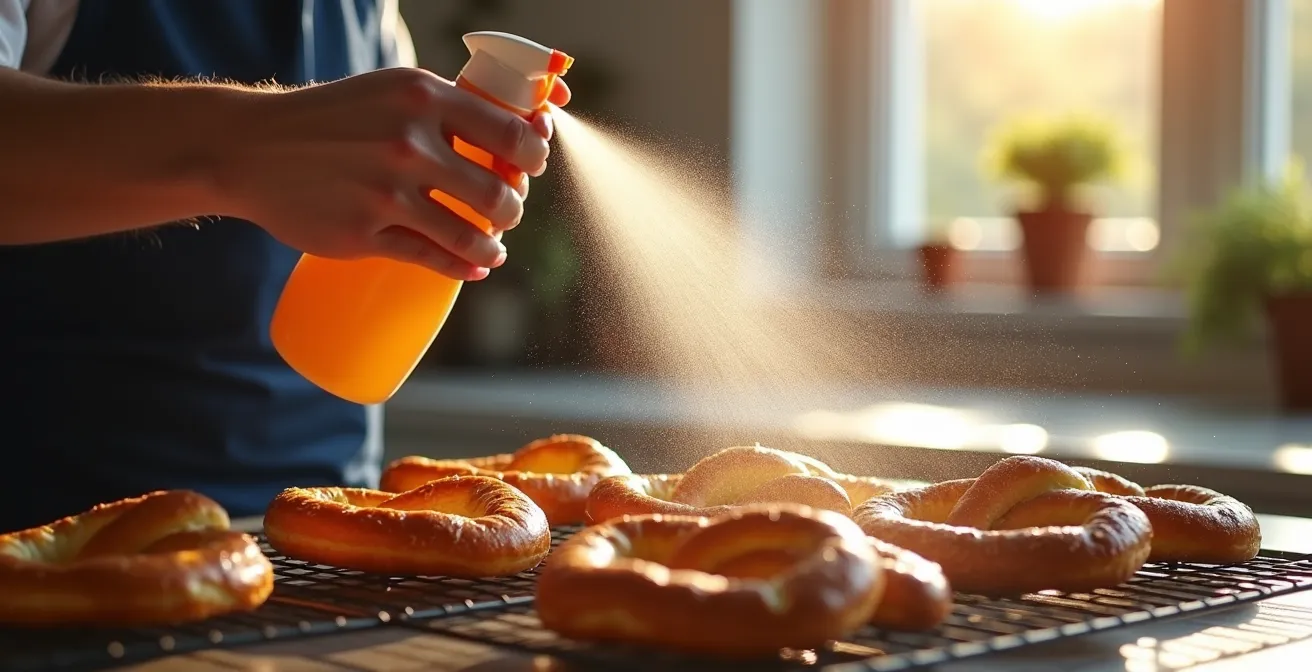
The solution lies in the “water-heat method.” It is based on briefly adding moisture to the crust and then evaporating it quickly through high heat. This shock effect restores the original crispness. The process is simple and effective: first, the pretzel pastry is lightly misted with water from a spray bottle – it should be moistened, not soaked. Then it goes into the oven preheated to 180°C.
Even more efficient and faster than the oven is the airfryer. In a comparison test, the hot air fryer proved to be the champion: at 160°C, it required only 2-3 minutes to achieve perfect crispness, consuming significantly less energy at 0.04 kWh than the oven. Important for both methods: the pastry should be served immediately, as the regained crispness is only temporary and fades again after about 20 minutes.
Your Action Plan: Refreshing Pretzel Pastries Perfectly
- Moisten: Lightly spray the pastry all over with water. A spray bottle provides a fine mist and prevents it from getting too wet.
- Preheat: Preheat your oven to 180°C (convection) or your airfryer to 160°C. The heat must be able to act immediately.
- Bake: Place the pastry in the oven for 3-4 minutes or in the airfryer for 2-3 minutes. Watch it to avoid burning.
- Check: Tap on the crust. If it sounds hollow, it is perfectly crispy.
- Enjoy: Serve the refreshed pastry immediately to experience maximum crispness.
Thus, a sad leftover from the day before becomes a highlight on the breakfast table again in no time.
Why is drinking German tap water the underrated booster for your skin?
The connection between a lye pretzel and the condition of your skin may not be obvious at first glance, but it is direct and mediated by the factor of salt. The high sodium content of pretzel pastries has a direct influence on the body’s water balance and thus also on the appearance of the skin. This is where German tap water comes in as a crucial opponent.
A single lye pretzel can contain a considerable amount of salt. According to the German Nutrition Society (DGE), an 80g pretzel contains an average of 1.3g of salt, which already represents 22% of the recommended maximum daily amount of 6 grams. High salt consumption causes the body to retain water to dilute the sodium. This can lead to swelling and a bloated feeling. At the same time, water is drawn from the cells, including skin cells, making the skin look dry and sallow and making small wrinkles more visible.
This is where drinking enough water unfolds its effect – and German tap water is particularly well-suited for this. It is not only of excellent quality but also rich in minerals that help regulate the electrolyte balance disturbed by salt. An analysis of tap water from 50 German cities showed that it contains an average of 50-100 mg of calcium and 10-30 mg of magnesium per liter. These minerals are cofactors in numerous metabolic processes and support the kidneys in excreting excess sodium more efficiently. Sufficient fluid intake flushes the system, reduces water retention, and ensures that the skin cells are plump and hydrated again.
This simple act of hydration thus becomes a direct and cost-effective “booster” for a fresh, healthy complexion.
Why do most hobby bakers fail at using sodium hydroxide lye at home?
The dream of making pretzel pastries at home that taste like they came from the bakery ends in disappointment for many hobby bakers. The reason often lies in the improper handling of the decisive element: the lye. While professional bakers work with dangerous, highly concentrated sodium hydroxide lye that requires protective equipment, laypeople often resort to unsuitable or incorrectly applied alternatives.
Swiss baking expert Marcel Paa identifies two main sources of error that lead to failure. One is the wrong dough temperature. He emphasizes repeatedly in his courses:
The most common mistake is the wrong dough temperature. Dough pieces must be cold, otherwise they become too soft in the lye. Also, using aluminum bowls is fatal – the lye dissolves the aluminum.
– Marcel Paa, Swiss Baking Academy
Warm dough pieces lose their shape in the lye and become mushy. On the other hand, the choice of the lye itself is crucial. Many recipes recommend dissolving normal baking soda (sodium bicarbonate) in boiling water. This solution is safe but often too weak to trigger the intensive Maillard reaction responsible for the typical color and taste. The result is often pale and disappointing in flavor.
However, there is a safe and effective method for the home. Commercial baking soda can be chemically converted into washing soda (sodium carbonate) by heating it in the oven, which has a stronger alkaline effect but is still much safer than caustic soda. Here is a safe instruction: heat 200g of baking soda at 150°C for one hour in the oven. Then dissolve 60g of this powder in 1 liter of cold water. The dough pieces, which have previously been chilled for 30 minutes in the refrigerator, can then be briefly dipped into this lye. Even though gloves and good ventilation are recommended, there is no risk of chemical burns as with professional baker’s lye.
With the right preparation and a safe lye alternative, nothing stands in the way of perfect homemade pretzel pastries.
The Essentials in Brief
- Pretzel pastry is nutritionally a system: not generally good or bad, but optimizable through conscious decisions (salt, type of flour, toppings).
- The spelt variant is not a marketing trick but offers real added value in taste and nutrient content through more minerals and a different gluten structure.
- Day-old pretzel pastries can be made perfectly crispy again in a few minutes using the “water-heat method” (spraying and briefly baking in a hot oven/airfryer).
How do you distinguish a real, hand-twisted baker’s pretzel from industrial frozen goods?
At first glance, many pretzels look deceptively similar. But worlds lie between a carefully hand-twisted baker’s pretzel and a mechanically produced, uniform industrial product – both in taste and quality. For the conscious connoisseur, it is therefore crucial to know the subtle but clear characteristics that reveal true craftsmanship.
Perhaps the most important feature is the “Ausbund,” the characteristic tear on the “belly” of the pretzel. In an artisanal pretzel, this tear occurs because the baker scores the dough piece at this point before baking. In the oven, the crust tears open irregularly and wildly here, which ensures a particularly crispy texture. Industrial goods often do not have this cut, or it is only indicated as a smooth, stamped line. The test by Stiftung Warentest confirmed that this score is one of the most reliable distinguishing features.
Further evidence includes shape and color. A hand-twisted pretzel is never perfectly symmetrical. The arms are of different thicknesses, the loops slightly uneven. Industrial goods, on the other hand, come from a mold and are flawlessly uniform. The same applies to the color gradient: artisanal pretzels often show uneven browning because the thinner arms get more heat in the oven and become darker than the thick belly. A completely uniform brown coloring indicates a standardized industrial baking process. The following table summarizes the most important identification features:
| Feature | Artisanal Pretzel | Industrial Goods |
|---|---|---|
| Belly Cut | Irregularly torn open | Smooth or mechanically stamped |
| Color Gradient | Uneven (arms darker) | Uniformly brown |
| Crumb Structure | Coarse-pored, slightly moist | Fine-pored, cotton-like |
| Shape | Slightly asymmetrical | Perfectly symmetrical |
| Salt Distribution | Irregular | Uniform |
Your 5-Point Check for Identifying Artisanal Pretzels
- The Belly Cut: Look for a wildly torn, irregular rift on the thick part of the pretzel. A smooth or missing line is an indication of mechanical production.
- The Shape: Observe the symmetry. Real manual work always shows small irregularities and asymmetries in the shape and thickness of the arms.
- The Color Gradient: Check if the thin arms are darker and crispier than the lighter, softer belly. A uniform color suggests an industrial process.
- The Crumb: If possible, take a look at the interior. A coarse-pored, juicy, and slightly irregular structure speaks for craftsmanship; a fine, cottony one for industry.
- The Salt Distribution: Observe the salt crystals. In manual work, they are often unevenly and randomly distributed; in machine-made goods, they are usually perfectly uniform.
Armed with this knowledge, your next visit to the bakery will become an informed and enjoyable decision. Pay attention to the details, for they are the key to real quality and authentic taste.