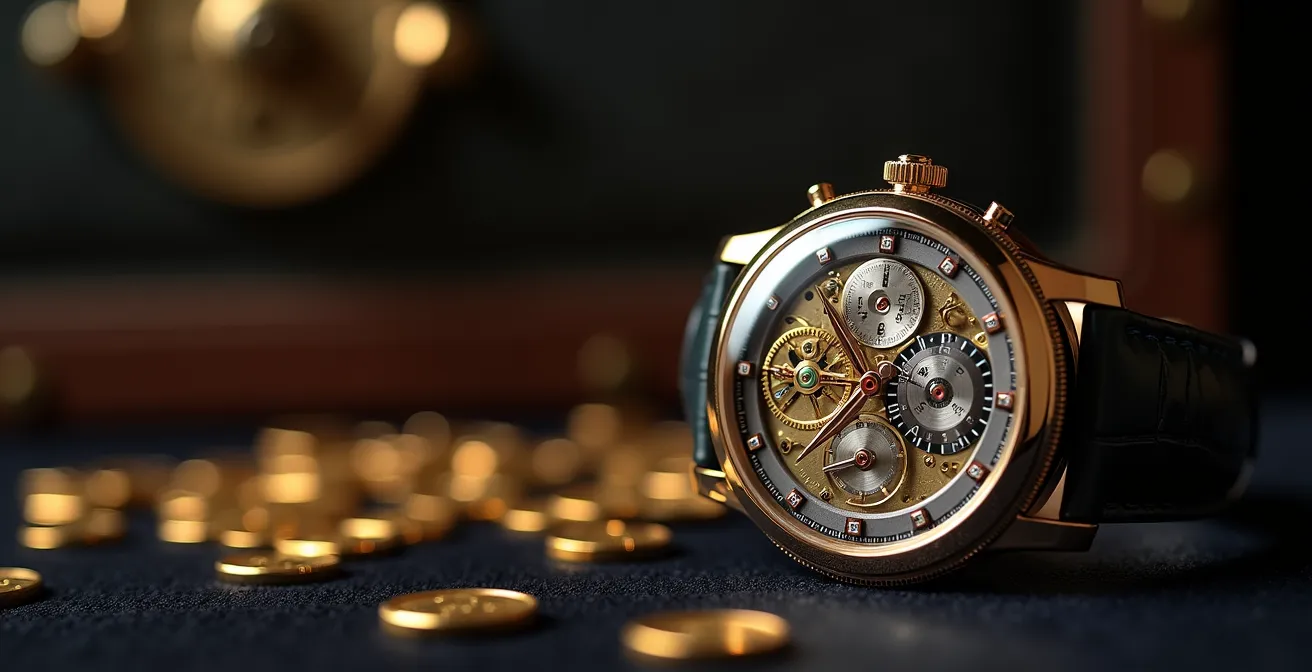
The question of a Glashütte watch is less a financial calculation than a decision for lasting values and masterful craftsmanship.
- The true value lies not in speculation, but in the mechanical soul that lives in every tick of the movement.
- Proper care and knowledge of details are more decisive for value retention than short-term market trends.
Recommendation: Do not view the purchase as a pure investment, but as the acquisition of a cultural asset whose value is measured in daily joy and consistency.
A silent battle rages on the wrists of many professionals today. On one side, the smartwatch flashes and vibrates—a marvel of connectivity that constantly links us to the digital world. On the other side, there is often a void, or perhaps a watch that merely tells the time. Yet, in between, many feel a desire for something more substantial, an object with weight, history, and soul. This is where the mechanical watch from Glashütte enters the stage, a symbol of German watchmaking excellence.
Discussions often revolve around terms like “investment,” “return on investment,” and “alternative to stocks.” One reads about models whose prices skyrocket and limited editions that sell out instantly. However, this focus on pure financial speculation obscures what is truly at the core. It clouds the view of the fine details that make such a watch a lifelong companion. The value of a Glashütte watch is not primarily measured by auction results, but by the perfection of its inner workings.
So, what if the real question isn’t “How much money can I make with this?”, but rather “What piece of craftsmanship and permanence am I acquiring?” This article takes you on a journey into the heart of a mechanical watch. We will leave the perspective of a pure investor behind and adopt that of a connoisseur and enthusiast. Only those who understand the mechanical soul of a watch can truly measure its worth—a value that goes far beyond the financial and is rooted in pure, daily joy.
This guide leads you through the crucial aspects that define a mechanical watch. From the quiet ticking of the second hand to choosing the right strap and the correct maintenance that decides between value retention or total loss—here you will find the knowledge to make an informed and personal decision.
Table of Contents: The True Value of a Glashütte Watch
- Why does the second hand tick differently on an automatic, and what does that say about quality?
- How do you determine the ideal diameter so the watch looks neither boastful nor lost?
- When is a leather strap a no-go, and when is steel too sporty for a suit?
- The maintenance error in mechanical watches that leads to total loss after 5 years
- At what value should you include your watch separately in your homeowners insurance?
- Why buying a €300 coat saves more money in the long run than three cheap models?
- Is it okay to mix gold and silver today, or is it still a style faux pas?
- How to distinguish real 80s quality from cheap retro kitsch in vintage shops?
Why does the second hand tick differently on an automatic, and what does that say about quality?
The first thing that fascinates a newcomer about a mechanical watch is the movement of the second hand. While a quartz watch—the battery-powered counterpart—moves the hand in individual, audible steps, it seems to glide smoothly on an automatic watch. This gliding is the outward sign of the pulsing heart within: the mechanical movement. It is the most fundamental difference and the first unmistakable sign of quality.
This smooth gliding is created by the high frequency of the balance wheel, the timekeeper of the watch. Modern movements often vibrate at 28,800 vibrations per hour (vph), which corresponds to 4 Hertz (Hz). This means the second hand takes eight tiny steps per second, which our eye perceives as one fluid motion. A higher frequency generally stands for higher accuracy, as it is less sensitive to shocks. This is the mechanical soul that connoisseurs speak of—a living organism made of hundreds of parts, powered only by movement or the winding of a spring.
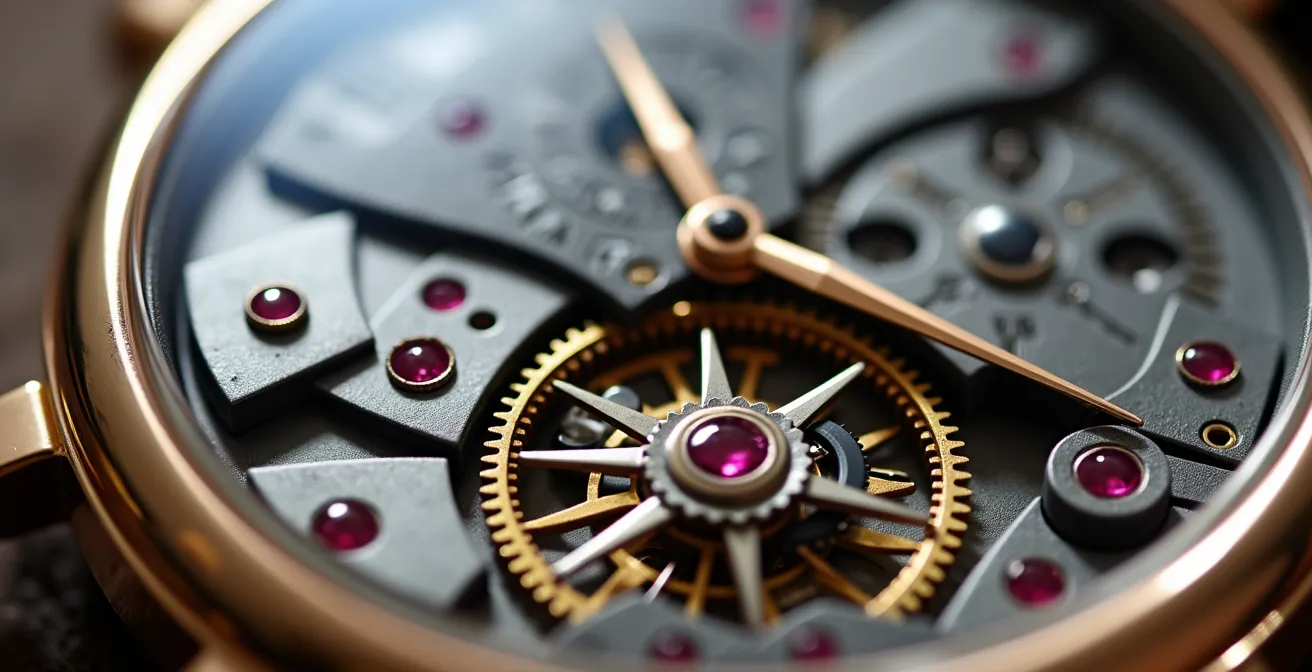
Sometimes, manufacturers deliberately take a different path. For example, Union Glashütte has reduced the frequency to 3.5 Hz (25,200 vph) in some models. This makes the glide of the second hand slightly less fluid but, in return, increases the power reserve—the time the watch runs when not moved—to an impressive 60 hours. This is not a lack of quality, but a deliberate technical decision, a compromise between two desirable characteristics. Understanding such nuances separates the enthusiast from the mere consumer.
How do you determine the ideal diameter so the watch looks neither boastful nor lost?
After the inner value of the movement, the outward appearance on the wrist is crucial. Nothing disrupts the overall image more than a watch with an unsuitable size. A timepiece that is too large looks boastful and clumsy, while a watch that is too small gets lost on the arm of a powerful wearer. Choosing the right diameter is an art in itself, but it is based on clear principles and goes far beyond the mere millimeter measurement.
The pure case diameter is only half the truth. The visual impact of a watch is determined by many other factors. A narrow bezel (the ring around the glass) makes a watch appear larger, as does a light dial. A crucial but often overlooked measurement is the so-called “lug-to-lug” measurement: the distance from one set of lugs to the other. Ideally, these lugs should not protrude beyond the edges of the wrist. If they do, the watch quickly looks too massive, even with a moderate diameter.
Fortunately, the trend is moving away from the oversized “dinner plates” of the early 2000s toward a new, classic modesty. Manufacturers like Nomos Glashütte are pioneers of this movement. As one watch blog notes, models like the Nomos Tangente in elegant sizes around 38 mm are a clear sign of this change:
Nomos Tangente, presented with 25 models, is classic and straightforward, with variants in 38mm diameter—a sign of the trend toward smaller, more elegant sizes.
– Watch.de Blog, Which Glashütte watch is the best?
The following points will help you find the visually perfect size:
- Measure wrist circumference: A good rule of thumb is the ratio of watch diameter to wrist width, not circumference. The watch should cover about 60-75% of the width of your wrist.
- Check lug-to-lug measurement: The most important criterion. The lugs must not “float” in the air.
- Consider bezel width: Dive watches with wide bezels often look smaller than dress watches with narrow bezels of the identical diameter.
- Take dial color into account: Light dials (white, silver) appear more present and larger than dark ones (black, blue).
- Include case shape: Cushion-shaped or square cases visually wear larger than round models with identical diameters.
When is a leather strap a no-go, and when is steel too sporty for a suit?
The strap is the logical continuation of the watch and significantly determines its character and the appropriate occasion. It is like choosing shoes for a suit: one wrong detail can ruin the entire appearance. The eternal question between leather and steel is not one of personal taste, but a question of context and respect for the unwritten rules of style. A coarse rubber strap on an elegant dress watch is as much a faux pas as a shiny alligator leather strap with sportswear.
A steel bracelet is the versatile all-rounder, but even here, there are massive differences. A polished, fine-linked bracelet like a Jubilee or President bracelet fits perfectly with a business suit. A massive, brushed Oyster bracelet, commonly found on dive watches, appears robust and sporty and can quickly look out of place with a suit. The golden rule is: the finer the links and the more polished the surface, the more formal the character.
The leather strap is the epitome of elegance. For a tuxedo or a gala, a black, shiny strap made of alligator or calf leather is the only correct choice. Steel is an absolute no-go here. In a smart-casual setting, however, a rustic suede or vintage leather strap can give a watch a wonderfully relaxed and personal touch. It is important to match the leather color with your belt and shoes. The following overview serves as a reliable compass for the right appearance.
This table provides clear guidance on which strap fits which dress code and helps avoid fashion blunders. As an analysis of watch blogs shows, knowledge of these codes is a sign of style consciousness.
| Occasion | Suitable Straps | Unsuitable |
|---|---|---|
| Business/Suit | Polished, fine-link steel (Jubilee), smooth calf leather | Coarse diver strap, NATO strap, rubber |
| Tuxedo/Gala | Shiny alligator leather, narrow silk leather | Any steel bracelet, suede |
| Smart Casual | Rustic suede, Milanese bracelet, vintage leather | High-gloss alligator |
| Sporty/Leisure | NATO/Textile, rubber, robust steel bracelet | Alligator leather, silk leather |
The maintenance error in mechanical watches that leads to total loss after 5 years
A mechanical watch is a microcosm of delicate parts that are constantly in motion. Like any high-performance engine, a watch movement requires regular care to function precisely and reliably. Neglecting maintenance is the most common and expensive mistake an owner can make. Over the years, the oils in the movement resinify, the abrasion of metal particles increases, and the fine gears and bearings run dry. What begins as a minor timing error can end in a major movement failure after five to seven years, the repair of which is often uneconomical.
The cost of a professional service—a complete disassembly, cleaning, oiling, and adjustment of the movement—is not to be underestimated. As a rule of thumb, expect to pay about 10% of the watch’s original price. For a €10,000 watch, this can quickly exceed €1,000. However, as watch experts emphasize, during such a service, all wearing parts are replaceable, which makes the watch virtually immortal—provided the maintenance is carried out correctly.
The biggest mistake, however, is not the missed maintenance itself, but improper maintenance. Inappropriate polishing can irretrievably destroy sharp edges and the original case shape, pulverizing the collector’s value. Replacing original hands or dials with non-authentic parts is a sacrilege for any connoisseur. Especially with complex manufacture calibers, such as those found in watches from A. Lange & Söhne or Glashütte Original, service should only be performed by the manufacture itself or certified workshops.
Your plan to avoid maintenance errors:
- Question polishing critically: Insist on avoiding aggressive polishing. Light signs of wear are patina and a sign of authenticity; rounded edges are a value destroyer.
- Use authorized workshops: Check if a manufacture service is mandatory for your complex caliber to guarantee value retention.
- Have magnetization checked: If your watch suddenly runs very fast, it is often due to harmless magnetization. Demagnetization is quick and inexpensive and should be attempted before any costly repair.
- Preserve original parts at all costs: Explicitly instruct the workshop not to replace original parts like the dial and hands, even if they show slight signs of aging.
- Keep complete documentation: Carefully save all service receipts, invoices, and certificates. A complete service history is pure gold for value retention.
At what value should you include your watch separately in your homeowners insurance?
With the acquisition of a high-quality watch, not only does the joy grow, but also the responsibility. Theft or damage can mean a significant financial loss. Many assume that their expensive watch is automatically covered by homeowners insurance. While this is true in principle, the devil is in the details of the insurance conditions, specifically regarding the reimbursement limits for valuables.
Standard homeowners insurance policies often limit the reimbursement for valuables—which include jewelry and watches—to a percentage of the total insurance sum. An analysis by Finanztip shows that this limit is often only 20-25%. With an insurance sum of €80,000, that would be a maximum of €16,000 to €20,000 for all valuables in the household combined. If you own other jewelry in addition to a €10,000 watch, this limit is quickly exceeded. It becomes even more critical when storing items outside a certified safe, where the sums are often capped at a few thousand euros.
The decisive question is therefore: when does the value of my watch (or collection) exceed these standard limits? As soon as the value of a single watch exceeds approx. €5,000 or the total value of your watches and jewelry reaches the 20% limit of your insurance sum, you should act. The first option is to increase the reimbursement limit for valuables in your existing contract. The second, often better option for collectors, is taking out a special watch or valuables insurance. This often also covers risks such as simple theft while traveling or loss, which homeowners insurance does not cover.
Case Study: A Premium Solution for Collectors
An interesting practical example shows how insurers are adapting to the needs of watch lovers. Signal Iduna’s premium tariff does not treat stainless steel watches as valuables in the classic sense. This means they are insured up to the full insurance sum without a specific upper limit. This is particularly relevant for owners of valuable steel sports models. Furthermore, there is no obligation to immediately report every newly acquired watch. Such specialized tariffs offer significantly better and more straightforward protection than standard contracts.
Why buying a €300 coat saves more money in the long run than three cheap models?
This question from the world of fashion can be applied 1:1 to watchmaking. Why spend several thousand euros on a watch when there are countless models for a fraction of the money? The answer lies in the concept of value stability. A cheap product loses value the moment you buy it. In contrast, a high-quality, handcrafted product preserves its value or may even increase it under certain circumstances. It is an investment in quality that pays off over years, not only financially but also in terms of longevity and style.
The luxury watch market has undergone remarkable development in recent years. The continuous increase in value shows that interest in genuine craftsmanship is growing. For instance, the global market volume for luxury watches rose from around €35 billion in 2018 to a projected €45 billion in 2024. This trend confirms that more and more people recognize the difference between a throwaway product and a lasting value.
However, not every expensive watch is automatically a good investment. This is where the wheat is separated from the chaff. It is the brands with an authentic history, genuine manufacture performance, and iconic designs that prevail in the market. Uhrinstinkt Magazine puts it in a nutshell in an article about investment watches:
While most divers below the €5,000 mark lose value, the Black Bay Fifty-Eight can be resold at its original price if well-maintained.
– Uhrinstinkt Magazine, Best Investment Watches 2022
This statement is crucial: the goal is not necessarily doubling the capital invested, but avoiding depreciation. A watch that you wear with joy for years and can eventually sell without financial loss was essentially a free loan. No smartwatch and no cheap fashion watch offers this luxury. Buying a Glashütte watch is therefore a conscious decision to invest one’s money in a durable asset instead of spending it on short-lived consumption.
Is it okay to mix gold and silver today, or is it still a style faux pas?
The old style rules were strict: never wear gold and silver together. However, this doctrine has loosened significantly in recent years. What was once considered a style faux pas is now celebrated as a self-confident statement—provided it is executed skillfully. The watch plays a central role here, especially the so-called bicolor watches, which combine stainless steel (or white gold/platinum) with yellow or rose gold.
Once a symbol of the ostentatious style of the 80s, bicolor watches have evolved into established classics. They bridge the perfect gap between the sporty coolness of steel and the warm elegance of gold. A high-quality steel/gold combination watch on the wrist virtually legitimizes the mixing of metals in other accessories, such as cufflinks or rings. It becomes the anchor point that holds the entire look together. Instead of an unintentional style breach, the wearer signals conscious intent and fashion sense.
Those who dare to mix metals should follow a few basic rules to appear sovereign rather than arbitrary:
- Quality over uniformity: A high-quality silver ring harmonizes better with a gold watch than cheap, uniform costume jewelry. The value of the individual pieces creates a visual connection.
- Rose gold as a mediator: Rose gold has a warm copper tone that builds a wonderful bridge between cool silver/steel and bright yellow gold. A bicolor watch in steel and rose gold is therefore particularly easy to combine.
- Show intentionality: The key lies in confidence. Wear the mix as if it were the most natural thing in the world. If it looks intentional and not accidental, it will be recognized as style.
- Observe the finish: You can also connect metals through different surfaces. Matte and polished finishes can create an exciting and harmonious combination, regardless of the metal color.
The fear of mixing gold and silver is therefore unfounded. A bicolor watch is not only a beautiful piece of jewelry but also the perfect license to break with old conventions and find your personal style.
Key Takeaways
- The true value of a Glashütte watch lies in its mechanical complexity and craftsmanship, not in short-term speculation.
- Perfect fit (diameter, lug-to-lug) and a strap appropriate for the occasion are signs of a true connoisseur.
- Regular, professional maintenance and adequate insurance are essential for long-term value retention.
How to distinguish real 80s quality from cheap retro kitsch in vintage shops?
Entering the world of vintage watches is a fascinating next step for any enthusiast. Here you will find unique pieces with real history and a patina that no new model can offer. Especially watches from the GDR era, produced under the name “GUB” (Glashütter Uhrenbetriebe), are highly valued collector’s items today. You can find them for just a few hundred euros, as prices from 2015 show. However, the market is full of “Frankenwatches”—watches assembled from different, mismatched parts—and over-restored models.
The art lies in distinguishing genuine, honest quality from cheap kitsch or even fraud. A trained eye looks for details that a layman might overlook. The most important feature is the authenticity and homogeneity of the aging. Does the dial have an even patina? Do the signs of aging on the luminous material on the hands match those on the dial indices? If the colors differ, it is a strong warning signal that parts have been replaced.
Another critical feature is the condition of the case. Many vintage watches are polished during their lifetime. However, improper, aggressive polishing grinds down the original sharp edges and destroys the shape intended by the designer. A watch with scratches and signs of wear but preserved edges is often more valuable than a round-polished, flawless-looking specimen. The following checklist will help you separate the wheat from the chaff when hunting for vintage treasures.
| To Check | Positive Sign | Warning Signal |
|---|---|---|
| Case | Sharp edges preserved | Over-polished, rounded off |
| Dial | Even patina | Replacement dial, fresh color |
| Luminous Material | Uniform aging | Different colors on hands/indices |
| Movement | Original screws undamaged | Scratches on screw heads |
| Papers | Complete history | Missing documentation |
Your journey into the world of fine watches has only just begun. Whether you choose a new model or a vintage treasure—apply the knowledge gained here to make a choice that enriches not only your wrist but also your intellect and your passion for true craftsmanship.