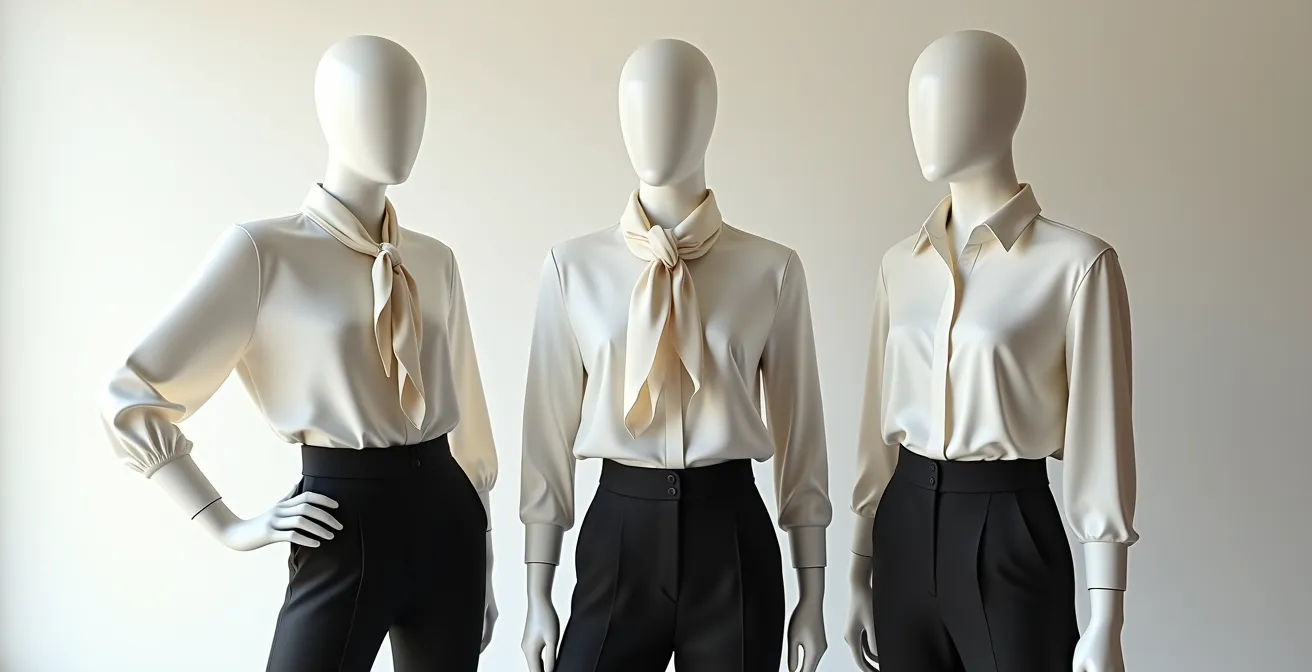
The ability to create countless outfits with a single scarf is no coincidence, but a system of knowledge and technique.
- The impact of a scarf depends on three factors: the knot, the material, and the color harmony with the rest of the outfit.
- Modern elegance often arises through deliberate “style breaks,” such as combining a sophisticated silk scarf with casual clothing.
Recommendation: Master the basic principles presented here to unleash the full potential of your accessories and achieve maximum style variety with minimal effort.
For minimalists and travelers, it is the ultimate challenge: How do you pack light and still look different and thoughtfully dressed every day? Many instinctively reach for a scarf as a solution, but the result often falls short of expectations. One feels the accessory looks out of place, overloaded, or in the worst case, even old-fashioned. Common advice is usually limited to folding and tying, but it leaves out the most crucial part.
The true secret lies not in the knotting technique alone. It is an interplay of material physics, color theory, and an understanding of proportions. Have you ever wondered why a silk scarf can keep you warm even in winter, or why a certain pattern makes your face glow while another makes you look pale? It’s about understanding the scarf not as decoration, but as a strategic tool that can give an outfit structure, a focal point, and a story.
But what if the key to transformation isn’t learning ever more complicated knots, but understanding the fundamental rules that make a scarf a powerful styling instrument? This article breaks through the surface of folding instructions. We dive deep into the subject and reveal the principles with which you can effortlessly transform any basic outfit – be it a simple dress, a jeans and T-shirt combination, or a business suit – into several completely different looks. It’s time to unleash the full potential of this one decisive accessory.
To provide you with a clear structure for this styling journey, we have divided the crucial aspects into clear sections. The following content will lead you from fundamental techniques and material science to the overarching philosophy of elegant minimalism.
Table of Contents: From the Knot to the Complete Outfit Philosophy
- Which 3 knots every woman must know to wear a silk scarf in a modern way?
- Why does silk stay warm in winter and when is wool too scratchy on the neck?
- When does a patterned scarf “overwhelm” your face and when is it the perfect accent?
- The mistake when tying small scarves that unintentionally makes you look like service staff
- How do you store scarves wrinkle-free so they sparkle like new?
- Which 10 garments form the foundation of an elegant German wardrobe?
- How do you check wool for moth holes that are barely visible to the naked eye?
- Why is “Less is more” considered the golden rule for the classic German business look?
Which 3 knots every woman must know to wear a silk scarf in a modern way?
The art of scarf tying lies not in complexity, but in the deliberate choice of the right technique for the desired effect. Instead of learning countless variations you will never use, focus on three essential knots that guarantee versatility and modern style. These techniques form the foundation for turning a scarf from a simple accessory into an integral part of your look. The key is adapting the knot to the occasion and the rest of the outfit to signal either casualness, professionalism, or creative expression.
For an effortlessly elegant everyday look, “Parisian Chic” is unbeatable. Fold a square silk scarf diagonally into a triangle and place it loosely around the neck. The trick for a modern feel is to tie the knot asymmetrically to the side instead of placing it perfectly centered. This small irregularity gives the look a relaxed sophistication. Another more minimalist variation is using the scarf as a bracelet. For this, the scarf is folded into a narrow band and wrapped tightly around the wrist several times. A small, firm knot secures it and creates a subtle but effective color accent that works particularly well with simple blouses or T-shirts.
For a bolder, creative appearance, the scarf can serve as a turban element. Guide the folded scarf from the forehead to the back, knot it at the back of the head, and either let the ends fall loosely or tuck them under. This look works wonderfully to give a simple summer dress a touch of bohemian flair. These three techniques allow you to adopt different personas with just one scarf and transform your outfit depending on your mood and the occasion.
Case Study from Practice: Elsa Hosk’s viral trick for modern elegance
Style icon Elsa Hosk demonstrates a brilliant alternative to the classic neck knot. She uses a silk scarf to tie it loosely around the hips, elevating simple trousers like linen or Capri pants. To recreate this look, it is best to combine the scarf with minimalist cuts. Simple, clean lines allow the accessory to stand out without overloading the overall image, shifting the focal point of the outfit to an unexpected place.
Why does silk stay warm in winter and when is wool too scratchy on the neck?
Choosing the right scarf material is not just a matter of taste, but a decision with direct consequences for comfort and function. The widespread assumption that wool always warms best while silk is only suitable for summer is a misconception. The thermoregulating properties of a material depend on its fiber structure, not its perceived thickness. Silk has a unique protein structure that allows it to act like a second skin: it insulates in the cold by storing body heat and cools in the heat by wicking away moisture. This makes a silk scarf a surprisingly effective companion for transitional seasons and even mild winter days.
The scratchy feeling of wool is also a physical phenomenon that can be objectively measured. The decisive factor is the fiber thickness, specified in microns. A study on the material science of Merino wool shows that the human sensitivity threshold for scratching is at about 25 microns. Fibers that are thicker do not bend upon skin contact but prick into the skin, which we perceive as scratching. While conventional sheep’s wool often has fiber thicknesses of 30 to 50 microns, Merino wool at 16.5 to 24 microns is significantly finer and thus below this irritation threshold. Silk, at approximately 10-15 microns, is even finer, which is why it invariably feels smooth and luxurious.
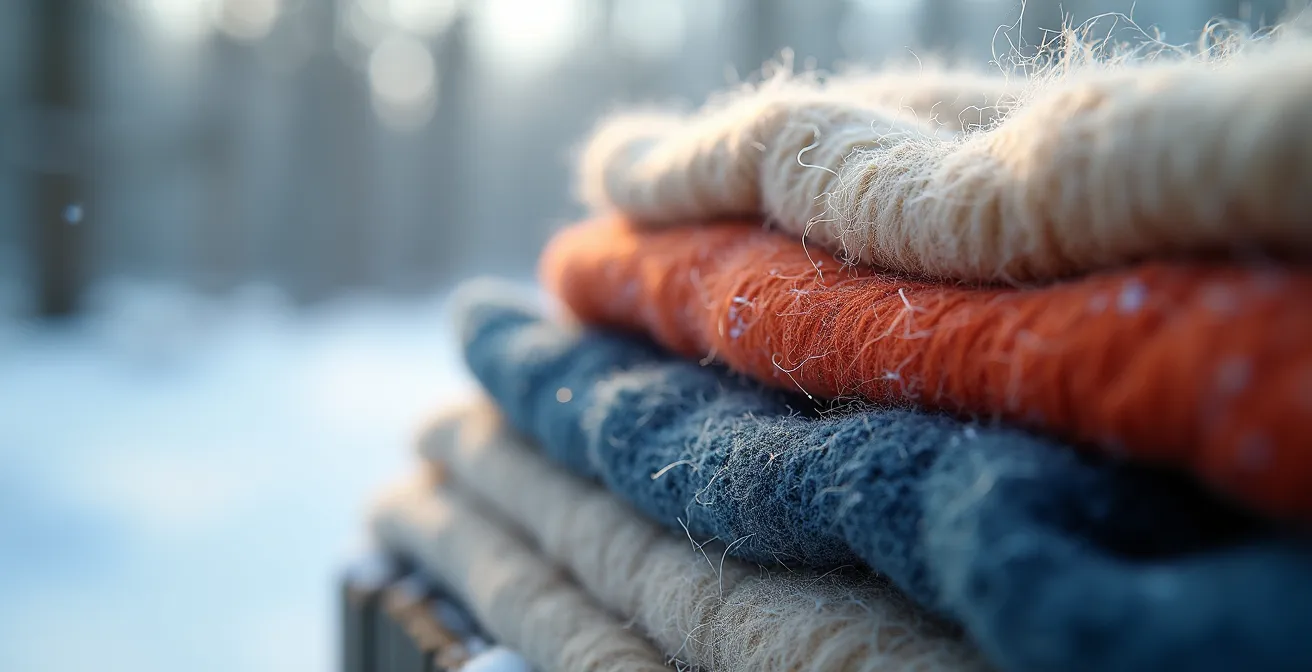
This insight opens up a clever styling possibility for winter: If you own a beloved but scratchy wool scarf, wear a thin silk scarf as the first layer directly against the neck. The silk acts as a soft, protective barrier between your skin and the coarse wool fibers, allowing you to enjoy the warmth of the wool scarf without the unpleasant scratching effect. This layering technique combines the best properties of both materials: the luxurious comfort of silk and the high insulation performance of wool.
The following table summarizes the most important differences between the materials and helps you make the right choice for every situation.
| Material | Micron Count | Scratch Factor | Thermoregulation | Skin Feel |
|---|---|---|---|---|
| Silk | 10-15 μm | No scratching | Cools in summer, warms in winter | Luxuriously smooth |
| Merino Wool | 16.5-24 μm | None to minimal | Very good | Soft, pleasant |
| Standard Wool | 30-50 μm | Clearly noticeable | Good | Rough, scratchy |
When does a patterned scarf “overwhelm” your face and when is it the perfect accent?
A patterned scarf can elevate an outfit from ordinary to extraordinary – or completely ruin it. The fine line between a stylish accent and a chaotic mess is determined by a simple but often ignored rule: color harmony. The scarf does not exist in a vacuum; it must communicate with the colors already present in your outfit. If the scarf introduces too many new, uncoordinated colors, it competes with the rest of the clothing and the face instead of flattering it. The result is a restless, overloaded look that distracts from your personality rather than emphasizing it.
The rule of thumb for a harmonious overall look is the “Three-Color Rule”. Count the main colors of your outfit (excluding the scarf). If you are already wearing a combination of, for example, blue jeans, a white T-shirt, and a beige trench coat, you have three colors in play. A patterned scarf that picks up these colors – perhaps with additional nuances of the same color family – will blend in seamlessly and refine the look. It creates a visual connection and makes the outfit appear thoughtful and consistent. However, a scarf that adds a fourth, fifth, and sixth color like red, yellow, and green breaks this frame and acts like a foreign body.
Style and image consultant Stefanie Diller summarizes this principle concisely:
Are you already wearing 3 colors like blue, white, and pink in your outfit? Then the scarf should not contain a fourth, fifth, and sixth color like yellow, red, and brown, otherwise it becomes too colorful.
– Stefanie Diller, Diller Yourself – Style and Image Consulting
A patterned scarf is therefore the perfect accent when it functions as a visual bridge and picks up existing colors. It “overwhelms” your face when it acts as an isolated, loud splash of color that has no connection to the rest of the look. Consider your scarf as the final puzzle piece that brings everything together, not as a completely new picture.
The mistake when tying small scarves that unintentionally makes you look like service staff
A small, neatly tied silk scarf around the neck – often referred to as a “Carré” – can be a symbol of timeless elegance. But there is a fine line that makes this look tip from chic to uniform-like. The most common mistake is the combination of a perfectly centered, tight knot and a formal outfit, such as a blazer-skirt ensemble. This strictness and symmetry inevitably bring to mind the uniforms of flight attendants or service personnel and rob the look of any individuality and casualness. The key to modern interpretation lies in deliberately breaking this formal expectation.
To avoid the “service look,” you must create a style break. Combine the small neckerchief with deliberately casual garments. A loosely unbuttoned blouse, a casual pair of boyfriend jeans, or wide Marlene trousers immediately defuse the strictness of the scarf. The contrast between the sophisticated accessory and the relaxed clothing creates an exciting dynamic. Another decisive trick is the placement of the knot: always turn it slightly to the side. This asymmetry signals “Sprezzatura” – the Italian art of looking effortlessly casual. It is this calculated imperfection that makes the look modern and personal.
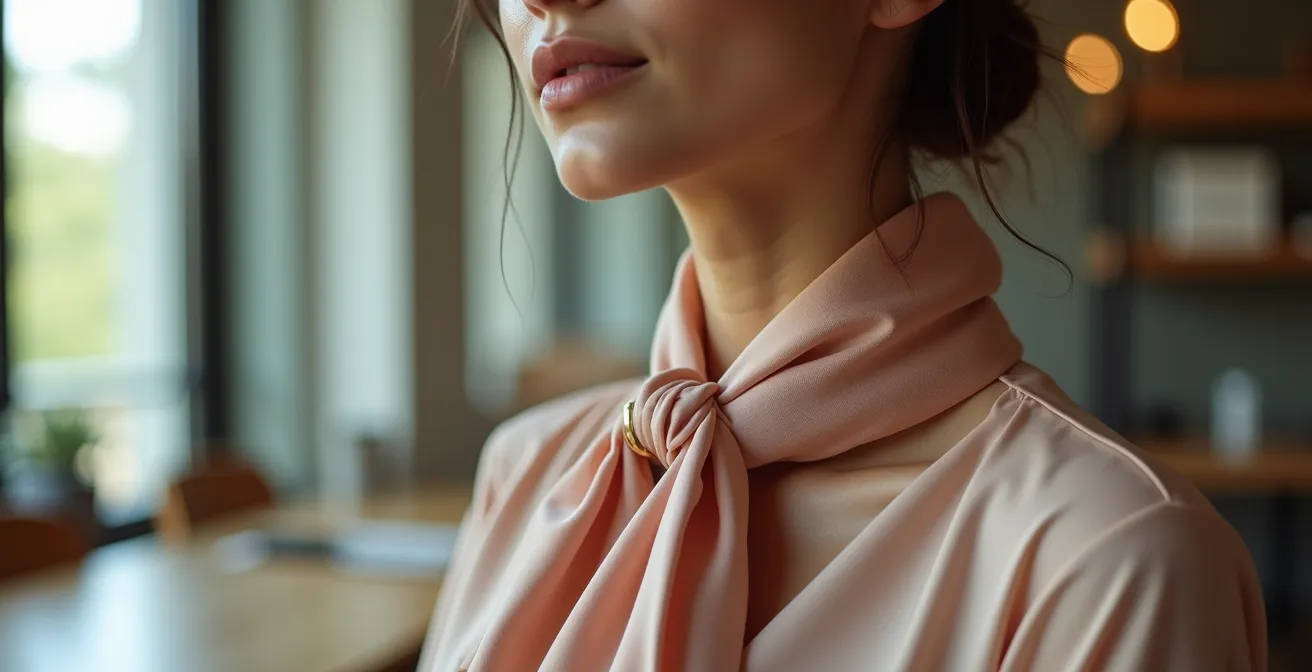
Another excellent method to avoid the uniform association is to forego the classic knot. Instead, use alternative fastening methods that appear more modern and individual. For example, pass both ends of the scarf through an elegant ring or a small cuff. This creates a clean, jewelry-like focal point. Alternatively, you can wrap the scarf loosely several times around your wrist or the handle of your handbag and let the ends hang freely. These techniques shift the function of the scarf from a pure neck accessory to a versatile style element.
How do you store scarves wrinkle-free so they sparkle like new?
The most beautiful scarf collection loses its appeal if the pieces emerge wrinkled and dull from a drawer. Proper care and storage are crucial to maintaining the lifespan and brilliance of your scarves, especially delicate silk. Heat is the greatest enemy of silk fibers, so an iron is often not a good idea. A much gentler method for smoothing is the steam method: simply hang your scarf in the bathroom while you take a hot shower. The rising water vapor gently smooths the fibers and removes creases without damaging the material.
For long-term storage, a simple psychological principle applies that is often overlooked. As the saying goes: “Out of sight, out of mind.” Accessories hidden in a drawer are worn less frequently.
‘Out of sight, out of mind’ – this psychological effect applies particularly to accessories. Scarves stored visibly on a decorative ladder or a special trouser hanger are not only kept wrinkle-free but are also worn much more often. Visual presence reminds us daily of the styling possibilities.
– Mira, Miras-World.com
Visible storage is therefore the best strategy. Hang your scarves over a trouser hanger with multiple bars or drape them over a decorative wooden ladder. This way, they remain not only wrinkle-free and within reach but also serve as a colorful decorative element in your dressing room. For particularly valuable heirlooms or scarves that are worn less often, archiving in a breathable cotton bag lined with acid-free tissue paper is recommended. Absolutely avoid plastic bags, as they prevent air circulation and can lead to mildew spots and color loss. A small lavender sachet or a piece of cedarwood in the bag provides additional natural protection against moths.
Which 10 garments form the foundation of an elegant German wardrobe?
A versatile and elegant wardrobe is based not on an abundance of clothing, but on a carefully curated selection of timeless classics. This concept, often referred to as a “Capsule Wardrobe,” is particularly anchored in the German sense of style, which prioritizes quality over quantity and functionality over fleeting trends. A scarf can only unfold its full potential as a master of transformation when it can act on a solid and neutral base. This base consists of about ten fundamental garments that are interchangeable and provide the perfect canvas for accents like a silk scarf.
The foundation of such a wardrobe is formed by pieces that impress with their clean lines and high-quality materials. These typically include: a well-cut trench coat, a navy blue blazer, a classic Breton striped shirt, perfectly fitting straight jeans, a flowing silk blouse, a simple black turtleneck sweater, comfortable yet chic ballerinas or loafers, and a structured leather bag. The silk scarf itself is the tenth, decisive element that lends personality to all these combinations.
The art lies in working with simple outfit formulas. A proven formula is: Blazer + T-shirt + Jeans + Loafers. Another: Silk Blouse + Wool Trousers + Leather Accessories. Within these formulas, the scarf becomes the variable element. Tied around the neck, it adds a formal touch to a business look with a blazer. Knotted to the bag, it makes the same outfit weekend-ready. The German business wardrobe often follows the rule of restraint: a maximum of three colors per outfit, with neutral tones dominating. Here, a colored scarf becomes a deliberate and powerful statement of creativity.
How do you check wool for moth holes that are barely visible to the naked eye?
High-quality wool and cashmere scarves are an investment threatened by a tiny but insidious enemy: the clothes moth. Their larvae feed on keratin, the protein in animal fibers, and often leave damage that only becomes visible when it is too late. Small, beginning moth holes are barely recognizable to the naked eye on the textured surface of a wool scarf. Regular and systematic inspection is therefore essential to protect your valuable pieces. The most effective method for this is the “against-the-light test,” a simple technique that requires no special tools.
This test takes advantage of the fact that even the smallest damage to the fiber structure changes the light permeability of the fabric. Hold the scarf in front of a bright light source, such as a window in daylight or a strong lamp. Instead of looking at the whole scarf at once, go through it systematically section by section. Pay attention not primarily to holes, but to areas that appear thinner and let more light through than their surroundings. These are the first signs of moth damage. Examine the edges and folds especially, as moths prefer these protected areas.
Once you have identified a suspicious spot, you can use a magnifying glass for closer inspection. Real moth holes often have irregular, slightly frayed edges, unlike a clean tear. To prevent infestation, practitioners swear by natural repellents. As experts in sustainable materials confirm, moths avoid intense scents. A bag of dried lavender or small blocks of cedarwood in your scarf drawer or wardrobe can create an effective and natural defense barrier.
Your Checklist: The Against-the-Light Test
- Find a light source: Hold the wool or cashmere scarf in front of a bright window or lamp.
- Scan systematically: Go through the scarf slowly and in strips, instead of just glancing at it.
- Look for bright spots: Watch for tiny, bright dots or areas that look thinner than the rest of the fabric.
- Check edges: Inspect edges, corners, and any folds particularly thoroughly – these are popular points of attack.
- Confirm suspicion: Examine suspicious spots with a magnifying glass for the typical frayed edges of a moth hole.
The Essentials in Brief
- A single scarf can become a master of transformation for your wardrobe through strategic knots, material, and color choices.
- Modern elegance arises through deliberate asymmetry and the style break between sophisticated accessories and casual clothing.
- Proper storage (visible and steam-smoothed) as well as material care are crucial for the longevity and impact of your scarves.
Why is “Less is more” considered the golden rule for the classic German business look?
In the context of the classic German business look, characterized by restraint, functionality, and quality, the principle of “less is more” gains special significance. Here, it is not about standing out through an abundance of accessories, but about making a statement through a single, deliberate choice. An overloaded look with several competing elements – such as striking earrings, a statement necklace, and a patterned scarf simultaneously – quickly appears unprofessional and distracts from the essentials. The art consists of giving a single accessory the full stage, thus lending it maximum impact.
A high-quality silk scarf in this environment becomes a subtle but powerful symbol of taste and status. It signals attention to detail and an understanding of quality without being intrusive. As a manufacturer of luxury accessories emphasizes, a fine silk scarf is a symbol of luxury and timeless elegance that refines every outfit. In the German business context, this refinement is most effectively achieved when the scarf does not have to fight for attention.
A fashion business expert formulates a clear rule for this, serving as a guideline for a professional appearance:
In the German business context, the scarf should be either the only splash of color OR the only pattern to respect the rule of minimalism and not appear overloaded.
– Fashion Business Expert, Schrank trifft Stil – Combining Outfits
This rule forces a clear decision: If you are wearing a monochrome outfit in neutral tones, a patterned scarf can be the perfect creative accent. If your outfit already includes a pattern, such as a pinstripe blouse, the scarf should be solid-colored and pick up one of the colors of the outfit. This disciplined approach ensures that the look always remains controlled, confident, and elegant – the quintessence of successful business style.
Now that you know the techniques, material secrets, and the philosophy behind perfect scarf styling, the next step is to put this knowledge into practice. Start by analyzing your own capsule wardrobe and deliberately integrating a scarf as a strategic element to rediscover your existing outfits.