Summary:
- The key to a conflict-free holiday is not blindly following rules, but understanding the system behind them.
- Document everything upon arrival (damages, waste system) to protect yourself from unjustified claims.
- German waste separation varies by region; correct handling saves you additional costs on final cleaning.
- Respect local quiet hours (especially after 10 PM) to satisfy not only the landlord but the entire neighborhood.
- See the rules as part of the authentic experience to live like a local in Germany rather than just visiting as a tourist.
A warm welcome! I am delighted that you have chosen to spend your holiday in a vacation rental. It is the best way to experience Germany authentically, away from the standardized hotel atmosphere. However, I also know the concern that many of my guests have: the fear of strict German rules, above all the almost mythical waste separation. You read about complicated color codes, threatening fines, and angry landlords. Many think it’s just about separating paper waste from plastic and simply not making a mistake.
But what if I told you, as a landlord, that it’s about much more? What if the true art lies not in perfect sorting, but in understanding the system behind it? It’s about efficiency, respect, and foresight – the same principles that make for a smooth and relaxed stay in a holiday apartment. Waste separation is just the most visible symptom of a culture you want to get to know. It is the key to not only avoiding trouble but to impressing your host and truly feeling like part of the community.
This guide is your initiation. From my perspective as a landlord, I will show you how to navigate typical pitfalls – from arrival to departure. We will talk about hidden costs, nighttime noise disturbances, and regional peculiarities. In the end, you will see: German rules are not a nuisance, but your ticket to a genuine, local experience.
To give you the best possible overview, this article is divided into logical sections. The following table of contents will guide you through all the important aspects of a successful stay in your holiday apartment.
Table of Contents: The Complete Guide to a Smooth Vacation Rental Stay
- Why should you photograph every scratch upon arrival at the holiday apartment?
- Hidden cost trap: When is final cleaning included in the price and when do you pay extra?
- Agency or private: Who helps you faster if the heating fails on a Sunday?
- The mistake on the balcony after 10 PM that often brings the police in Germany
- Which 5 kitchen utensils are almost always missing in German rentals and should be brought along?
- Holiday home or hotel: What saves family peace during bad weather on the North Sea?
- What is the ideal daily budget for two people including tourist tax and tips?
- Why does Sauerbraten taste so different in the Rhineland compared to Franconia or Saxony?
Why should you photograph every scratch upon arrival at the holiday apartment?
Your holiday begins the moment you step into the apartment. However, your first action should not be unpacking, but reaching for your smartphone. From my perspective as a landlord, this is the most important step for a relationship built on trust. It’s not about mistrust, but about a common, transparent starting point. A small scratch in the parquet or a chip on a plate that was there before your arrival can easily lead to unpleasant discussions about the security deposit upon departure. Quick photographic documentation protects both sides.
This principle of proactive documentation applies particularly to the waste system. Take a photo of the provided trash bins and the sorting instructions, if available. This not only shows your commitment but also serves as proof. In the case study of a holiday guest in Munich who had to pay an extra €150 because the trash area was already dirty upon arrival, a single photo would have prevented the conflict. Consider these first five minutes of your stay as the best investment in a worry-free holiday. It is a simple avoidance strategy that gives you security and shows me as a landlord that you are a mindful guest.
Your 5-Point Plan for Arrival Documentation
- Systematic Walkthrough: Upon arrival and in good light, walk through every room and identify all visible contact and utility surfaces.
- Collect Evidence: Photograph any existing damage (scratches on the floor, stains on upholstery, cracks in dishes) from both close-up and a distance.
- Check Systems: Document the condition and labeling of the trash bins. Take a short video of the shower’s water pressure and the functionality of important appliances (e.g., stovetop).
- Assess Condition: Note whether it’s old wear and tear or new, potentially problematic defects. Also check cleanliness aspects like refrigerator seals or the oven.
- Create a Communication Plan: Send the most important photos (especially of major pre-existing damage) immediately with the date and time via email or messenger to your landlord. This creates clarity from the very first moment.
Hidden cost trap: When is final cleaning included in the price and when do you pay extra?
Final cleaning is a common point of contention. The clause “to be handed over broom-clean” (besenrein) means something completely different than “final cleaning included.” Yet the biggest hidden cost trap often lurks where you least expect it: in the trash can. Even if final cleaning is included in the price, we as landlords expect the waste to be at least correctly separated. Improper waste separation means significant extra work for us. We have to sort the waste by hand, which costs time and money – costs that we must pass on to the guest.
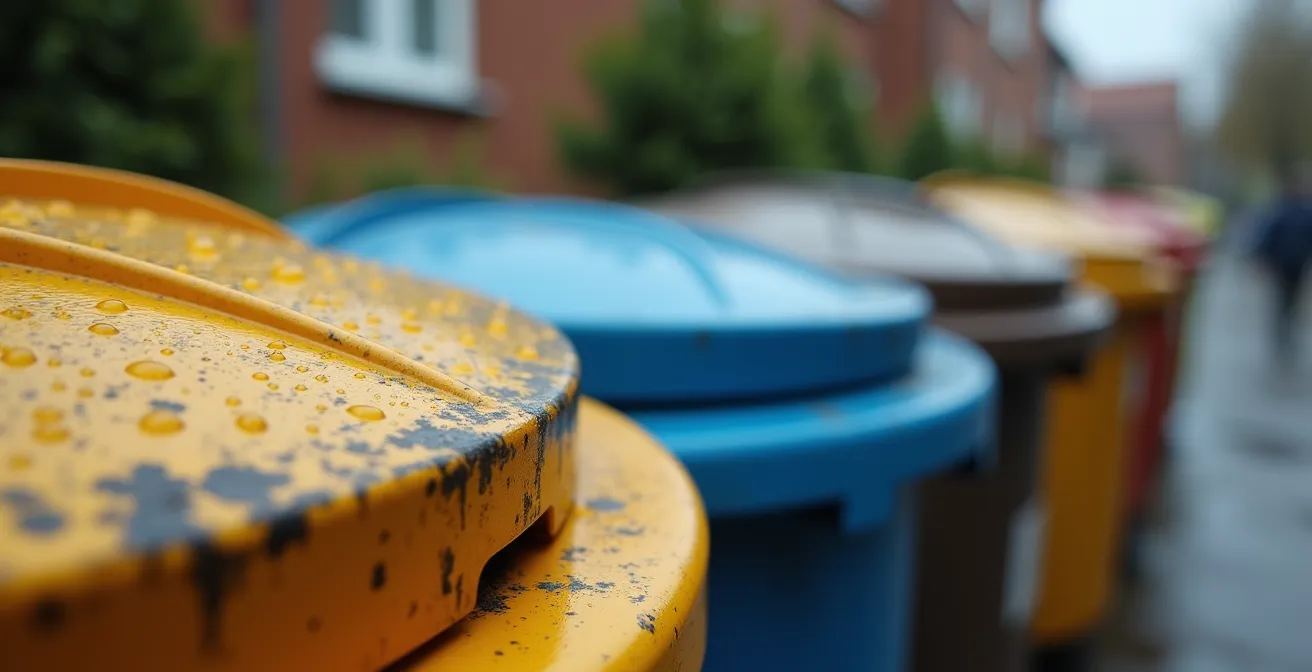
The problem is widespread: According to the Federal Environment Agency, up to 40% of waste in Yellow Bins is incorrectly disposed of, which complicates recycling and increases costs for everyone. If a guest throws pizza boxes into the paper bin despite food scraps sticking to them (they belong in general waste), or if yogurt cups end up unrinsed in the Yellow Bag, an “inclusive” final cleaning can quickly turn into an expensive surcharge. A fee of 20 to 50 euros for post-sorting is not uncommon in Germany.
The following table helps you understand common contract clauses and correctly assess responsibility for waste disposal.
| Contract Clause | Meaning | Waste Disposal | Potential Extra Costs |
|---|---|---|---|
| Broom-clean (Besenrein) | Guest performs basic cleaning | Completely by guest, incl. disposal | €30-80 if neglected |
| Final cleaning included | Professional cleaning by landlord | Only correct separation into bins | €20-50 for incorrect sorting |
| Final cleaning optional | Guest can book cleaning service | Depending on agreement | Variable costs based on effort |
Agency or private: Who helps you faster if the heating fails on a Sunday?
A defect on the weekend can dampen the holiday mood. This is often where the difference between a privately rented apartment and a booking through a large agency becomes apparent. As a private landlord, I am usually more directly and flexibly reachable. A single call is often enough, and I can either come by myself or activate my trusted local craftsman. Agencies often have standardized processes and hotlines, which can lead to longer wait times on a Sunday.
This direct communication is also your biggest advantage when it comes to uncertainties regarding house rules, especially waste separation. Don’t be afraid to ask! A short, friendly question is appreciated by any good host. It shows that you are making an effort to do everything right. As the Handbook for Waste Separation in Germany aptly puts it: “If we all sort correctly, we avoid this effort, lower costs, and do something for the environment.” Your inquiry is a sign of respect and helps keep the system running.
To make communication easier, here are a few useful phrases in German:
- “Guten Tag, wir sind uns bei der Mülltrennung unsicher. Könnten Sie uns kurz erklären, was in die [color] Tonne gehört?” (Hello, we are unsure about waste separation. Could you briefly explain what belongs in the [color] bin?)
- “Entschuldigung, wo finden wir den nächsten Glascontainer?” (Excuse me, where can we find the nearest glass container?)
- “Können Sie uns bitte zeigen, wo die Biotonne steht?” (Could you please show us where the organic waste bin is?)
- “Gibt es eine Anleitung zur Mülltrennung in der Wohnung?” (Is there a guide for waste separation in the apartment?)
The mistake on the balcony after 10 PM that often brings the police in Germany
In Germany, respect for nighttime peace is deeply rooted in the culture. Loud music or parties on the balcony after 10 PM are an absolute no-go and can actually lead to a police visit. What surprises many tourists, however, is that this rule also extends to seemingly harmless everyday noises. A classic mistake is disposing of glass bottles in public containers during quiet hours.
The clinking sound of glass falling into a container is audible from afar at night and is perceived as a significant noise nuisance. That’s why disposal times are strictly regulated. Statutory quiet hours for glass containers are generally from 10 PM to 7 AM, as well as all day on Sundays and public holidays. Disregarding these times is not a trivial offense.
Case Study: Police Intervention due to Nighttime Glass Disposal
In a residential neighborhood in Hamburg, the police were called after holiday guests threw their empty wine bottles into the glass recycling container on the street at 11 PM. Neighbors felt disturbed in their nighttime rest and alerted the authorities. The action ended for the tourists with an official warning and a fine of €50. This incident clearly shows that the quiet hours established in house rules and local ordinances are legally binding.
This aspect of local integration goes beyond the four walls of your holiday apartment. It’s about respecting the unwritten laws of living together in a German neighborhood. Your considerate behavior contributes significantly to peaceful coexistence – and ensures that your landlord receives no complaints from the neighbors.
Which 5 kitchen utensils are almost always missing in German rentals and should be brought along?
As an experienced landlord, I know that despite all efforts, a holiday apartment kitchen is never as perfectly equipped as one’s own. While pots and plates are usually available, specific helpers are often missing. These often include: a truly sharp kitchen knife, a peeler, a good cheese grater, a lever corkscrew, and specific spices you like to use.
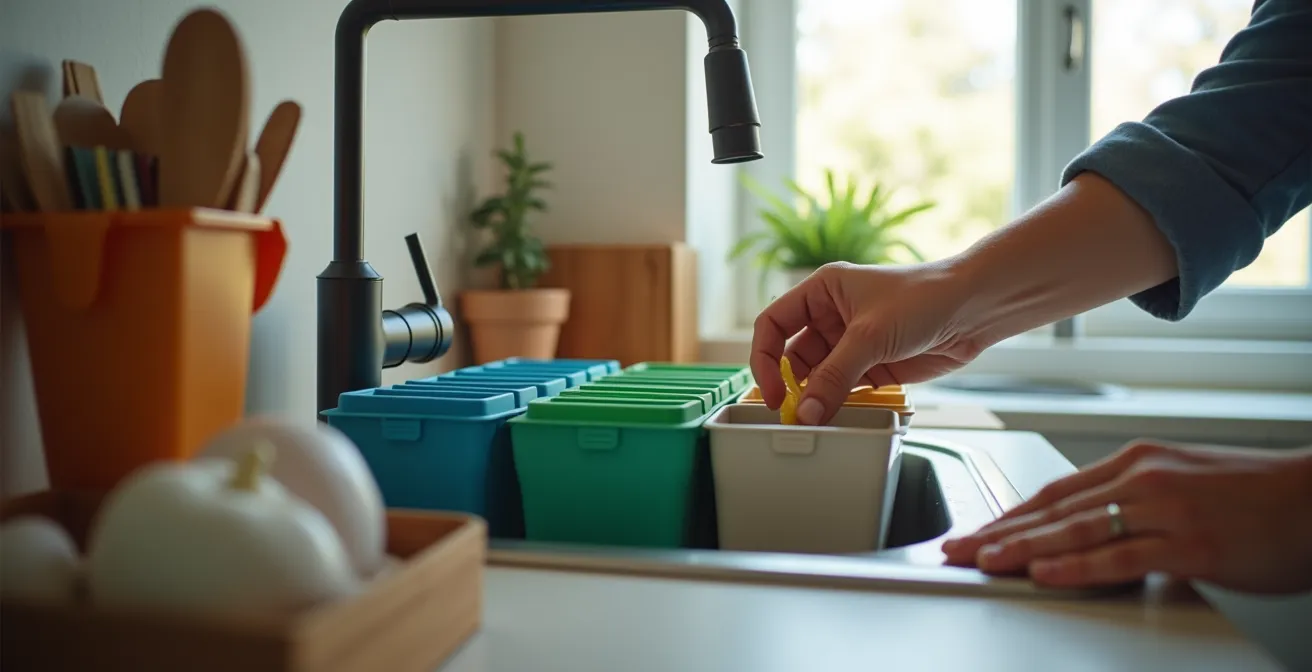
But the most important “utensil” you should bring for a German holiday apartment is a strategy for waste separation right in the kitchen. Often, there is only one large trash can under the sink. To avoid chaos and later sorting work, a simple trick used by experienced guests has proven effective.
We always bring our own small trash bags because holiday apartments often only have one large bin. With colored bags or reusable bags, we can pre-sort right in the kitchen – one for plastic, one for paper, and one for organic waste. This saves time at the end of the day and prevents mistakes when disposing into the large bins.
– The Schmidt Family, Berlin
This small preparation makes a huge difference. It transforms the chore of waste separation into a smooth, almost automatic process. It is a perfect example of the system understanding that makes your stay so much easier.
Holiday home or hotel: What saves family peace during bad weather on the North Sea?
A rainy day on the North Sea: In a hotel room, the walls can quickly close in on a family. In a holiday home, however, there is space and the possibility to shape the day together. Cooking, playing – and yes, even waste separation can become a shared activity. Choosing a holiday home is a choice for more autonomy and a more authentic holiday experience. However, this is also linked to more responsibility, which in a hotel is handled entirely by the staff.
This responsibility, used correctly, can be an opportunity. Instead of seeing waste separation as a chore, it can become part of the adventure, especially for children. They learn about local conditions playfully and take on a small but important task.
Case Study: Waste Separation as a Family Learning Game
A family from Hamburg turned German waste separation into a detective game during their North Sea holiday. The children were given the task of finding out what belongs in which bin. They created a “waste map” of the apartment and earned points for every correct sorting. The result: not only did everyone learn the local rules in an entertaining way, but it also created a shared sense of achievement on an otherwise gloomy rainy day. The activity strengthened family bonds and conveyed valuable knowledge.
The choice between a holiday home and a hotel also depends on what kind of holiday experience you are looking for. The following table compares the most important differences regarding waste disposal.
| Aspect | Holiday Home | Hotel |
|---|---|---|
| Responsibility | Entirely with the guest | Handled by staff |
| Learning Experience | Authentic & educational | No direct experience |
| Risk of Error | High, but with learning effect | Minimal, as it’s invisible |
| Family Activity | Potential for a shared task | None at all |
| Cost of Errors | Possible extra fees from landlord | No direct costs |
What is the ideal daily budget for two people including tourist tax and tips?
When planning a holiday budget, most people think of expenses for food, admissions, and transport. However, the topic of waste also plays a financial role, albeit in an unexpected way. First, you should always plan a small buffer of about €10 for the entire duration of the trip for unforeseen costs, such as a possible extra charge for incorrect waste separation. Much more interesting, however, is how you can actively save money by understanding the German waste system.
The key to this is called “Pfand” (deposit). In Germany, a deposit of 25 cents is charged on most single-use plastic bottles and cans. Instead of disposing of these in the Yellow Bag, you can return them to reverse vending machines in almost any supermarket. For a family, this can quickly add up to €2-5 per day – money for an extra ice cream or coffee. This is not only good for your wallet but also an essential part of the German recycling system. In Germany, an average of almost 600 kilograms of household waste is generated per person per year; the deposit system is an important pillar in managing this amount.
Here are some concrete tips on how you can save your budget through clever waste avoidance:
- Consistently collect and return deposit bottles: Plan a trip to the supermarket for this at the end of the holiday.
- Shop at the weekly market: Here you can often buy fruit and vegetables unpackaged, saving on packaging waste.
- Use reusable containers for take-away: Many restaurants give a discount if you bring your own container.
- Drink tap water: The quality in Germany is excellent, and you save the cost of buying bottled water.
- Appreciate the tourist tax (Kurtaxe): A part of this local fee often goes into the maintenance of public infrastructure, which includes waste disposal.
The Essentials in Brief
- Documentation is Protection: Photograph pre-existing damage and the waste system upon arrival to avoid conflicts upon departure.
- Rules are Regional: What goes into the recyclables bin in Berlin might belong in general waste in Cologne. When in doubt, always ask the landlord.
- Respect the Community: Compliance with quiet hours (especially regarding glass disposal after 10 PM) is a sign of respect toward neighbors.
Why does Sauerbraten taste so different in the Rhineland compared to Franconia or Saxony?
This question may seem unrelated to your holiday rental stay at first glance, but the answer holds the deepest secret to understanding Germany – and its waste separation. A Rhenish Sauerbraten is often sweetened with raisins, a Franconian one is refined with gingerbread, and a Saxon one comes without any sweetness at all. It is the same dish, but every region has its own tradition grown over generations. Exactly the same principle applies to waste separation.
Just as every region has its own Sauerbraten recipe, every district has its own ‘recipe’ for waste separation.
– Federal Environment Agency, Regional Differences in Waste Management
There is no uniform “German” waste separation system. Municipalities decide on the details themselves. The greatest confusion is often caused by the “Yellow Bin” (Gelbe Tonne) or the “Yellow Bag” (Gelber Sack). While in some regions (like Cologne) only packaging made of plastic, metal, and composite materials belongs here (the “Dual System”), in others (like Berlin or Hamburg) there is the so-called “Recyclables Bin” (Wertstofftonne). There, other items made of plastic or metal may also be disposed of, such as an old frying pan or a broken plastic toy.
Knowing these regional differences is the final step from a simple tourist to a true connoisseur. It explains why a guide from the internet might not apply exactly to your holiday apartment.
| Region | Peculiarity | System |
|---|---|---|
| Berlin | Recyclables Bin (Wertstofftonne) | Also non-packaging plastic/metal (e.g., old pots) |
| Cologne | Yellow Bag (Gelber Sack) | Only packaging with the Green Dot (Grüner Punkt) |
| Munich | Recycling Islands (Wertstoffinseln) | Central collection points for various recyclables |
| Hamburg | Hamburg Recyclables Bin | Extended collection similar to Berlin |
If you internalize these principles – foresight upon arrival, understanding of costs, respect for the community, and curiosity for regional differences – then your stay in a German holiday apartment will be an enriching and absolutely stress-free experience. You will not only come as a guest but live a bit like a local.