Summary:
- Choose well-marbled meat (shoulder, mock tender), as fat and collagen are the guarantors of juiciness.
- Give the roast time: Long, slow braising at a low temperature (around 80 °C) transforms tough connective tissue into tender gelatin.
- A rich sauce is not made from powder, but from roasted vegetables, roasting aromas from searing, and patience during reduction.
- Resting after cooking is not an optional luxury, but a must, so that the meat juices can redistribute throughout the roast.
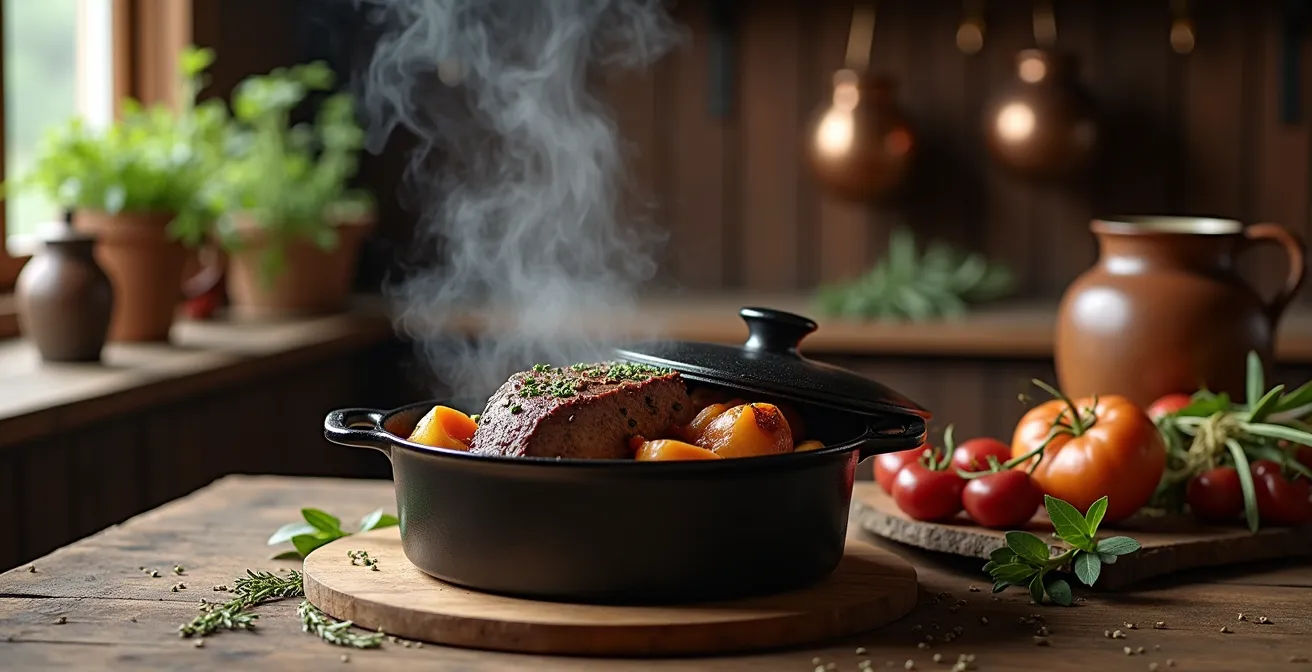
Do you know that smell? The scent of a Sunday roast wafting through the house, awakening childhood memories of cozy family dinners and the warmth of Grandma’s kitchen. Roast beef is more than just a dish; it is a piece of German “Gemütlichkeit,” a culinary symbol of community and tradition. But with the anticipation often comes a slight worry: What if the roast turns out dry again? As tough as a shoe sole, despite all the effort and expensive ingredients?
Countless tips can be found on the internet and in cookbooks: sear it hot, cook at a low temperature, baste it repeatedly. These are all good pieces of advice, but they often only scratch the surface. They tell you *what* to do, but rarely *why*. And that is exactly where the secret of a truly unforgettable, juicy roast beef lies. It’s not about stubbornly following a recipe, but about understanding the soul of the meat and treating it with patience and knowledge.
But what if we told you that the real secret doesn’t lie in a single trick, but in the interplay of the right meat selection, the magic of the sauce base, and above all: the art of waiting? In this article, we won’t just repeat recipes. We will reveal the kitchen secrets that turn a good roast into a perfect one. We dive into the science of braising, the traditions behind regional differences, and the small but decisive steps that make all the difference.
This guide will take you by the hand and lead you step-by-step through the entire process. We clarify the most important questions so that your next roast beef is guaranteed to be the most tender and juicy your family has ever tasted. Discover with us the joy of authentic, unadulterated German home cooking.
Summary: The Path to the Perfect Sunday Roast
- Shoulder or Leg: Which cut of beef forgives beginner mistakes during braising?
- How do you make a dark, rich sauce without powders and artificial additives?
- Grandma’s Roaster or Modern Sous-Vide: Which method brings more flavor?
- The mistake of cutting the roast immediately, which can cost you all the juice
- What to do with leftover roast: 3 creative ideas beyond reheating
- Why must the meat sit in a marinade for at least 3 days to become tender?
- Why are you allowed to bring your own food to a Munich beer garden, but not drinks?
- Why does Sauerbraten in the Rhineland taste so different from Franconia or Saxony?
Shoulder or Leg: Which cut of beef forgives beginner mistakes during braising?
The most important decision for a juicy roast is made at the butcher counter. Many reach for the leg (topside, silverside) out of old habit because it looks so lean. But that is exactly the first misconception! Lean meat is the enemy of the pot roast because it lacks what is crucial for juiciness: fat and collagen. Fat is a flavor carrier and protects the meat from drying out. Collagen, the tough connective tissue that runs through muscles, is our best friend during slow cooking.
Cuts from the shoulder, the chuck, or the so-called “mock tender” are therefore the better choice for beginners and gourmets alike. They are marbled with fine veins of fat and collagen. During the long, gentle braising process, the magic happens: the collagen transforms into buttery-soft gelatin, making the meat incredibly tender and juicy. A cut from the leg does not have this potential and will inevitably become dry and fibrous with long cooking times. Talk to your trusted butcher and ask for a well-marbled piece for braising. They will know what you need.
To make the most of this principle, you should keep an eye on the temperature. The conversion of collagen into gelatin is a slow process that takes place at the right temperature:
- Step 1: Let the meat braise at 70-80°C – at this temperature, collagen converts optimally into gelatin.
- Step 2: Plan for a cooking time of at least 3-4 hours at a constant temperature. Patience is the most important ingredient here.
- Step 3: Never heat the roast above 95°C. At too high a heat, the muscle fibers contract strongly, squeezing out the juice and making the meat tough.
- Step 4: As a modern alternative, sous-vide cooking at 65°C for several hours offers perfect, repeatable results.
How do you make a dark, rich sauce without powders and artificial additives?
A deep dark, velvety sauce is the soul of every roast beef. Many reach for ready-made sauce powders or bouillon cubes out of uncertainty, but the true magic of sauce lies in the roasting aromas and requires only a few, honest ingredients. The secret begins with searing. When you sear the meat sharply on all sides in hot fat, the so-called Maillard reaction occurs. Sugars and amino acids in the meat react and create hundreds of new flavor compounds – what we love as typical roast flavor. These roasting aromas at the bottom of the roaster are pure gold.
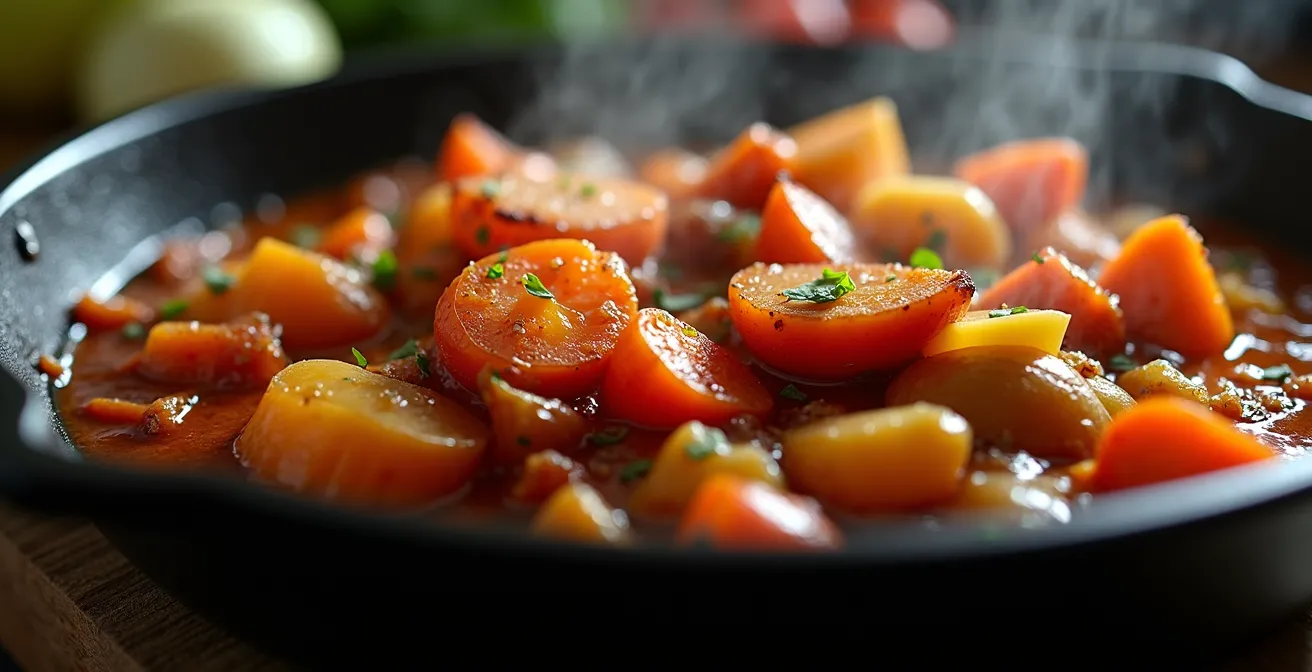
After the meat has been removed from the pot, the second step follows: roasting the vegetables. Onions, carrots, and celery are vigorously roasted in the drippings until they take on color. Then a spoonful of tomato paste is added and also briefly roasted. This removes its acidity and provides a deeper color and a slightly sweet note. Only then is it deglazed with a strong red wine. In the process, you scrape all the delicious roasting aromas from the bottom of the roaster with a wooden spoon – this is called deglazing. The liquid is cooked down almost completely before the rest of the wine and broth are added. This creates an incredibly intense base.
Case Study: Traditional Sauce Making
The chopped vegetables are roasted with tomato paste and sugar in the roaster, then deglazed with red wine and heavily reduced. Filled with beef stock and refined with bay leaves, a highly aromatic gravy is created during braising. After braising, the liquid is poured through a sieve, the vegetables are squeezed out well, and the sauce is thickened if necessary with a little cornstarch mixed in cold water. In this way, you easily get about 800 ml of a perfect, natural gravy.
Grandma’s Roaster or Modern Sous-Vide: Which method brings more flavor?
The question of the best cooking method divides culinary spirits. On one side is the heavy, cast-iron Dutch oven – Grandma’s roaster – which has provided comfort and the incomparable scent of roasting throughout the house for generations. On the other side is the modern technique of sous-vide cooking, which ensures perfectly tender meat with scientific precision. But which method is truly better?
The cast-iron roaster is a master of heat storage and distribution. It allows for sharp searing and subsequent slow braising in the same pot. The biggest advantage lies in the automatic sauce formation. All the flavors – from the meat, the roasted vegetables, the wine – unite during the cooking process in the pot to form a complex, harmonious sauce. The scent that fills the house is an essential part of the “Sunday roast” experience and awakens anticipation in everyone at the table. As chef and food photographer Thomas Sixt aptly notes, this is part of the cultural experience:
Comparison of the two methods under the aspect of ‘comfort.’ The cast-iron roaster creates roasting aromas and a scent in the house that is part of the cultural experience.
– Thomas Sixt, Chef and Food Photographer
Sous-vide, on the other hand, is the method of total control. The meat is vacuum-sealed and cooked over many hours at an exactly constant, low temperature (e.g., 65°C) in a water bath. The result is unsurpassed tenderness and juiciness, as no juice can escape and the collagen is perfectly converted. The disadvantage: roasting aromas and a classic braised sauce are not created in this process. The meat must be removed from the bag after cooking and briefly seared in a hot pan to create a crust. The sauce must be prepared completely separately. The typical roasting scent in the house is also missing.
Ultimately, the choice is a matter of priority: Is it about maximum tenderness with technical perfection or about the traditional, cozy overall experience with a profound sauce that almost makes itself?
The following table summarizes the key differences based on a comparative analysis of braising methods.
| Criterion | Cast-Iron Roaster | Sous-Vide |
|---|---|---|
| Temperature Control | 70-80°C monitored manually | Exactly 65°C constant |
| Cooking Time | 2.5-3 hours at 160°C oven | 24-48 hours at 65°C |
| Roasting Aromas | Intense through searing | Must be generated afterwards |
| Effort | Regular monitoring needed | Set once and wait |
| Sauce Formation | Occurs automatically during braising | Must be prepared separately |
| Atmosphere | Roast scent throughout the house | Odorless |
The mistake of cutting the roast immediately, which can cost you all the juice
The roast is ready, smells wonderful, and everyone at the table is hungry. The biggest mistake you can make now is to take the knife and cut into it immediately. This impatience will literally cost you all the juice. During cooking, the muscle fibers in the meat contract and press the juice into the center of the roast. If you cut it directly, this collected juice runs out unhindered onto the cutting board – and your roast becomes dry.
The solution is a small game of patience: letting it rest. Remove the roast from the oven and wrap it loosely in aluminum foil. Let it rest in a warm place (e.g., on top of the switched-off, slightly opened oven) for about 10-15 minutes. During this time, something crucial happens: the muscle fibers relax again, and the meat juice that has collected in the center can redistribute evenly throughout the entire roast. Every bite becomes juicy and tender. During this phase, a process known as “carry-over cooking” also takes place. Studies show that resting after roasting can increase the internal temperature by 5-8 degrees Celsius. You should factor this in when determining the perfect cooking point.
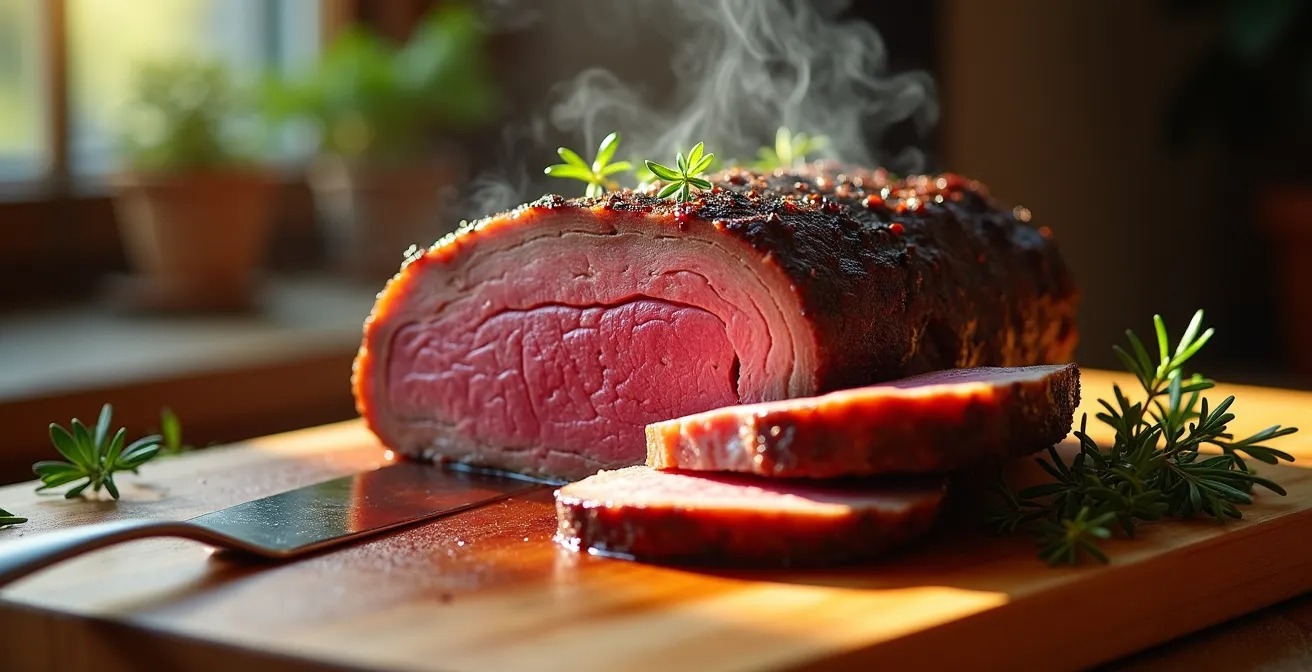
The resting time is also the perfect opportunity to finalize the sauce: pass it through a sieve, taste it one last time, and thicken it slightly if needed. When the roast has rested, cut it with a sharp knife always across the grain. This shortens the long muscle fibers, making the meat even more tender to the bite.
Your Checklist for the Juiciest Roast
- Plan a resting break: Remove the roast from the oven after cooking.
- Keep it warm: Wrap the roast loosely in foil to retain heat without softening the crust.
- Have patience: Maintain a resting time of 10-15 minutes so the juices can redistribute.
- Use the time: Finish and taste the sauce during the resting period.
- Cut correctly: Always cut the roast across the grain into slices to ensure maximum tenderness.
What to do with leftover roast: 3 creative ideas beyond reheating
A generously sized Sunday roast has a wonderful side effect: there is usually something left over. But what to do with the leftovers? Simply reheating in the microwave is often a disappointment, as the meat quickly becomes tough and dry. Yet leftovers are a delicacy if treated correctly. Stored properly – sliced with some sauce in an airtight container – the roast keeps for up to 4 days in the refrigerator. For gentle reheating, the slices can be wrapped in aluminum foil with a spoonful of gravy and heated for about 10 minutes at 180°C in the oven.
But the true art lies in creative repurposing. Here are three ideas that go far beyond simple reheating:
- 1. Classic Roast Salad: Cut the cold roast into fine strips or cubes. Mix it with diced pickles, red onion rings, and a vinaigrette made of mustard, vinegar, oil, salt, pepper, and a spoonful of the remaining gravy. Sprinkled with fresh parsley and served with fried potatoes or simply a slice of hearty bread, this is a quick and delicious dinner.
- 2. Noble Beef Sandwich: Slice the cold roast into paper-thin slices. Spread two slices of good farmhouse bread or ciabatta with remoulade or horseradish cream cheese. Top the bread with the roast slices, arugula, a few onion rings, and perhaps a slice of tomato. This is the German answer to the American roast beef sandwich and a true delight.
- 3. Hearty Roast “Gröstl” (Hash): Cut the roast and boiled potatoes from the previous day into cubes. Sauté diced onions in a pan until translucent, add the potatoes, and fry until golden brown. Finally, add the roast cubes and heat only briefly. Season with salt, pepper, and marjoram and serve with a fried egg – a perfect leftover meal that satisfies and delights.
A roast beef is more than just a meal; it is a dish that connects people and can bring joy over several days. As one lover of German cuisine puts it:
A roast beef is a real family dish. It combines simple effort with great taste and brings everyone to one table.
– Elle Republic
Why must the meat sit in a marinade for at least 3 days to become tender?
When we talk about classic roast beef, a special variant must not be missed: the Sauerbraten. It owes its characteristic, tangy-savory taste and incredible tenderness to an old technique: marinating (beizen). But why this effort of several days? The answer lies in chemistry. Traditionally, tougher cuts of meat were used for Sauerbraten. The marinade, a mixture of vinegar, wine, water, and spices, had the task of making this meat tender.
The acid from vinegar or wine acts directly on the tough collagen in the meat’s connective tissue. It begins to slowly dissolve the firm collagen bonds and convert them into softer gelatin – a process called denaturation. A study on the role of collagen in meat products confirms that acidic marinades dissolve collagen bonds and make the meat more tender. This process takes time. After one day, the effect is only superficial. Only after three to five days has the acid completely penetrated the meat and done its tenderizing work. At the same time, the aromas of spices such as bay leaves, juniper, and cloves penetrate deep into the meat, giving it its unmistakable flavor.
Today, we often use more tender cuts of meat, so marinating would no longer be strictly necessary for tenderness. However, for the authentic Sauerbraten taste, it is indispensable. Marinating is therefore not just a method for tenderizing, but above all a deep aromatization.
Case Study: Traditional Marinating Method
Renowned chef Thomas Sixt practices the classic method and consistently marinates his meat for a Sauerbraten-style roast beef for 3-4 days. His mixture consists of root vegetables, red wine, and a dash of balsamic vinegar. He particularly recommends Spanish Rioja wines, which develop special aromas through barrel aging that later benefit the sauce and ensure a harmonious richness of flavor.
Why are you allowed to bring your own food to a Munich beer garden, but not drinks?
The Sunday roast represents coziness at home, but German culinary culture has another famous facet of conviviality: the beer garden. Especially in Bavaria, the beer garden is the second living room in summer. And anyone visiting a traditional Munich beer garden for the first time will notice a curious rule: many people unpack their own tablecloths, plates, and plenty of food, but no one brings their own drinks. What is behind this peculiar tradition?
The roots of this custom go far back. In the 19th century, beer in Munich was still brewed by small breweries that filled their cellars with ice from nearby rivers for cooling. To provide additional shade for the cellars, they planted chestnut trees above them. Soon, the brewers came up with the idea of serving their beer directly from the cool cellars on the spot. This displeased the local innkeepers, who saw their clientele dwindling. To settle the dispute, King Maximilian I of Bavaria made a wise decision. A royal decree of 1812 established that brewers could serve beer but were not allowed to sell food. In return, guests were officially permitted to bring their own snacks (“Brotzeit”). As the official tourism site of the city of Munich emphasizes:
King Maximilian I of Bavaria issued a decree in 1812: brewers could serve beer but not sell food. To this day, everyone is allowed to bring their own snack.
– München Travel, Official Munich Tourism Website
This regulation still exists today and is deeply rooted in Bavarian culture. It makes the beer garden a uniquely democratic and social place. The obligation to buy drinks on-site ensures the economic survival of the host, while the freedom to bring your own food allows everyone to participate in social life, regardless of their budget.
Case Study: The Beer Garden Revolution of 1995
How sacred the beer garden tradition is to Munich residents was shown in 1995. When a new regulation sought to move the closing time to 9:30 PM to protect residents from noise, the so-called “Beer Garden Revolution” occurred. On May 12, 25,000 people took to the streets to demonstrate for their cozy evenings. With success: The Bavarian Beer Garden Ordinance of 1999 established that beer gardens could remain open until 11 PM and confirmed the special protection of this Bavarian institution.
The Essentials at a Glance
- The foundation for a juicy roast is well-marbled meat with fat and collagen (e.g., from the shoulder). Avoid pieces that are too lean.
- True tenderness comes through time and low temperatures. Braise the roast slowly at approx. 80 °C so that collagen can transform into gelatin.
- Resting the roast after cooking is essential. Wrap it in foil for at least 10 minutes so that the meat juices can redistribute evenly.
Why does Sauerbraten in the Rhineland taste so different from Franconia or Saxony?
The term “roast beef” is not monolithic in Germany. Rather, it is the umbrella term for an entire “roast family,” whose most famous member is the Sauerbraten. Yet even here, the fascinating regional diversity of German cuisine is evident. A Sauerbraten in the Rhineland is a completely different world in terms of taste compared to one in Franconia or Saxony. The reason for this lies in regional preferences for the balance between sweet and sour and the typically used ingredients for the sauce.
The Rhenish Sauerbraten is famous for its pronounced sweet-and-sour note. The sauce here is traditionally thickened and sweetened with raisins and often also with crumbled Printen (spiced cookies) or Aachen gingerbread. Sometimes a dash of beet syrup is also added. The result is a dark, almost black, velvety sauce with a complex, bittersweet aroma that harmonizes perfectly with the acidity of the marinade.
In Franconia, a wine-growing region, people prefer a more purist approach. The marinade is often set with local wine, and heavy sweetening is avoided. The Franconian Sauerbraten is therefore much more acid-forward and less sweet. The focus is on the pure taste of the meat, refined by the spicy marinade. In Saxony, on the other hand, people also like to use gingerbread (often Pulsnitzer Pfefferkuchen) to bind and season the sauce, giving it a special spicy depth. In Bavaria, there is its own variant often referred to as ‘Böfflamott.’ As EDEKA explains in its recipe world:
In France, braised beef is called ‘boeuf à la mode,’ which the inventive Bavarians quickly turned into ‘Böfflamott.’ In Tuscany, it is called ‘Brasato’.
– EDEKA Recipe World, Classic Braised Beef
These regional differences are a wonderful testament to Germany’s rich culinary history. The following table provides a quick overview of the characteristic features.
| Region | Sweetener | Marinade Base | Special Features |
|---|---|---|---|
| Rhineland | Raisins, Printen, Beet Syrup | Vinegar-based | Sweet-sour balance |
| Franconia | Purist-sour | Wine from wine regions | Less sweet |
| Saxony | Gingerbread | Regionally varying | Spicy note |
| Bavaria | ‘Böfflamott’ | Red Wine | French influence |
Now you have all the secrets at your fingertips to conjure up a roast beef that not only satisfies hunger but makes you truly happy. Dare to experiment with regional variations and bring the priceless feeling of Grandma’s Sunday dinner back to your table. Start today and establish your own roasting tradition!