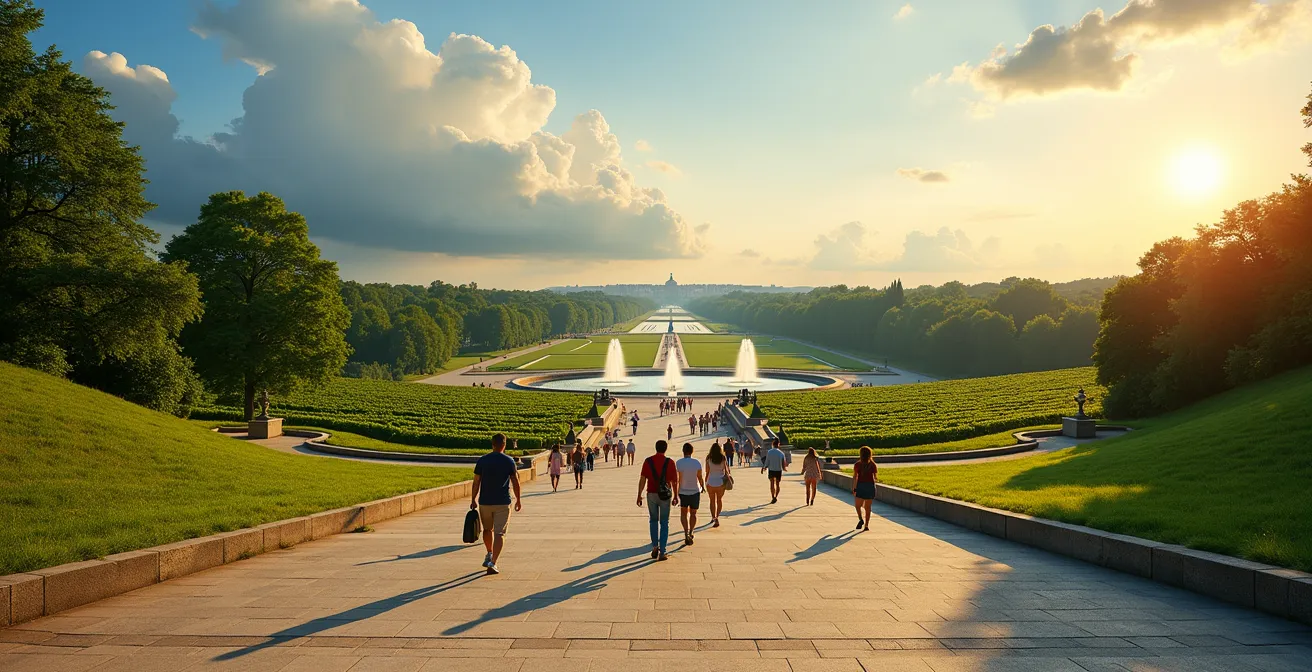
The sheer size of Sanssouci Park often leads to exhaustion for many visitors as they try to see everything at once. The key is not to walk less, but to understand the inner logic of the park: it consists of two fundamentally different types of gardens. By strategically planning your visit as a journey through these two worlds—from strict Baroque to the free-form landscape garden—you transform a potentially tiring march into a fascinating and enjoyable tour of discovery.
A stroll through Sanssouci Park in Potsdam is like stepping into a living history book. Across nearly 300 hectares, a landscape unfolds that is so much more than just a backdrop for magnificent palaces. Many visitors, armed with a list of sights, start at the Green Gate (Grünes Gitter) and march along the main avenue, only to find after a few hours that the distances are vast and their own energy is finite. The disappointment of not having “finished” everything often clouds the experience. Incidentally, the park itself is free to enter; tickets are only required for the interiors of the palaces.
The usual advice is: “Wear comfortable shoes” or “Take your time.” But that only scratches the surface. The real secret to truly enjoying Sanssouci lies in perspective. You have to stop seeing the park as a collection of photo opportunities and start reading it like a landscape architect: as a composed production with a clear dramaturgy. But what if the key to enjoyment lies not in following a straight line, but in understanding and utilizing the deliberate breaks and transitions in the park’s design?
This article guides you through the eyes of a planner. We decode the two souls of the park, provide strategic decision-making aids, and show how understanding the landscape composition allows you to design your own personal “enjoyment route.” In this way, a potential marathon becomes an unforgettable dialogue with garden art and the philosophy of Frederick the Great.
To help you with your planning, we have compiled the most important strategic considerations for your visit. The following overview guides you through the central questions that turn a simple walk into a profound, unforgettable experience.
Table of Contents: Strategically Exploring and Enjoying Sanssouci
- Why did Frederick the Great want to be buried here, and why are there potatoes on his grave?
- New Palace or Sanssouci Palace: Which interior is more impressive if you can only see one?
- Where does the French Baroque garden end and the English landscape park begin?
- The mistake of entering the park in summer without water, where kiosks are scarce
- Are you allowed to cycle in Sanssouci Park, or do you risk a fine?
- What is the ideal time to visit Museum Island to avoid school groups?
- Linderhof or Hohenschwangau: Which castle offers a more intimate experience without a 2-hour wait?
- How do you take the perfect photo of the Brandenburg Gate without hundreds of tourists in the shot?
Why did Frederick the Great want to be buried here, and why are there potatoes on his grave?
The most emotional and perhaps most important place in the entire park is the simple grave slab of Frederick the Great on the uppermost vineyard terrace, right next to his beloved Sanssouci Palace. To understand why this location is so central, one must know the King’s will. He decreed that he wanted to be buried “as a philosopher,” modestly and alongside his dogs. This wish was a break with tradition, a statement against monarchical pomp and in favor of a life dedicated to the Enlightenment and personal inclinations. However, his successor ignored this, and it was not until 205 years after his death, following German reunification, that his coffin was transferred to Potsdam. This late burial was an act of historical justice that has been commemorated since August 17, 1991.
The potatoes that visitors place on his grave today are a posthumous gesture of thanks and humor. Frederick II enforced the cultivation of the then-unpopular tuber in Prussia through cunning and “Potato Decrees” to combat famine. The potatoes are thus a symbol of his pragmatic, populist reform spirit, which was hidden behind the facade of the art-loving philosopher. In his testamentary disposition of 1769, he formulated his wish unmistakably:
I have lived as a philosopher and wish to be buried as such, without pomp, without luxury, and without the slightest ceremony
– Frederick the Great, Testamentary Disposition of 1769
This spot is the philosophical ground zero of the park. Starting here means understanding the entire complex not as a demonstration of power, but as an expression of a personal life design—a crucial perspective for further exploration.
New Palace or Sanssouci Palace: Which interior is more impressive if you can only see one?
Given the size of the park and limited time, this is the first and most important strategic decision you must make. Both palaces are masterpieces, but they couldn’t be more different. They represent the two sides of Frederick the Great: the private philosopher and the powerful monarch. Sanssouci Palace, his “little vineyard palace,” is an intimate Rococo jewel. With only twelve rooms, it served as his personal retreat for making music, philosophizing, and working. Here, you feel the private atmosphere and the spirit of the King most directly. A visit is like stepping into his living room.
The New Palace (Neues Palais) at the opposite end of the main avenue is the exact opposite. Built after the Seven Years’ War, it was a pure demonstration of power—a “fanfaronnade” (boasting), as Frederick himself called it. With over 200 magnificent rooms, the breathtaking Grotto Hall, and the massive Marble Hall, it served exclusively for representation and housing guests. The splendor is overwhelming, the dimensions gigantic. Here, you experience the official, political side of Prussia.
The choice depends on your personal preference. Are you looking for intimacy and the authentic spirit of the King, or do you want to be overwhelmed by Baroque grandeur? Note that for the small Sanssouci Palace, booking a time slot online in advance is essential due to the limited capacity of only 2,000 visitors daily. The following comparison helps with the decision:
| Criterion | Sanssouci Palace | New Palace |
|---|---|---|
| Construction Period | 1745-1747 | 1763-1769 |
| Style | Intimate Rococo | Grand Baroque |
| Rooms | 12 Rooms | Over 200 Rooms |
| Atmosphere | Personal retreat | Demonstration of power |
| Highlights | Concert Room, Library | Grotto Hall, Marble Hall |
| Visit Duration | 45-60 Minutes | 90-120 Minutes |
Where does the French Baroque garden end and the English landscape park begin?
The feeling of exhaustion in Sanssouci often arises from misjudging its two faces. The park is not a homogeneous site, but a masterful composition of two fundamentally different garden philosophies. The older, western part around Sanssouci Palace is a classic French Baroque garden. Its hallmark is strict geometry: a 2.5-kilometer-long, straight main axis, symmetrical paths, precisely trimmed hedges, and a clear, rational order. Here, nature is subjected to human will—a symbol of the Enlightenment.
The decisive transition, the “interface” between the eras, is located approximately at the level of the Chinese House (built 1755-1757). To the east of it begins the world of the English landscape park, largely designed by Peter Joseph Lenné starting in the 1820s. Here, everything changes: straight lines give way to winding paths that gently snake through the landscape. Instead of geometric patterns, there are deliberately arranged groups of trees meant to look “natural,” and recurring surprising vistas that direct the eye to idyllic scenes. This romantic staging is intended to evoke emotions and encourage the stroller to dream.
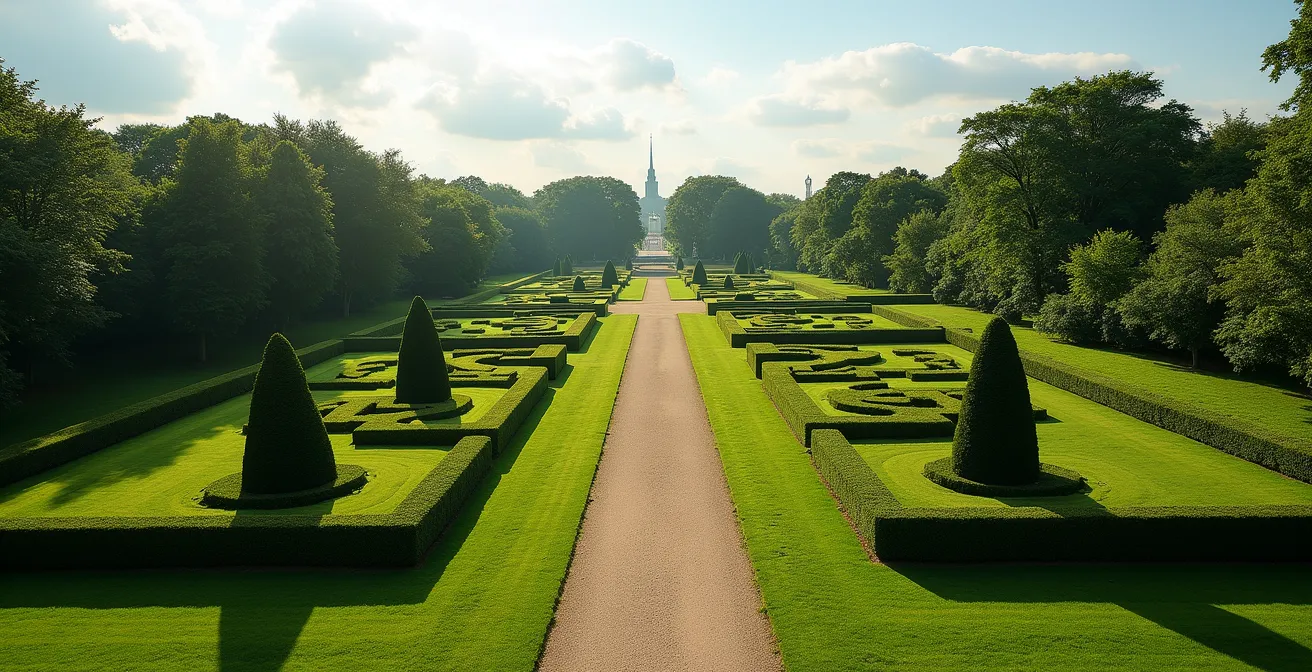
As the image illustrates, the contrast is fundamental. Anyone trying to cross the English section using the logic of a Baroque garden will inevitably get lost in the gentle curves. The strategic route consists of consciously perceiving this transition and adapting your own rhythm to the respective garden philosophy. The main axis serves for orientation and quick traversal, while the winding paths of the landscape park invite you to linger and discover.
The mistake of entering the park in summer without water, where kiosks are scarce
A brilliant landscape architect thinks of vistas and composition, but not necessarily of 21st-century tourist infrastructure. One of the most common practical mistakes visitors make in Sanssouci is underestimating the distances combined with a lack of refreshment options. Especially on a hot summer day, a walk from the New Palace to the Church of Peace can quickly become an ordeal if you don’t have a water bottle. Kiosks and cafes are rare and strategically distributed—you need to know where they are.
Instead of wandering aimlessly, you should conceive your route as a sequence of stages with planned rest points. Plan not just from sight to sight, but also from shade spot to cafe. The old, tall trees along the avenues provide valuable shade, and the cool interiors of smaller park buildings like the Picture Gallery or Schloss Charlottenhof can be integrated into your path as welcome “climate oases.” A prepared picnic is often the best solution for remaining independent and flexible.

Good preparation turns potential heat stress into pure enjoyment. Use existing resources wisely:
- Plan cafe stops: Restaurant at the Dragon House (center of the park), Mövenpick Restaurant at the Historic Mill (near Sanssouci Palace), and Cafe “Dr. med. P. V. Fredersdorf” (near the Green Gate).
- Use shade routes: Linden Avenue and Mulberry Avenue offer thick leaf canopies for cooler passages.
- Include cool interiors: The Picture Gallery is often pleasantly cool, as are the Roman Baths.
- Note drinking fountains: There are public drinking fountains at the visitor center near the Historic Mill and at the New Palace.
- Start early: The park opens as early as 8 AM. Before 10 AM, it is usually still pleasantly cool and significantly less crowded.
Checklist for Your Strategic Park Exploration
- Rest points: Mark cafes and drinking fountains on your park map as fixed targets.
- Bring inventory: Pack at least one large bottle of water, snacks, and possibly a small picnic.
- Adjust route: Plan your route along shaded avenues and integrate a visit to a cool palace interior at midday.
- Break quality: Deliberately choose a beautiful spot for a break (e.g., a bench with a view) instead of just continuing when you are exhausted.
- Develop Plan B: Identify an “exit point,” such as a bus stop at the edge of the park, in case your energy fades.
Are you allowed to cycle in Sanssouci Park, or do you risk a fine?
The question of cycling is a classic dilemma in Sanssouci. Given the enormous distances, a bicycle seems like the ideal mode of transport. But beware: the park is a heritage-protected work of art, and the historic paths are not designed for the stress of bicycle tires. Cycling is therefore fundamentally prohibited throughout the park. Those who ignore this and ride on the main paths risk not only damaging the ground but also a heavy fine. According to reports, a fine of 35 euros can be charged.
However, there is an important and very useful exception: the so-called Economy Path (Ökonomieweg). This specially paved route was deliberately created as a compromise. Since 2010, it has run along the edge of the park, allowing a 2.2-kilometer traversal by bicycle. The path connects the Green Gate (the main entrance from the city) with the area around the Chinese House and continues to the New Palace. It is ideal for getting quickly from one end of the park to the other without crossing the historic gardens.
The rule is clear and easy to remember: you may ride on the asphalt of the Economy Path; on all other sandy or paved paths in the historic park, you must push your bicycle. Respecting this is a sign of respect for the heritage and the work of the gardeners who maintain this site daily. The bicycle can thus be a strategic aid for traveling to and from certain parts of the park, but not for exploring the garden itself.
What is the ideal time to visit Museum Island to avoid school groups?
Museum Island in Berlin is another magnet that is often overcrowded, especially by school groups. To enjoy the art in peace, timing is crucial. The general consensus and experience show that the greatest rush occurs in the morning between 10 AM and 2 PM. To avoid these peak times, there are several proven strategies. The late afternoon from 3:00 PM is often the best choice, as most school groups have already finished their visit by then.
Another excellent option is Thursday evening. On this day, the Neues Museum and the Pergamon Museum (if open) have extended opening hours until 8:00 PM. The evening hours are generally much quieter and offer an almost contemplative atmosphere. If you want to visit several museums, it can also be wise to start anti-cyclically: begin your day at the less frequented Bode Museum and save the main attractions for late afternoon. Online booking of a fixed time slot is almost always the best guarantee for quick and stress-free entry anyway.
- Book late afternoon: From 3:00 PM onwards, most school groups have already left.
- Use Thursday evenings: Neues Museum and Pergamon Museum are open until 8:00 PM.
- Start with the Bode Museum: It is often less crowded than the Pergamon or Neues Museum.
- Choose Friday afternoon: Towards the end of the school week, there are typically fewer class trips.
- Prefer winter months: From December to February, the volume of school groups is significantly lower.
Linderhof or Hohenschwangau: Which castle offers a more intimate experience without a 2-hour wait?
When planning a trip to the Bavarian royal castles, many face the choice between the overcrowded Neuschwanstein and its neighbors. For a more intimate experience, Linderhof and Hohenschwangau often come into focus. Both offer a deeper look into the lives of the Wittelsbachs, but with different characters and waiting times. Linderhof Palace is the embodiment of King Ludwig II’s dream world. It was his favorite and only completed residence, a magnificent “Royal Villa” full of gold and mirrors that pays homage to his veneration of French absolutism. The intimacy here is that of royal solitude. The surrounding park with the famous Venus Grotto and the Moorish Kiosk is an attraction in itself. Waiting times for the palace are moderate, especially during the week.
Hohenschwangau Castle, on the other hand, offers a different kind of intimacy: that of familial childhood memories. Ludwig spent his youth here. The castle is designed in the Neo-Gothic style and feels more lived-in, almost bourgeois. It tells the story of an entire royal family. Since it is located right next to the tourist magnet Neuschwanstein, waiting times here are potentially longer, but can be almost completely eliminated by pre-booking online. For a truly quiet experience, a visit to the nearby Museum of the Bavarian Kings is recommended.
In summary: Linderhof offers the more intimate experience for those who want to immerse themselves in Ludwig II’s solitary fantasy world, while Hohenschwangau provides an intimate insight into the family life of the Bavarian kings.
| Aspect | Linderhof | Hohenschwangau |
|---|---|---|
| Type of Intimacy | Royal solitude & dream world | Familial childhood memories |
| Typical Wait Time | Park immediate, Palace 30-45 min | With pre-booking: 15 min |
| Best Visit Time | During the week, mornings | First slot 9:00 AM |
| Main Attraction | Venus Grotto & Park | Living quarters of the royal family |
| Insider Tip | Moorish Kiosk without waiting | Museum of the Bavarian Kings as alternative |
Summary at a Glance
- Understand the park as a work of art: The transition from Baroque (straight axes) to English landscape garden (winding paths) is the key to navigation.
- Make a strategic choice: Focus on ONE main palace per visit—the intimate Sanssouci Palace (pre-book!) or the grand New Palace.
- Plan like a strategist: Integrate breaks, shade routes, and the few cafes firmly into your route to avoid exhaustion.
- Respect the rules: Cycling is only allowed on the asphalt Economy Path, not in the historic gardens.
How do you take the perfect photo of the Brandenburg Gate without hundreds of tourists in the shot?
The Brandenburg Gate is one of the most famous landmarks in the world and is therefore almost always surrounded by crowds. Taking a photo without tourists seems impossible, but it is doable with the right techniques and timing. The most obvious method is to come at a time when hardly anyone is around. Early morning, especially on a Sunday around 6:00 AM, often provides an almost deserted motif. An even more atmospheric alternative is the “Blue Hour,” which begins about 30 minutes after sunset. The gate is then already dramatically illuminated, the sky is deep blue, and most tourists are already at dinner.
If you don’t want to get up early, photographic tricks help. Instead of standing directly in front on Pariser Platz, look for a perspective from the Tiergarten. By photographing sideways through the trees, you can hide the crowds on the ground with foliage and isolate the columns of the gate. A telephoto lens is also a powerful tool. If you photograph from further away on the Strasse des 17. Juni (e.g., with a 200mm focal length), the perspective compresses the image and makes the gate appear more powerful, while the people in front of it look smaller and less significant. For advanced users, a long exposure with an ND filter (neutral density filter) is an option: even during the day, moving people become invisible “ghosts” or blur into a dynamic veil, while the gate remains tack sharp.
- Use the Blue Hour: 30 minutes after sunset for dramatic lighting and fewer people.
- Tiergarten perspective: Photograph sideways through trees to hide crowds.
- Telephoto lens trick: Shooting from Strasse des 17. Juni with a long focal length isolates the gate.
- Sunday morning at 6:00 AM: The safest time for a deserted image.
- Long exposure during the day: Use an ND filter to make moving people disappear.
- Reichstag dome alternative: A shot from above offers an unusual perspective without the people on the ground.
Exploring Sanssouci, Museum Island, or the Bavarian castles shows: an unforgettable experience depends less on a complete checklist than on a clever, enjoyment-oriented strategy. By taking the perspective of a planner or architect, you discover the deeper logic and beauty of these places. You transform a potential stress factor into pure fascination and, in the end, take home not just photos, but a profound understanding and lasting memories. Start today by planning your next cultural visit not as a to-do list, but as a well-composed voyage of discovery.