
In summary:
- The key to clear skin in adults lies not in aggressive treatments, but in understanding and gently interrupting the inflammatory cycle.
- Patience is crucial: Real, sustainable improvements align with the skin’s natural 28-day renewal cycle.
- Proven home remedies and the correct use of oils can be more effective than expensive products when used correctly.
- Mental well-being and stress management are often overlooked but central building blocks for a clear complexion.
The frustration is all too familiar to many adults: teenage years are long gone, yet skin problems remain. Blemishes, pimples, and adult acne feel like a battle that simply cannot be won. In an effort to finally achieve clear skin, many reach for supposed “miracle weapons”: aggressive washing lotions, alcohol-based toners, and highly concentrated acid peels. People scrub, etch, and dry out their skin, hoping to defeat the impurities. But often, the result is only even more irritated, reddened, and unbalanced skin – and the pimples come back anyway.
This cycle of aggressive treatment and disappointing results is based on a fundamental misunderstanding. Adult acne is rarely a pure hygiene problem. Rather, it is the visible sign of a complex process beneath the skin’s surface. But what if the key lies not in “fighting” the skin with all one’s might, but in understanding it and supporting its natural processes? What if the true solution lies in gentleness and patience instead of the chemical club?
This article breaks the myth of aggressive acne treatment. Instead, we dive deep into the causes of blemishes in adults and show you a path based on strengthening your skin barrier, understanding the skin’s own inflammatory cycle, and the power of targeted, natural active ingredients. We will discover why patience is your most important ally, which simple ingredients from your kitchen can work wonders, and why true beauty ultimately begins in the mind.
The following guide offers you a comprehensive overview of the gentle but effective treatment of adult acne. Discover the individual steps to healthier and more resilient skin.
Table of Contents: Your Path to Clear Skin Through Gentle Methods
- Why are these old home remedies often more effective against pimples than modern chemical clubs?
- Is it an initial breakout (purging) or do you simply not tolerate the gentle product?
- Which acid exfoliates your skin without making it red and flaky?
- The hygienic mistake when removing impurities that leaves lifelong marks
- Why do plant-based anti-inflammatories need at least 28 days to show visible results?
- Which 3 ingredients from your kitchen work better than some expensive organic masks?
- Which oil is guaranteed to clog your pores and which is safe for blemished skin?
- Why does true beauty begin in the mind and not in a jar?
Why are these old home remedies often more effective against pimples than modern chemical clubs?
Modern skincare products often promise fast results through highly concentrated active ingredients. However, especially with sensitive adult skin prone to blemishes, these “chemical clubs” can significantly disrupt skin barrier integrity. They dry out the skin, which stimulates the sebaceous glands to overproduce oil – a vicious cycle. Old home remedies, on the other hand, are often based on a principle of balance. They do not aim to radically destroy bacteria but to soothe inflammation, calm the skin, and restore its natural balance. Their effectiveness lies in their multi-factorial and gentle nature.
An outstanding example is Manuka honey. Its particular strength lies in its high content of methylglyoxal (MGO), a substance with extraordinary antibacterial and anti-inflammatory properties. Unlike alcohol, which dries out the skin indiscriminately, MGO acts specifically against inflammatory foci. This effect is so well-researched that Manuka honey is even used in medical wound healing to prevent infections and accelerate regeneration. It fights “bad” bacteria without completely destroying the skin’s delicate microbiome balance.
Other proven natural substances work according to similar balancing principles. They offer a range of effects often not found in a single synthetic product:
- Chamomile: German chamomile is known for its wound-healing and antibacterial properties. It effectively soothes redness and irritation.
- Aloe Vera: The gel of this plant is a master of hydration and cooling. It immediately relieves the itching that often occurs with inflammatory pimples and calms the skin sustainably.
- Yarrow: This herb acts as an astringent and anti-irritant, which helps to refine pores and clear the complexion.
The decisive advantage of these remedies: they support the skin in its self-healing process instead of forcing it into a defensive mode. They provide nutrients, relieve stress symptoms on the skin, and promote healthy regeneration from within.
Is it an initial breakout or do you simply not tolerate the gentle product?
You’ve switched your routine to gentle, natural products and suddenly your skin is really breaking out? This frustrating moment often leads to uncertainty. Is it “purging” (initial breakout), where the skin is cleaning itself, or a simple intolerance? The distinction is essential, because in the first case, perseverance is required; in the second, immediate discontinuation. An initial breakout occurs when active ingredients accelerate cell turnover. This causes existing, underlying microcomedones to be transported to the surface faster and become visible as pimples. This is actually a good sign – a cleaning process.
An allergic reaction or intolerance, however, is an immune system response to a specific ingredient. The symptoms are different and a clear signal to stop using the product. As dermatologist Christiane Bayerl emphasizes, patience is a key factor in any skincare change. She explains:
All measures only show an improvement in the skin’s appearance after a few weeks or months.
– Christiane Bayerl, Dermatologist at Helios Dr. Horst Schmidt Kliniken Wiesbaden
This time span is important to account for the natural skin cycle and to distinguish purging from a real reaction. The following table helps you categorize your skin symptoms:
| Criterion | Purging (Initial Breakout) | Intolerance |
|---|---|---|
| Timing | After 2-3 weeks of use | Immediately or after a few days |
| Location | In usual problem areas | Also in new areas |
| Appearance | Typical pimples/blackheads | Redness, itching, rash |
| Duration | Heals faster than usual | Persists or worsens |
Your Action Plan: Interpreting Skin Conditions Correctly
- Identify contact points: List all new products and their main ingredients that you have recently introduced into your routine.
- Log symptoms: Exactly where are the blemishes occurring (known problem zones or new areas)? What do they look like (normal pimples, severely reddened pustules, itchy rash)?
- Check the timeline: Analyze when the symptoms began. Did they appear immediately after the first application or only after two to three weeks of consistent use?
- Observe healing: Pay attention to how quickly new blemishes heal. A faster healing process than usual is a strong indicator of purging.
- Make a decision: In case of severe itching, swelling, or spreading to completely new areas, you should stop using the product immediately. Otherwise, the rule is: give your skin at least one full renewal cycle (approx. 28 days).
Which acid exfoliates your skin without making it red and flaky?
The word “acid” makes many people shrink back when it comes to skincare, as they associate it with aggressive chemical peels, redness, and flaky skin. However, the concept of exfoliation – gently removing old skin cells to keep pores clear and stimulate cell renewal – is essential for clear skin. The good news: there are highly effective methods that work entirely without synthetic acids like glycolic or high-percentage salicylic acid. The trick lies in relying on the mechanical and absorbent properties of natural substances.
One of the gentlest and yet most effective alternatives is healing clay (Heilerde). This mineral powder, mixed into a paste with water or chamomile tea, acts like blotting paper for the skin. While drying on the skin, it develops a strong suction effect that pulls excess sebum, bacteria, and dirt particles out of the pores. Unlike an acid that chemically dissolves the top layer of skin, healing clay works physically and is therefore particularly gentle. It doesn’t exfoliate in the classic sense but cleanses the pores so deeply that cornifications don’t even turn into inflamed pimples in the first place.
Another method that prepares the skin for gentle cleansing is the classic facial steam bath. The warm steam opens the pores and liquefies trapped sebum so that it can flow out more easily. This is the perfect preparation for a subsequent cleansing mask.
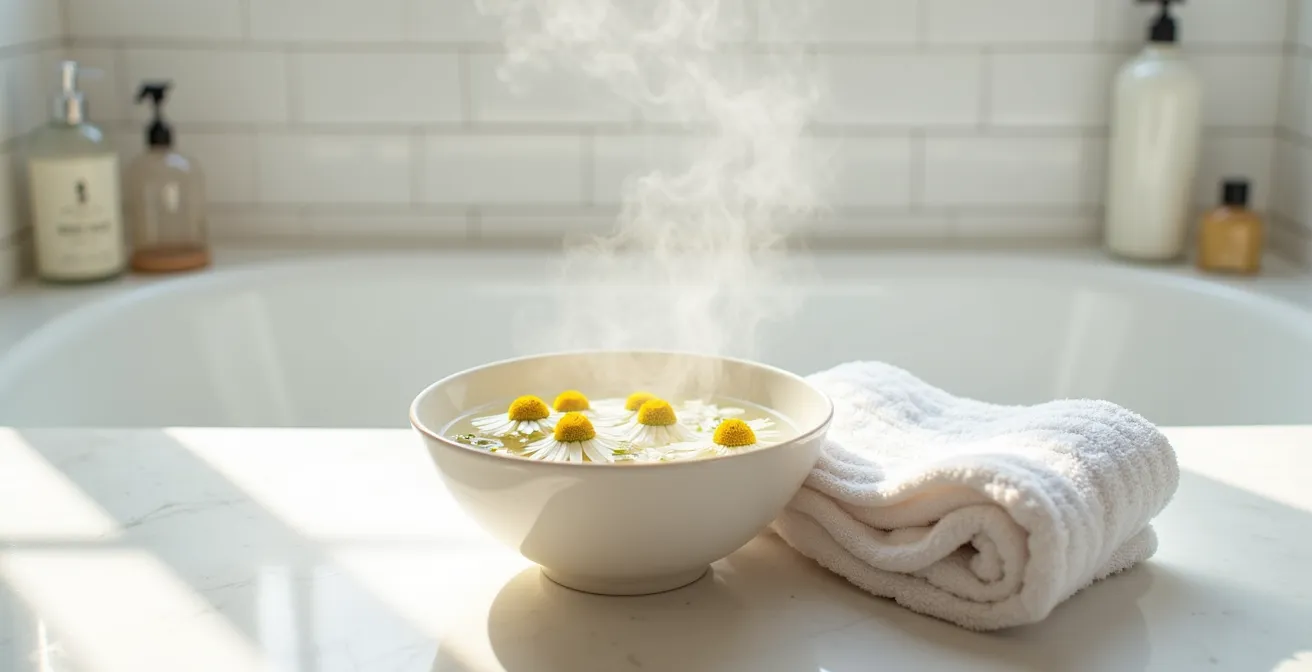
As the image shows, a steam bath can become a true care ritual through targeted additives. Depending on skin needs, different herbs or oils can unfold their effects and enhance the cleansing result:
- Chamomile additive: Has an anti-inflammatory effect and calms already irritated areas.
- Rosemary additive: Has a disinfecting effect and helps regulate bacterial flora.
- Sea salt: Supports the deep-cleansing effect of the steam.
- Grapefruit oil: A few drops have an invigorating and nourishing effect on the skin.
These natural peeling alternatives are a prime example of effective care that supports the skin in its rhythm rather than overwhelming it. They cleanse deeply without attacking the protective skin barrier.
The hygienic mistake when removing impurities that leaves lifelong marks
It is an almost compulsive reflex: a pimple appears, and fingers move as if by themselves to the face to squeeze it. As understandable as this impulse is, it is the most common and fatal mistake in skincare – with potentially lifelong consequences. The problem is not only that you worsen the inflammation, but that you open the door to far greater problems. Our hands and fingernails, even if they appear clean, are breeding grounds for a variety of germs. Attempting to squeeze a pimple turns a small, local inflammation into an open wound.
Dr. Ute Schlossberger, an experienced dermatologist from Cologne, gets straight to the danger. In an interview, she warns urgently:
Basically, you should never squeeze pimples yourself. We don’t have sterile hands and we have germs on our hands. If the pimple is then squeezed, they get into the wound.
– Dr. Ute Schlossberger, Dermatologist from Cologne
What exactly happens? Pressure forces pus and bacteria not only outwards but also deeper into the surrounding tissue. This leads to an expansion of the inflammation; the pimple becomes larger, redder, and more painful. Far worse, however, is the long-term consequence: scarring. Through tissue injury during improper squeezing, the skin’s natural healing process is disturbed. The body tries to repair the damage but often produces inferior replacement tissue. This can lead not only to inflammation but also to infections and permanent scarring, which remain visible for years in the form of reddish spots (post-inflammatory hyperpigmentation) or indentations (atrophic scars).
The only safe method is to keep your fingers off your face and rely on anti-inflammatory care that allows the pimple to heal on its own. If removal is unavoidable, it should only be performed by a trained aesthetician under sterile conditions. They use special instruments to open the skin without traumatizing the surrounding tissue. Anything else is a gamble where your skin’s appearance is the long-term loser.
Why do plant-based anti-inflammatories need at least 28 days to show visible results?
In a world of instant effects and “overnight” solutions, it’s hard to accept that the skin has its own uncompromising schedule. Many give up a new, gentle care routine in frustration because they don’t see flawless skin in the mirror after a week. This lack of patience is the main reason why natural treatments are often labeled “ineffective.” But the truth is: real, sustainable healing takes time because it follows the skin’s natural renewal cycle, which lasts an average of about 28 days.
During this period, new, healthy cells migrate from the lowest layer of the epidermis to the surface, while old, cornified cells are shed. Plant-based active ingredients like calendula, chamomile, or aloe vera do not aggressively intervene in this process. Instead, they work *with* it. They create an optimal environment for the new cells: they act as anti-inflammatories, provide moisture, and protect with antioxidants against harmful environmental influences. The improvement you see is therefore not just superficial symptom relief, but the result of skin growing back healthier from the ground up.
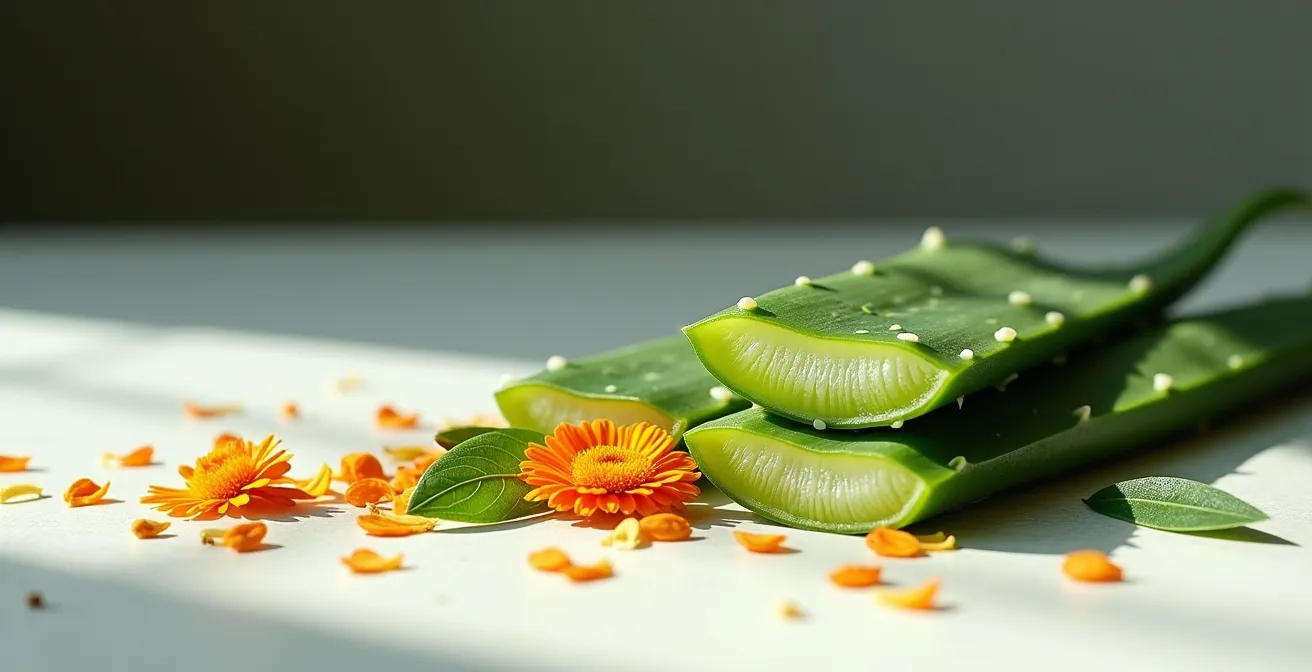
This process of patient regeneration is the reason why a visible improvement in skin appearance requires time. It is a biological fact confirmed by experts. Dermatologists emphasize that all measures only show improvement after several weeks. Those who give up after a few days haven’t given the new skin layer a chance to reach the surface. Plant-based care is not a sprint, but a marathon. The reward, however, is not a short-term, fragile improvement, but long-term stable, resilient, and healthy skin.
Think of a gardener: he doesn’t pull on a seedling to make it grow faster. He provides good soil, water, and light and trusts that the plant will grow and thrive at its own pace. You should treat your skin the same way: with gentle support, nourishing ingredients, and above all, patience.
Which 3 ingredients from your kitchen work better than some expensive organic masks?
The organic cosmetics market is booming, but we often pay for elaborate packaging, marketing, and a long list of ingredients, only a few of which have a high concentration. Yet, in your kitchen, true powerhouses for the skin are slumbering, which when used specifically, are in no way inferior to expensive finished products. The advantage: they are fresh, free of preservatives, and you know 100% what you are putting on your skin. Three helpers stand out in particular.
The undisputed star is Manuka honey. As already mentioned, its high MGO content is a potent anti-inflammatory. Its germ-killing effect is so strong that it is even used in medicine for treating difficult-to-heal wounds. Applied as a face mask, it calms acute inflammation and promotes fast healing. In second place is healing clay. Mixed as a mask, it acts like a magnet for excess sebum and bacteria without draining the skin. The third powerhouse is a simple facial steam bath with chamomile additive. The steam opens the pores while the chamomile unfolds its antiseptic and soothing effects.
These three home remedies form a complete, highly effective routine: the steam bath prepares the skin, the clay mask deep-cleans the pores, and the honey acts as a soothing, healing spot treatment or full-face mask. A direct comparison with commercial products, as shown by a comparison of home remedies and finished products, highlights the advantages:
| Home Remedy | Effect | Application | Advantages over finished products |
|---|---|---|---|
| Honey-Cinnamon Mask | Antibacterial, anti-inflammatory | Leave for 10-20 mins, 1-2x weekly | No preservatives, cheaper |
| Healing Clay | Binds sebum and oils | Until dry, 2-3x weekly | Purely natural, no additives |
| Chamomile Steam Bath | Opens pores, disinfects | 10-15 mins, 1x weekly | No chemical surfactants |
Applying these remedies might require a bit more preparation than opening a jar, but the reward is pure, unadulterated, and highly effective care that is gentle on your skin and your wallet.
Which oil is guaranteed to clog your pores and which is safe for blemished skin?
The subject of oil in skincare is a minefield for people with blemished skin. The fear of clogging pores and provoking new pimples is huge. This fear is not unfounded, as there are indeed oils that are highly comedogenic, meaning they promote the formation of blackheads. Olive oil, as healthy as it is in a diet, often falls into this category for skin prone to impurities. It is rich and can form a film on some skin types that seals the pores. However, this does not mean all oils are taboo – on the contrary.
The key lies in choosing non-comedogenic or low-comedogenic oils. These have a lighter molecular structure and often contain a high proportion of linoleic acid. Linoleic acid is an important component of the skin’s own sebum. Studies have shown that the skin of acne patients often has a deficiency of linoleic acid, which makes the sebum more viscous and thus clogs the pores more easily. Supplying linoleic-rich oils from the outside can help make the sebum more supple and facilitate drainage.
Safe and even beneficial oils for blemished skin include almond oil and poppy seed oil. Coconut oil can also work well for many, although it can act comedogenically for some people. Individual reaction is crucial here. These oils nourish the skin, lock in moisture, and strengthen the skin barrier without weighing it down. They can even be used for cleansing (Oil Cleansing Method), as oil is known to dissolve oil and thus gently removes makeup and excess sebum from the skin.
To ensure your skin tolerates an oil, some simple steps are essential:
- Perform a patch test: Test every new oil before the first application on the face in an inconspicuous place, for example, behind the ear or on the forearm. Wait 24-48 hours for a possible reaction.
- Use as the last step: A facial oil should ideally be the last step in your routine. It seals previously applied moisture (e.g., from a water-based serum) into the skin.
- Try the Oil Cleansing Method: Gently massage the oil into dry facial skin to dissolve makeup and sebum. Then remove it with a warm, damp cloth.
Generalized fear of oil is unfounded. Correctly selected and applied, it is a powerful ally for balanced, hydrated, and paradoxically, clearer skin.
The most important things in brief
- Gentleness before aggressiveness: Protecting and rebuilding the skin barrier is more important than radically fighting symptoms.
- Patience is a virtue: Real improvements align with the natural 28-day skin renewal cycle. Short-term results are often not sustainable.
- The psyche cares too: Stress is a proven trigger for blemishes. Relaxation techniques are an integral part of effective skincare.
Why does true beauty begin in the mind and not in a jar?
You can use the most expensive products, follow the most perfect routine, and strictly adhere to every piece of advice – and still suffer from new outbreaks of blemishes time and again. The reason for this often lies not in the bathroom cabinet, but in our nervous system. The link between skin and psyche is clearly scientifically proven: stress is a central trigger for acne and other skin problems. When we are under pressure, the body releases more stress hormones like cortisol. These hormones boost sebum production and promote inflammatory processes in the body – the perfect foundation for new pimples.
The AOK health magazine clearly summarizes this finding and states that “stress can lead to acne worsening.” This is not mere speculation but the result of numerous dermatological observations. The influence is so direct that even positive excitement can become a pimple booster. Who doesn’t know the notorious pimple that appears right on time for an important event like a wedding or a job interview?
This connection makes it clear that holistic acne treatment must go beyond pure skincare. It’s about identifying and managing systemic triggers. Stress reduction techniques are therefore not esoteric gimmicks, but a tough, biochemically effective part of your skincare strategy. These include, for example:
- Regular exercise to break down stress hormones.
- Mindfulness exercises or meditation to calm the nervous system.
- Sufficient sleep, as the skin (and the mind) regenerates at night.
- Setting clear boundaries in everyday life to avoid chronic overload.
Accepting that the skin’s appearance is a mirror of internal well-being is a revolutionary step. It relieves the feeling of having “failed” at skincare and opens up new, effective areas for action. Instead of only fighting symptoms on the face, you begin to treat the cause at the root – in your head and in your lifestyle.
Start today by integrating this gentle philosophy into your care routine and give your skin the chance to heal itself at its own pace.