
The decisive factor for a confident appearance is not the price of your jewelry, but the strategic coherence of your choice.
- Incorrectly chosen jewelry can be perceived as “style dissonance” and undermine your competence.
- Each piece of jewelry acts as a visual anchor that consciously directs or unconsciously distracts your counterpart’s focus.
Recommendation: Analyze your jewelry not as an accessory, but as a communication tool to specifically send signals of authority, modernity, and attention to detail.
Every morning, countless career women face the same subtle but crucial question: Which jewelry rounds off the business look without appearing unprofessional? The common answer is often a hesitant “less is more,” leading many to avoid expressive jewelry out of sheer caution. They reach for tiny, almost invisible studs that are more of an apology than a statement. However, this defensive stance overlooks a crucial strategic component of your professional appearance.
The truth is, your jewelry – especially your earrings, which are located directly in the communication zone of your face – is much more than mere decoration. It is a non-verbal tool, a subtle but powerful competence signal. While most guides stick to superficial rules about shape and color, the key to a confident appearance lies deeper. It is about understanding the psychology behind perception and using jewelry as a deliberate part of your personal brand message.
But what if the true art lies not in avoiding jewelry, but in using it strategically to signal authority, build trust, and direct attention to your message rather than distracting from it? This article breaks with old, uncertain rules. Instead, we equip you with a strategic framework to choose earrings that not only complement but actively underscore your expertise. We decode the signals sent by different materials, define the boundaries of professional aesthetics in modern work environments, and give you practical tools to banish style dissonance from your wardrobe forever.
This guide is your personal career advisor for jewelry etiquette. It leads you through all facets of the right choice, so you can enter any room with the certainty that your entire appearance sends a single, coherent message: competence.
Table of Contents: Your Strategic Guide to Professional Earrings
- Gold or Silver: Which Precious Metal Makes Your Complexion Glow in Office Light?
- When is a Dangling Earring Perceived as Unprofessional in a Meeting?
- Is the Price for Real Pearl Studs Worth the Daily Impact?
- How Do You Truly Recognize Nickel-Free Jewelry Before Your Earlobes Itch?
- How Do You Clean Your Earrings at Home so They Sparkle Like New?
- The Outfit Mistake That Immediately Makes You Look Insecure in the Office
- Necklace or Earrings: Why You Should Choose One “Hero” and Not Emphasize Both?
- How Do You Apply the “Coco Chanel Rule” to Never Leave the House Overdressed Again?
Gold or Silver: Which Precious Metal Makes Your Complexion Glow in Office Light?
The choice between gold and silver is often reduced to a simple question of skin undertone. However, in a professional context, this decision is far more strategic. It’s not just about what flatters you personally, but about what message you want to send. Each metal carries an unconscious psychological connotation that can influence your perceived authority and spirit of innovation. Artificial light in offices, often cool and neon-heavy, plays a crucial role as it can significantly alter the effect of metals.
The following table summarizes the psychological impact of the most common precious metals in a business context and provides a recommendation for which signal works strongest in which industry. Consider this your strategic compass for metal selection.
| Metal | Psychological Impact | Industry Recommendation | Lighting Situation |
|---|---|---|---|
| Gold | Tradition, Authority, Warmth | Finance, Law, Consulting | Optimal in warm LED light |
| Silver/Platinum | Modernity, Innovation, Clarity | Technology, Design, Start-ups | Advantageous in cool neon light |
| Rose Gold | Balance between Tradition and Modernity | Creative Industry, Marketing | Universally flattering |
Gold radiates a classic authority and stability, which builds trust in conservative industries such as finance or law. Silver and platinum, on the other hand, appear cooler and more modern. They signal innovation and technological affinity, making them the ideal choice for the tech industry or creative start-ups. Rose gold has established itself as an elegant mediator; it balances the warmth of gold with the modernity of silver and is excellent for industries where both creativity and professionalism are required, such as marketing.
Your decision should therefore be a conscious one: Do you want to be perceived today as a rock of stability or as a driving force of change? The choice of metal is your first, subtle move.
When is a Dangling Earring Perceived as Unprofessional in a Meeting?
The line between stylish and unprofessional is particularly thin with dangling earrings. While a small, subtle drop can exude elegance, an earring becomes a problem the moment it turns from a communication tool into a distractor. The core question is: Does the earring draw the eye to your eyes and support your facial expressions, or does it draw attention to itself through movement and reflections? In a professional context, anything that distracts from your message is a strategic disadvantage.
This principle of the visual anchor is more important than ever in today’s work world, which is dominated by video conferences. On a small screen, every uncontrolled movement is amplified. A dangling or jingling earring can become a hypnotic pendulum for your counterpart, pulling concentration away from your words. A subtle stud or a small, stationary hoop, on the other hand, frames the face without creating visual noise.

The rule of thumb for meetings – whether virtual or physical – is: If you can feel or hear the earring yourself, it is probably too present. Choose pieces that become part of your appearance rather than taking the lead role. The perception of professionalism depends heavily on control and composure. A piece of jewelry that swings uncontrollably subtly but effectively undermines this image. It suggests a playfulness that can seem out of place in decisive negotiations or presentations.
Ultimately, the most professional earring is the one that makes people forget it’s there and instead puts the person wearing it in the spotlight.
Is the Price for Real Pearl Studs Worth the Daily Impact?
Real pearl studs are considered the epitome of timeless elegance, yet their price makes many hesitate. Is this investment really justified in daily business life? The answer lies not just in the material value, but in the unsurpassed symbolic power of the pearl. Unlike sparkling gemstones, which can quickly look opulent, pearls radiate a calm, unobtrusive authority. They are the ultimate competence signal for women in leadership positions who want to demonstrate strength without aggressiveness.
Financially speaking, the investment is often lower than assumed. The true value lies in the longevity and frequency of wear. An investment that pays off: With a wearing period of 10 years, according to market analysis, the cost is only €0.04 per day for high-quality pearl studs. This makes them one of the most cost-effective pieces of jewelry in a professional wardrobe.
But the true return is psychological. The pearl has always been associated with wisdom and integrity. This symbolism is used specifically by modern leaders, as a style consultant notes in the Business Dress Code Guide 2024:
Pearls signal not only elegance, but also wisdom and calm authority – modern leaders like Kamala Harris use them specifically as a symbol of competence.
– Style consultant to German politics, Business Dress Code Guide 2024
Unlike fashion jewelry, which is subject to trends and quickly loses value, real pearls are a long-term investment in your personal brand. They signal an awareness of quality and consistency – qualities that are highly valued in professional life. They don’t have to scream to be heard; their soft glow speaks for itself.
While a cheaper piece might serve the purpose in the short term, with real pearls you are investing in a symbol that will outlast your career and reflect your growing expertise.
How Do You Truly Recognize Nickel-Free Jewelry Before Your Earlobes Itch?
An itchy, red earlobe during an important meeting is more than just unpleasant – it’s a distraction that impairs your concentration and composure. The cause is often a nickel allergy, one of the most common contact allergies. Current data shows that up to 20% of women in Germany are affected by nickel sensitization. The problem: Nickel is an inexpensive metal often used in alloys for fashion jewelry, even when labeled “nickel-free.” Unfortunately, labeling is not always reliable.
For a career woman, avoiding such distractors is not a side issue, but part of professional self-management. It’s about being able to focus on the essentials without being distracted by physical discomfort. Choosing the right material is therefore a proactive measure to ensure your performance. Don’t rely on vague product descriptions, but on knowledge of guaranteed hypoallergenic materials.
The following list contains materials considered extremely safe, giving you the certainty that your jewelry won’t let you down:
- Titanium (medical grade): Absolutely inert and the safest choice for highly sensitive skin. It is also used for medical implants.
- Niobium: Similarly skin-friendly as titanium, but rarer to find. Often available anodized in bright colors.
- Surgical Steel 316L: Although it contains traces of nickel, the release rate is so low that it is considered hypoallergenic and safe for most people.
- Solid Gold (14 karat and above): Pure gold is hypoallergenic. In alloys of 14 karat and above, the nickel content is usually so low that it is non-problematic. Be careful with lower karat numbers or white gold, which is often alloyed with nickel.
If you already own jewelry that you’re unsure about, you can act proactively. Nickel test kits are available in pharmacies, allowing you to quickly and easily check existing pieces for nickel release.
This conscious material choice is a sign of professionalism: It shows that you plan ahead and eliminate potential sources of disruption to focus entirely on your goals.
How Do You Clean Your Earrings at Home so They Sparkle Like New?
A flawless appearance is based on details. Dull, tarnished, or dirty earrings can undermine the most high-end business look. They unconsciously send the signal that details are being neglected – an impression no ambitious career woman wants to leave. Regular and, above all, material-appropriate care of your earrings is therefore not a luxury, but an essential part of a professional wardrobe. It not only preserves the value of your investment but also ensures that your jewelry always radiates quality and care.
However, incorrect cleaning methods can do more harm than good. Aggressive chemicals, abrasive pastes, or even just water can permanently damage sensitive materials like pearls or fashion jewelry coatings. Each material requires a specific protocol to maintain its luster without attacking the substance.
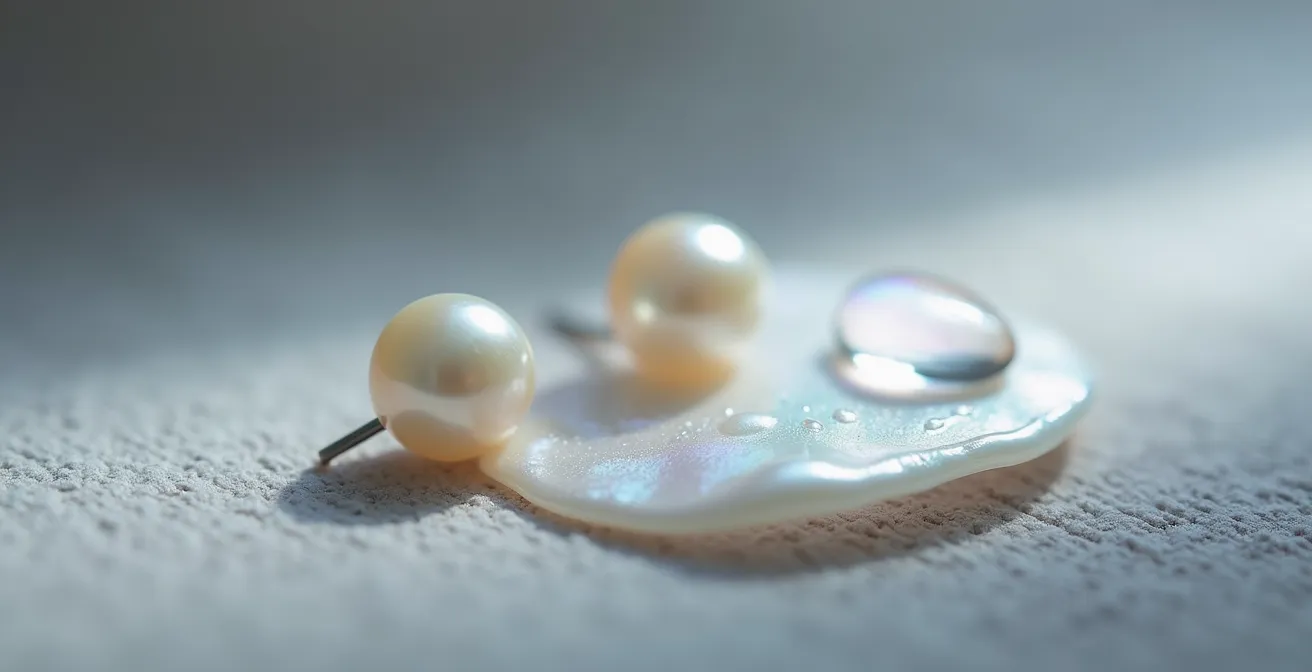
The following table provides a clear overview of the correct cleaning methods for the most common materials in business jewelry. Consider it your maintenance protocol for a consistently sparkling appearance.
| Material | Cleaning Method | Frequency | Warning |
|---|---|---|---|
| Pearls | Damp microfiber cloth | After every wear | No chemicals – porous! |
| Silver | Special silver polishing cloths | Monthly | No baking soda – scratches! |
| Gold | Lukewarm soapy water, soft brush | Weekly | No toothpaste – too abrasive |
| Fashion Jewelry | Dry cloth | After every wear | No water – coating dissolves |
By giving your jewelry the same attention as the rest of your outfit, you ensure that your entire appearance sends a consistent message of excellence and attention to detail.
The Outfit Mistake That Immediately Makes You Look Insecure in the Office
In the German business environment, where substance and quality are traditionally held high, there is one style error that says more about your perceived competence than any gap in your CV: style dissonance. This term describes the inconsistency between different elements of your appearance. The most common and fatal mistake is combining a high-quality suit or dress with cheap-looking plastic or fashion jewelry. This break is not interpreted as a fashion statement, but as a lack of judgment.
It is an unconscious signal that immediately unsettles your counterpart. If the quality of your jewelry cannot keep up with the quality of your clothing, the question arises: Where else are there inconsistencies? Is the substance of your work as superficial as the choice of your accessories? This perception is not just a guess but has been proven in studies.
Case Study: Style Dissonance in Everyday Office Life
A study on dress codes in German companies quantified this effect. The combination of high-quality business attire with low-quality jewelry was interpreted by 73% of surveyed executives as a lack of sense for context and detail. This faux pas significantly reduced the perceived competence of the person before the first word was even spoken.
To avoid this trap and leave a consistently coherent and competent impression, regular self-checks are essential. The following checklist helps you review your appearance for style dissonance and ensure that every detail underscores your professionalism.
Your 5-Point Check for a Coherent Appearance
- Points of Contact: List all visible accessories you are wearing (earrings, necklace, watch, rings, belt buckle, pen). These are the signals you send.
- Material Inventory: Assess the material of every single element. Is everything made of high-quality, authentic materials (leather, metal, pearls), or are there “stowaways” made of plastic or cheap alloys?
- Coherence Check: Compare your accessory list with the quality of your typical business clothing. Do a 20-Euro plastic necklace and a 500-Euro blazer go together? Be honest.
- Impact Analysis: Look at the overall picture in the mirror. Does everything look like it belongs together, or does one element stand out as “cheap” or “unfitting”? Does this element pull the overall effect down?
- Integration Plan: Identify the inconsistent pieces. Create a priority list to gradually replace them with qualitatively equivalent alternatives. Start with the element closest to the face.
A coherent overall picture signals that you have thought through not only your work but also your personal presentation down to the last detail – an unmistakable sign of sovereignty.
Necklace or Earrings: Why You Should Choose One “Hero” and Not Emphasize Both?
In an effort to complete a look, many tend to wear both a bold necklace and statement earrings. However, the result is often the opposite of elegance: visual noise. In professional styling, the “One-Hero Rule” is an unshakeable principle for a clear, focused appearance. This rule states that in the “communication zone” – the area from your collarbone to your eyes – only one piece of jewelry should take on the role of the dominant “hero.” All other pieces act as subtle supporters.
Choosing your hero is a strategic decision that directs your counterpart’s focus. Do you want people to listen attentively and look you in the eye? Then earrings are your hero. They frame the face and emphasize the eye area, which underscores active listening and non-verbal signals. Do you want to direct attention to your words? Then a necklace is your hero. It draws the eye to the throat area and subtly emphasizes the spoken message. Two competing heroes in this sensitive area lead to a visual conflict and distract from both – your eyes and your words.
This doesn’t mean you can only wear one piece of jewelry. It means creating a clear hierarchy. If you choose statement earrings, a necklace should either be omitted entirely or replaced by an extremely fine, barely visible model. Conversely, a present necklace requires very subtle studs. This principle of focus is a sign of self-confidence and clarity. It shows that you manage your impact consciously and do not leave it to chance.
By choosing one visual anchor point, you give your entire appearance a calm authority and ensure that your message arrives clearly and undisturbed.
The Essentials in Brief
- Your jewelry is not an accessory, but a strategic communication tool that signals your competence.
- The “One-Hero Rule” is crucial: Choose only one visual focal point (earrings OR necklace) in the communication zone.
- Avoid “style dissonance” by ensuring that the quality of your jewelry matches that of your clothing.
How Do You Apply the “Coco Chanel Rule” to Never Leave the House Overdressed Again?
“Before you leave the house, look in the mirror and take one accessory off.” This famous advice from Coco Chanel is the essence of the “less is more” principle. In a business context, this rule is not a mere fashion tip, but a strategy to maximize your impact. An overloaded look appears restless, insecure, and distracts from the essential: your competence. As a German style expert emphasizes in a Business Etiquette Guide for 2024, a maximum of five pieces of jewelry should complement the outfit, with a watch and wedding ring already counting as two. This leaves only three other slots for professional balance.
But how do you apply this rule in practice, especially in the digital age? A modern and extremely effective method is the “Thumbnail Test.” It adapts Chanel’s rule for the reality of video conferences, where your appearance is reduced to a small preview image.
Here is how the test works:
- Take a selfie or a screenshot of your video preview as you would appear in the meeting.
- View the image in thumbnail size, about 2×2 centimeters on your screen.
- Analyze the effect: What stands out? If your jewelry is more present than your face or eyes, it is too dominant for the professional context. It creates visual noise and should be reduced.
To objectify the decision, you can use a simple point system, the “Professional Style Budget.” Assign points to each piece of jewelry (e.g., subtle studs = 1 point, statement necklace = 3 points, watch = 1 point, bold ring = 2 points). For a typical workday, you should not exceed a total budget of 3-4 points. This method forces you to make conscious decisions and create a clear hierarchy in your accessories.
Start today by no longer viewing your jewelry as just an addition, but as a strategic element of your professional toolbox. Master this art, and you will find that the right earrings can make not just your face, but your entire career shine.
Frequently Asked Questions About Professional Jewelry Etiquette
Can I still wear a coordinated set?
Coordinated sets of necklaces and earrings may still work in very conservative industries but are considered outdated or uncreative in most modern business environments. A more stylish alternative is to choose pieces made of the same metal and in a similar style, but that are not identical. This shows a sense of harmony without appearing uninspired.
How do I correctly combine jewelry when layering?
When layering, i.e., wearing multiple necklaces, the same rule of hierarchy applies. Combine delicate necklaces of different lengths and thicknesses to create depth. However, crucial for a professional look is staying consistent with one metal. Mixing gold and silver can quickly look cluttered and should be avoided in a business context.
What if my outfit is very simple?
A minimalist outfit (e.g., a simple, high-necked sweater or a plain blouse) is the perfect stage for a jewelry “hero.” Here, your chosen piece – whether statement earrings or a special necklace – can be a bit more present. But even here, the “One-Hero Rule” applies: decide on one focal point to avoid disturbing the simple elegance of the outfit with visual unrest.