
The Coco Chanel rule does not mean arbitrarily removing an accessory. It is a strategic guide for creating visual harmony.
- True elegance arises from a conscious curatorial decision, not from random reduction.
- Every outfit needs a clear visual “hero” (focal point) to which all other elements are subordinate.
- Rigid rules like “don’t mix gold and silver” are outdated; modern elegance is based on context and harmony.
Recommendation: Don’t think about what to remove; instead, decide from the beginning which accessory should play the leading role.
The scene is a familiar ritual: fully dressed, a final glance in the mirror before leaving the house. But instead of self-confidence, a slight doubt creeps in. Is it too much? The necklace, the earrings, the bracelets – does the ensemble look harmonious or overloaded? In this moment, the famous quote by Coco Chanel inevitably comes to mind: “Before you leave the house, look in the mirror and take one thing off.” This sentence has become a universal formula against fashion overload, a mantra for everyone striving for elegance.
However, this simple interpretation only scratches the surface of what true style means. It degrades the art of using accessories to a simple act of subtraction. The real challenge is not randomly removing something at the end. The true mastery, the essence of Chanel’s philosophy, is far more subtle and strategic. What if the rule should be understood not as a commandment of reduction, but as a principle of visual hierarchy? What if it’s not about wearing less, but about choosing more consciously?
This article breaks away from the superficial reading of the “less is more” platitude. Instead, we introduce you to the art of the curatorial decision. We will analyze how to set a focal point, intelligently break old style rules, and choose accessories so that they radiate competence and sophistication rather than distracting from the essential. It is time to move from a logic of omission to a strategy of conscious composition.
To master this philosophy, we will examine a series of common style questions. From the choice between a necklace and earrings to the modern combination of bag and shoes, this guide offers a structured insight into the art of perfect balance.
Table of Contents: The Curatorial Guide to Perfect Accessories
- Necklace or earrings: Why should you choose one hero instead of emphasizing both?
- Is it okay to mix gold and silver today, or is it still a style faux pas?
- When does an outfit need loud accessories, and when do they destroy the line?
- Why noisy bracelets in the office annoy colleagues and look unprofessional
- When is a dangling earring perceived as unprofessional in a meeting?
- Do bag and shoes still have to be the same color today, or does that look stuffy?
- When does a patterned scarf “overwhelm” your face and when is it the perfect accent?
- How do you choose earrings that radiate competence without distracting from the face?
Necklace or earrings: Why should you choose one hero instead of emphasizing both?
The question of whether one can wear a bold necklace and large earrings at the same time is at the heart of the principle of visual hierarchy. An outfit intended to look elegant needs an undisputed focal point – a “hero” that draws attention. When both an opulent necklace and extravagant earrings compete for dominance, visual noise is created. The viewer’s eye doesn’t know where to focus, and the result is not double the impact, but divided and thus weakened attention.
Deciding on only one hero doesn’t necessarily mean giving up the other piece of jewelry entirely. The art lies in the curatorial selection of supporting “co-stars.” If you choose a statement necklace, then the earrings should be little more than an echo – tiny studs or delicate hoops that pick up the metal or color of the necklace without competing with it. This approach, as embodied by brands like BeWooden with their “less is more” ethos, aims to emphasize the wearer’s beauty rather than overwhelming it. Minimalist pieces are not the goal here, but the logical result of a clever visual hierarchy.
Think like a director: your lead actor needs space to perform. Everything else is part of the stage set and should support the scene, not steal the show. This conscious staging is the first step away from being overloaded and toward true sophistication.
Is it okay to mix gold and silver today, or is it still a style faux pas?
The ironclad rule of never mixing gold and silver is one of the most persistent myths in the fashion world – and today, it is definitely outdated. In modern style etiquette, the conscious mixing of metals is no longer seen as a faux pas, but as a sign of fashion confidence and sophistication. The key, however, lies in the “how.” A careless jumble can indeed look chaotic; a thoughtful mix, on the other hand, demonstrates curatorial skill.
To create a harmonious bimetal look, there are two proven techniques. The first is the “bridge technique”: wear a piece of jewelry that naturally combines both metals, such as a two-tone watch or ring. This piece acts as a link and legitimizes the combination of the remaining pieces. The second technique is mindful layering. Combine delicate gold and silver necklaces or bracelets, but make sure they have a common denominator – whether it’s a similar style (e.g., all very delicate) or a similar texture. The result then looks like a conscious composition and not like an accident.
This trend toward versatility is not a passing whim; current jewelry trends confirm that layered looks with mixed metals are a central theme for the coming seasons. It’s about showing personality and breaking free from rigid doctrines.
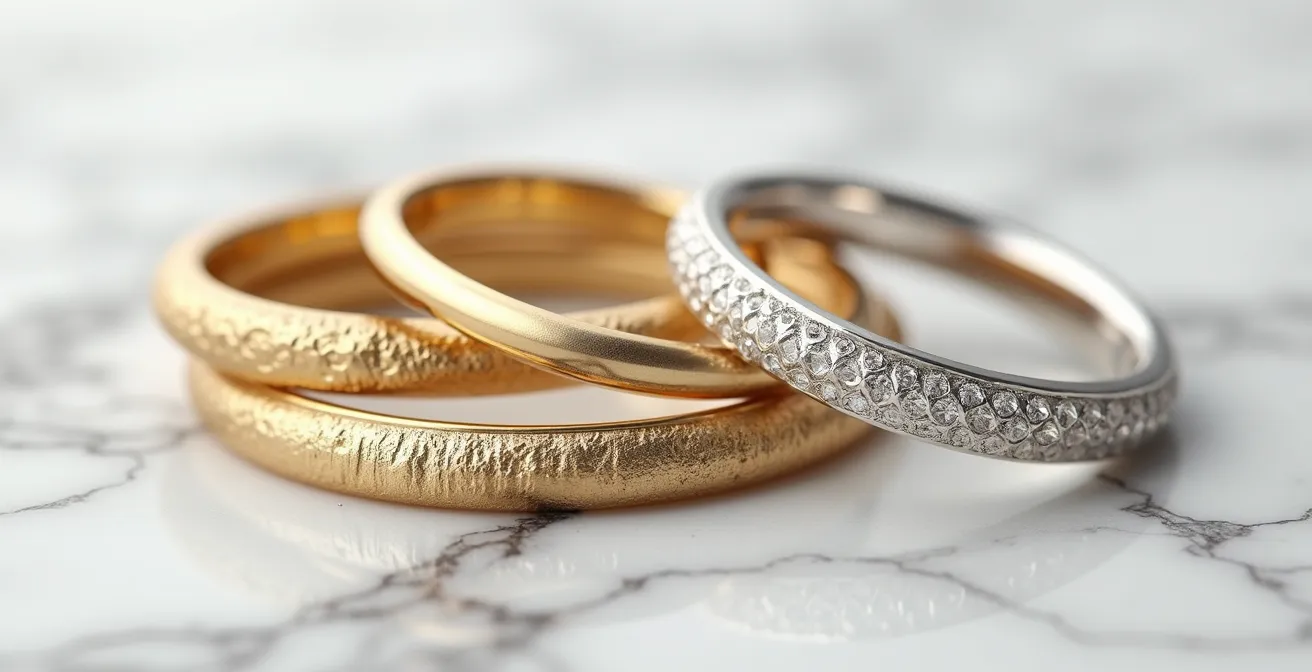
As the arrangement shows, beauty lies in the conscious play of contrasts. The warm glow of gold and the cool shimmer of silver can highlight each other when brought together with intention rather than by chance.
When does an outfit need loud accessories, and when do they destroy the line?
The decision for or against “loud” accessories is a matter of context and balance. A statement piece is not inherently good or bad – its effect depends entirely on the foundation it is placed upon: the outfit itself. The basic rule is simple: the more simple and minimalist the outfit, the more space and justification a bold accessory has to shine as the central focal point. A simple black dress or a white blouse with jeans practically screams for an opulent necklace or sculptural earrings to gain character.
Conversely, the opposite applies to outfits that already make a strong statement on their own. A dress with a loud pattern, a complex cut, or a dramatic silhouette needs no competition. Here, loud accessories would disrupt the intended line of the garment and overload the overall look. In such cases, subtle, almost invisible pieces of jewelry are the better choice – they complete the look without dominating it. The goal is to complement the outfit, not to fight it.
The following table, based on the principles of professional style consulting, offers a strategic orientation, as shown by a recent analysis by style consultants.
| Outfit Type | Accessory Recommendation | To Avoid |
|---|---|---|
| Simple, monochrome outfit | Loud accessories as focal point | Too many subtle accessories |
| Patterned outfit | Subtle, solid-colored accessories | More patterns or loud pieces |
| Outfit with a clear silhouette | Slim, close-fitting accessories | Voluminous pieces that break the line |
Ultimately, it’s about a conscious decision: should the accessory be the star of the show or play a supporting role? The outfit provides the answer.
Why noisy bracelets in the office annoy colleagues and look unprofessional
Accessories send not only visual but also acoustic signals. In a professional environment, the acoustic signature of your jewelry is an often overlooked but crucial aspect of your non-verbal communication. A stack of jingling bracelets that makes noise with every movement at the desk or in a meeting is more than just a small distraction. It unconsciously signals a lack of consideration and situational awareness – qualities that contradict professional competence.
The constant noise can be perceived as annoying and intrusive by colleagues. It breaks concentration and distracts from the actual content of your work or your words. In extreme cases, it can even be perceived as an attempt to draw attention to yourself, which is rarely associated with seriousness. Chanel-style elegance is based on control and conscious staging. Uncontrolled noises are the exact opposite. They appear random and thoughtless, undermining the authority that a carefully chosen outfit could otherwise radiate.
Fortunately, there are many alternatives to show presence on the wrist without creating a background noise. Choosing the right, quiet statement is a sign of sovereignty.
- Single sculptural cuff: A wide, solid bracelet made of metal or another material makes a strong statement without jingling.
- High-quality watch: It is the classic business statement – functional, elegant, and absolutely silent.
- Leather or fabric bracelets: These materials offer texture and color but remain silent during movement.
- Matte, brushed metals: They appear more subtle and tend to absorb light rather than reflecting it brightly, which further supports a calmer, more professional aesthetic.
When is a dangling earring perceived as unprofessional in a meeting?
Similar to the acoustic signature of bracelets, the choice of earrings in a professional context is about managing distraction. A dangling earring, especially a long or mobile one, can quickly become a visual disruption in a formal setting such as a meeting or a presentation. While you are speaking, the earring swings and dangles, catching the light and inevitably drawing eyes. Your counterpart’s attention shifts away from your eyes and lips – the centers of your verbal communication – and toward the dancing object at your ear.
This visual distraction can weaken your message. Your audience is unconsciously busy following the movement instead of fully concentrating on the content of your words. It can give the impression of playfulness or even frivolity, which is counterproductive in situations where competence and seriousness should be at the forefront. As style experts emphasize, accessories are like salt and pepper for an outfit: the right dosage is key. An element that moves too much is like too much seasoning – it masks the actual flavor.
The line to the unprofessional is crossed when the accessory receives more attention than the person wearing it. This is particularly true in digital meetings: a dangling, reflective earring can be extremely distracting in front of a webcam due to overexposure and constant movement. The choice should therefore fall on jewelry that is static and emphasizes facial features without distracting from them. Small hoops, elegant studs, or short, non-moving drops are the more sovereign choice here.
Do bag and shoes still have to be the same color today, or does that look stuffy?
The rule that handbag and shoes must be exactly matched in color is a relic of a past fashion era. Today, this pedantic “matchy-matchy” aesthetic often looks forced, uninspired, and, yes, tendentially stuffy. Modern elegance lives from a more subtle form of harmony based on a thoughtful color concept rather than a rigid one-to-one correspondence. It is no longer about finding identical colors, but about connecting complementary or harmonious tones into a well-thought-out color story.
A contemporary approach, recommended by professional style consultants, is defining a personal palette of four to six base colors (e.g., navy, gray, white, taupe) and a few accent colors. Your accessories then move within this harmonious color family. A cognac-colored bag can go wonderfully with shoes in a nude tone or even a soft olive green. The connection is created by the common “warmth” of the earth tones, not by the identical color. This approach gives an outfit depth and an effortless, curated look.

As this arrangement shows, a much more exciting and sophisticated aesthetic arises when colors correspond with each other instead of duplicating each other. It proves an understanding of color theory and an eye for nuance. Instead of looking for the perfect match, look for the perfect harmony. That is the true indicator of style awareness in the 21st century.
When does a patterned scarf “overwhelm” your face and when is it the perfect accent?
A patterned scarf is a potentially transformative accessory. It can breathe life into a simple outfit and provide a flattering frame for the face. However, the line between a perfect accent and visual overload is thin. A scarf “overwhelms” the face when a basic rule of visual proportion is ignored: the scaling of the pattern must match the wearer and the placement.
A large-scale, high-contrast pattern can literally dominate and make delicate facial features disappear. Conversely, a tiny, delicate pattern can look lost and insignificant on a person with striking features. It’s about the harmony of proportions. Colors also play a decisive role: a scarf whose color palette harmonizes with one’s own skin undertone, hair, and eye color will make the face glow. If the colors clash, the complexion can look sallow or restless.
The following overview helps with strategic selection to ensure that the scarf flatters the face instead of competing with it.
| Face Type | Recommended Patterns | Placement |
|---|---|---|
| Delicate features | Small, delicate patterns | Close to the neck or as a headband |
| Striking features | Larger, clearer patterns | Loosely draped |
| Warm skin type | Warm tones in the pattern | Directly at the face |
The second factor is the contrast with the rest of the outfit. A patterned scarf works best as a singular accent to an otherwise monochrome or very quiet look. Combining it with an equally patterned garment requires high mastery and, in case of uncertainty, quickly leads to an overloaded overall image.
Summary of the most important points
- The principle of “visual hierarchy” is more important than the rigid rule of taking one piece off.
- Every outfit needs a conscious “hero” or focal point to which other accessories are subordinate.
- Old rules like “no gold with silver” are outdated; modern elegance is based on harmony and context, not on prohibitions.
How do you choose earrings that radiate competence without distracting from the face?
After discussing the pitfalls of moving and distracting earrings in a professional context, the crucial question arises: what does the perfect, competence-radiating earring look like? The answer lies in a combination of shape, material, and size that signals presence without being intrusive. The ideal business earring frames the face, directs the gaze to the eyes, and supports non-verbal communication rather than disrupting it. It is a subtle statement of care and professionalism.
Particularly in the age of video conferencing, the so-called “webcam rule” has established itself. Earrings must look good up close and on a small screen without dazzling or distracting through movement. Geometric, clear shapes such as circles, squares, or simple bars look modern and structured. Matte or brushed surfaces are often more advantageous than high-gloss finishes, as they reflect light softly instead of creating bright light points that irritate the camera. Small, high-quality hoops or striking but flat studs are almost always a safe and stylish choice.
Checklist: Your Audit for Competence-Radiating Earrings
- Shape & Focus: Choose a clear, geometric shape that is static. Does the earring draw the eye to your face or away from it?
- Movement & Distraction: Do the “head nod test.” Does the earring dangle, swing, or rotate when you move? If so, it is unsuitable for formal settings.
- Material & Reflection: Look at the earring under direct light. Does it dazzle or reflect light softly? Prefer matte or brushed surfaces for video calls.
- Size & Proportion: Is the earring proportional to your facial features? A good rule of thumb: it should not be wider than your earlobe or extend beyond the jawline.
- Message & Context: What story does the earring tell? Does it look creative, classic, subtle, luxurious? Does this message fit the impression you want to convey in the respective context?
Choosing the right earring is a masterclass in subtlety. It’s about finding an accessory that emphasizes your professionalism and strengthens your personal brand without ever taking the lead role. It is the essence of what Coco Chanel meant:
The art of living is the art of leaving out correctly. That starts with talking and ends with the neckline.
– Coco Chanel, Learning from the Best: 10 Fashion Wisdoms
Start today by no longer viewing your jewelry as a collection, but as a curated composition. Consciously choose your focal point, create a visual hierarchy, and build your elegance with strategic intent. That is the true application of the Coco Chanel rule.