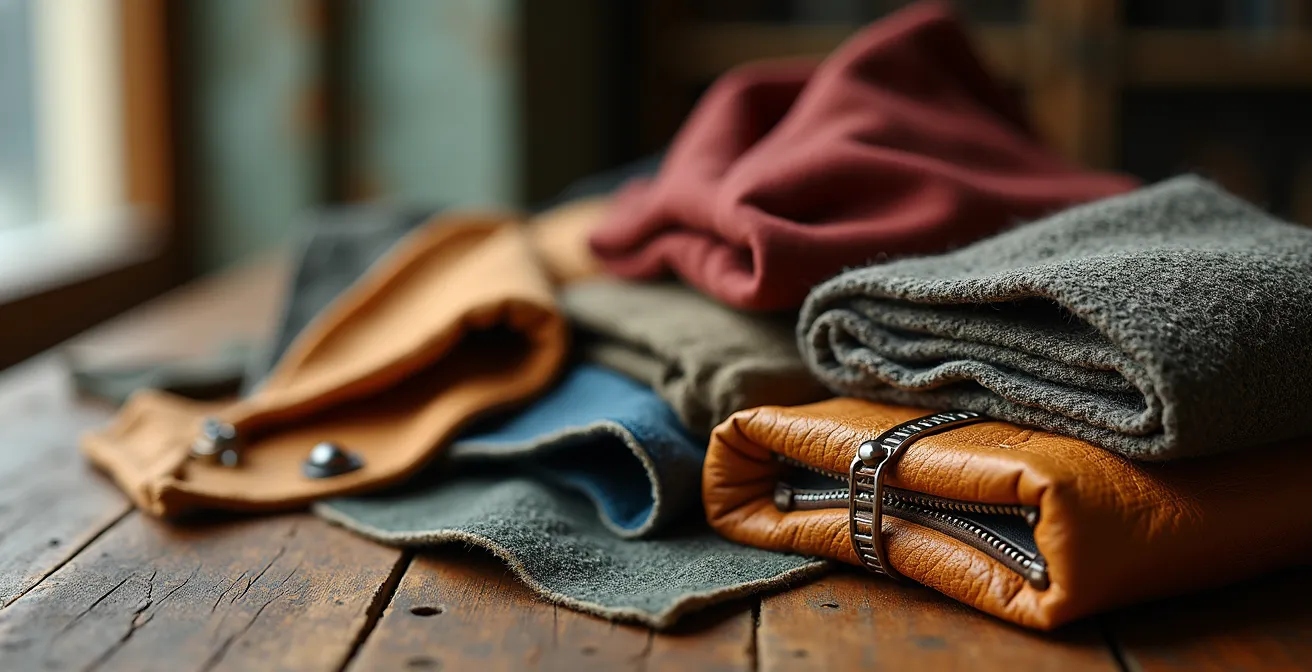
In summary:
- The key to quality lies not in the label, but in the ability to “read” material, cut, and details like an expert.
- Genuine vintage pieces are an investment that pays off long-term through the “cost-per-wear” philosophy, unlike short-lived fast fashion.
- Learn to interpret telltale signs: from correct measurement to checking for moth holes and removing odors from leather.
- Curated stores offer a pre-filtered selection and save time, while “rummaging” offers the chance of undiscovered treasures.
The feeling is incomparable: you stroll through the aisles of a cluttered vintage shop, the scent of old leather and lived stories in the air. Suddenly, your gaze falls on a jacket – the perfect silhouette, a color you don’t find anymore today. But then doubt creeps in: is this a real treasure from the 80s or just a cheaply produced retro knock-off? Many think the answer lies in the label or the price. One often hears that you only need to look for “Made in West Germany” or feel for heavy fabrics. But that is only half the truth and often leads to disappointment and musty bad purchases in the closet.
The hunt for authentic vintage fashion is more than a checklist. It is about understanding the fundamental difference between “vintage” – meaning original pieces that are at least 20 years old – and “retro,” which is newly produced clothing that imitates an old style. Genuine vintage tells a story of craftsmanship, material quality, and a design philosophy built for longevity. Cheap retro kitsch, on the other hand, is often just a superficial copy that loses its shape after a few washes. The true skill of a treasure hunter lies not in scanning labels, but in understanding the language of the garment itself.
But what if the true art consisted not only of paying attention to the obvious, but of decoding the hidden signals? Instead of being blinded by a well-known brand name, we will learn to read the material memory, interpret time-capsule details like zippers and seams, and distinguish between valuable patina and real damage. This article is your compendium, taking you from an uncertain buyer to a knowledgeable connoisseur. We will unlock the secrets of fit, learn infallible quality-check techniques, and find out why an expensive old coat is ultimately cheaper than three new ones.
The following guide will lead you systematically through the most important aspects of the vintage treasure hunt. Each section is designed to provide you with the necessary tools to fish the pearls out of the mass with confidence and a trained eye. Get ready to separate the wheat from the chaff.
Contents: How to Distinguish Real Vintage Quality from Kitsch
- Why does size 38 from the 90s no longer fit you today and how do you measure correctly?
- How do you check wool for moth holes that are barely visible to the naked eye?
- Is the surcharge in a curated vintage store worth it for the time saved compared to rummaging?
- Which methods reliably remove the typical “old clothes smell” from leather jackets?
- Which 5 vintage brands are currently rising in value and are an investment?
- How do you recognize the difference between hype and genuine creativity in the West of Leipzig?
- Why does buying a €300 coat save more money long-term than three cheap models?
- Why is “Less is more” considered the golden rule for the classic German business look?
Why does size 38 from the 90s no longer fit you today and how do you measure correctly?
It is one of the most common frustrations when vintage shopping: you confidently reach for your usual size, but in the dressing room, disillusionment follows. The blazer is tight across the shoulders, the pants won’t close. The reason for this is a phenomenon called “Vanity Sizing”. Over the decades, fashion brands have continuously adjusted clothing sizes downward to make customers feel better. A size 38 from 1990 often has nothing more in common with a today’s 38 than the number on the label.
Historical analyses show drastic shifts. But it’s not just about marketing. Average body measurements have also changed. A large-scale measurement study in Germany revealed that body dimensions have changed significantly since the last survey. For example, according to the Size GERMANY study, chest circumference in women has increased by an average of 2.3 cm. Vintage clothing is a time capsule from an era with different body ideals and realities. The cuts were often less designed for stretch and comfort and more for a defined, structured silhouette.
The golden rule for every vintage treasure hunter is therefore: Ignore the size label! Trust only the measuring tape. A good vintage dealer always has a small measuring tape at hand. Do not measure your body, but a well-fitting, comparable garment from your own closet. Note the most important measurements: shoulder width (seam to seam), chest width (armpit to armpit), sleeve length, and total length for tops; waist width, hip circumference, and inseam length for pants. With these reference values, you can quickly and precisely evaluate any vintage piece without any dressing room drama.
How do you check wool for moth holes that are barely visible to the naked eye?
A beautiful cashmere sweater, a perfectly tailored wool coat – the dream of every vintage lover. But a treacherous enemy can lurk in the weave: the clothes moth. Their larvae often leave only tiny holes or thin spots that remain invisible in the dim light of a second-hand shop. At home, in daylight, the damage is revealed. Distinguishing a true treasure from a holey nuisance requires a special technique that every connoisseur should master.
Forget the superficial scan. The professional method is the Backlight-Stretch Technique. It is simple but immensely effective at uncovering even the smallest damages that drastically reduce a piece’s value. With this method, you check not only for holes but also for thin, threadbare spots that are about to tear. It is the difference between a valuable patina and an irreparable defect.
This procedure is an almost meditative act that requires your full attention and connects you deeply with the material.
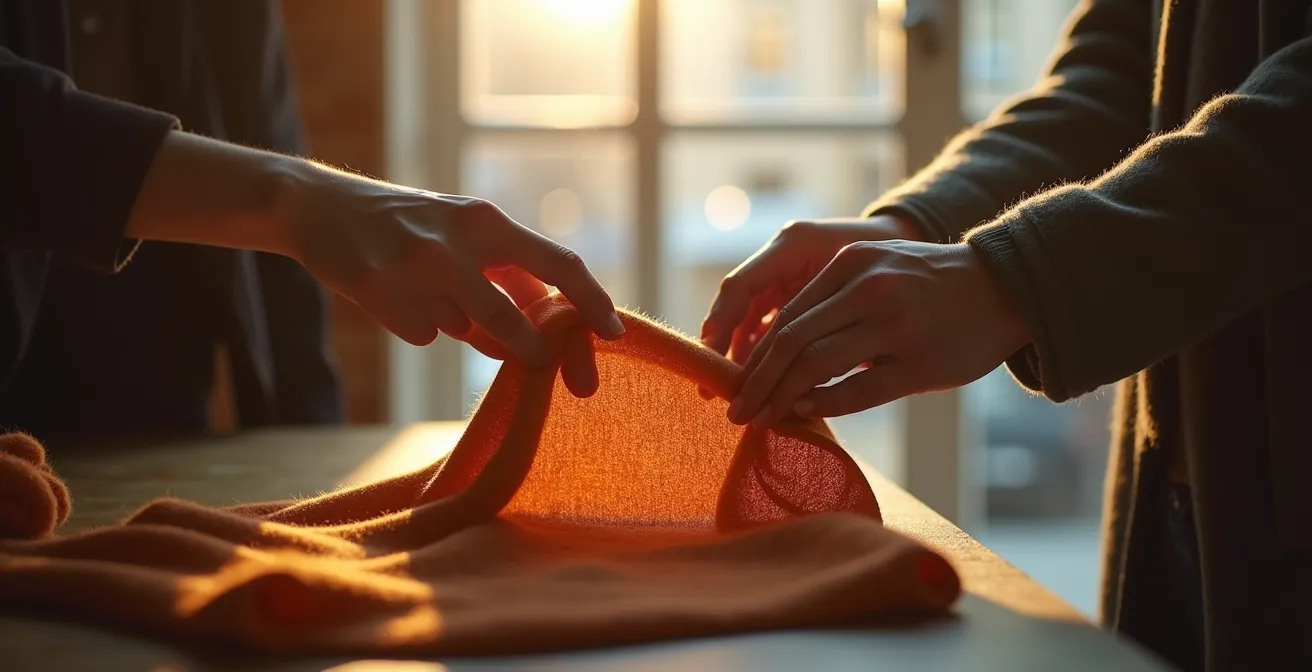
As you can see in the picture, correct handling is crucial. The fabric is not torn, but only gently put under tension. Follow these steps to check like a pro:
- Gently stretch the fabric: Take the area of the wool fabric to be tested between both hands.
- Hold against a light source: Hold the stretched fabric against a bright window, a lamp, or even the glowing screen of your smartphone.
- Systematically scan: Move the fabric slowly to inspect every square centimeter. Tiny holes will now appear as bright dots.
- Check risk zones: Focus particularly on areas like collars, cuffs, elbows, and shoulder sections, as these are often affected first.
Is the surcharge in a curated vintage store worth it for the time saved compared to rummaging?
The world of second-hand shopping is divided into two philosophies: rummaging and curation. On one side are the huge halls, flea markets, and kilo shops – a chaotic paradise for hunters who love the thrill of pulling an undiscovered designer treasure from a mountain of clothing for a few euros. On the other side, there are carefully curated vintage boutiques. Here, every piece is hand-picked, cleaned, often repaired, and provided with a story. The price is higher, but is it justified?
The answer lies in evaluating your most valuable resource: your time. “Rummaging” is a time-consuming hobby that often requires hours of searching for a single good find. The risk of bad purchases – whether due to undetected defects or poor fit – is significantly higher. A curated store acts as your personal curation filter. The owners have already done the hours of groundwork for you. You pay not only for the garment but for the expertise, the time saved, and the security of acquiring a high-quality and immediately wearable piece.
The following comparison illustrates the fundamental difference in the cost-benefit calculation, based on an analysis of both shopping experiences:
| Aspect | Curated Vintage Store | Flea Market/Rummaging |
|---|---|---|
| Average Price | €50-200 per piece | €5-50 per piece |
| Time Investment | 30 min per purchase | 3-5 hours per find |
| Quality Guarantee | Pre-checked, cleaned | Self-check necessary |
| Risk of Bad Purchase | Under 10% | 30-40% |
| Condition | Restored, wearable | Often repair necessary |
In the end, it is a personal decision. Do you see the hunt as part of the experience? Then the flea market is your arena. Do you value efficiency, guaranteed quality, and an inspiring presentation? Then the surcharge in a curated store is a worthwhile investment in your style and your time. As the experts from theplaincircle vintage aptly put it:
We curate genuine vintage pieces, check quality, origin, and era, and make buying second-hand clothing as easy as possible for you. This way, you get high-quality, timeless vintage fashion that tells a story – without risk, without guesswork, and without fake vintage.
– theplaincircle vintage, Vintage curators on their added value
Which methods reliably remove the typical “old clothes smell” from leather jackets?
You found it: the perfect vintage leather jacket. The leather is soft and has a beautiful patina. But one problem clouds the joy – that unmistakable, slightly musty “old clothes smell” that has settled into the material over years. Especially with leather, which you can’t just put in the washing machine, good advice is expensive. Aggressive chemical cleaners can dry out and damage the leather. But there are proven methods from the trick box of experienced dealers that reliably neutralize the odor without attacking the material.
The most effective and gentlest method for delicate leather is the Activated Charcoal Bag Method. Activated charcoal is extremely porous and has the ability to absorb odor molecules from the air like a sponge. It doesn’t mask like a perfume but removes the cause of the problem. This process requires some patience, but the result is an odor-neutral jacket where the natural leather aromas can emerge again.
The process is simple and safe. The jacket is isolated so that the activated charcoal can develop its full effect.

For successful odor removal, follow these steps exactly:
- Preparation: Thoroughly brush the leather jacket inside and out with a soft brush to remove loose dirt and dust.
- Packing: Place 2-3 bags of activated charcoal (available in drugstores or online) in a large, airtight plastic bag or a garment cover.
- Hanging: Hang the jacket on a wide hanger in the bag so that it does not directly touch the charcoal bags.
- Seal and Rest: Seal the bag airtight and let it rest in a cool, dry place for 48 to 72 hours.
- Airing out: Take the jacket out and let it air out for a few hours in the fresh air (but not in direct sun).
For particularly stubborn odors, the process can be repeated. As an immediate measure or for lighter smells, some connoisseurs also swear by a simple trick: spraying the jacket with a fine mist of clear vodka, which takes many odor-causing bacteria with it as it evaporates. But the activated charcoal method remains the safest bet for deep and lasting neutralization.
Which 5 vintage brands are currently rising in value and are an investment?
Vintage shopping is not only a sustainable and stylish choice; it can also be a clever investment. While some pieces are simply beautiful, others have the potential to increase in value. Recognizing these brands requires a sense of quality, design history, and current fashion trends that draw on past eras. Pieces from the 80s and 90s from brands known for their excellent craftsmanship and timeless design are particularly experiencing a renaissance. Here are five examples to look out for, especially from German or European production.
1. Jil Sander: Before the label lost its profile through numerous ownership changes, Jil Sander stood for purist luxury and flawless cuts in the 90s. Especially coats and suits from this period, which were often still manufactured in Germany or Italy, are highly sought after today for their superior material and processing quality. According to an analysis of German luxury brands, the company founded in 1968 celebrated its greatest international successes in the 1990s.
2. Escada: In the 80s and early 90s, Escada was the epitome of “power dressing” with a touch of glamour. The brand was famous for its vibrant colors, luxurious fabrics like silk and virgin wool, and elaborate embellishments. A well-preserved Escada blazer with striking shoulder pads or a silk dress is a real statement piece whose value is steadily rising among collectors.
3. Hugo Boss (Made in Germany): Before production was globalized, Hugo Boss manufactured a large part of its high-quality men’s clothing in Germany. Suits, jackets, and coats from the 80s and 90s with the “Made in W. Germany” or “Made in Germany” label are often made from first-class Italian fabrics and in a quality that is only found in the highest price segment today.
4. MCM (Michael Cromer Munich): Bags and suitcases with the iconic Visetos monogram were a global status symbol in the 80s. While the brand is popular again today, original pieces from the 80s are often more robustly made. Travel bags or backpacks in good condition are particularly sought-after collector’s items.
5. Bogner: As a pioneer of luxurious and functional ski fashion, Bogner has always relied on the highest material quality and innovative designs. A colorful ski jacket from the 80s is not only an eye-catcher on the slopes but is also worn in an urban context as a fashion statement. The quality of the processing ensures that these pieces are still fully functional even after 40 years.
How do you recognize the difference between hype and genuine creativity in the West of Leipzig?
This question, which seems to come directly from the heart of Leipzig’s creative scene, touches on a universal point for every vintage hunter, whether in Berlin-Neukölln, Hamburg’s Schanzenviertel, or indeed the West of Leipzig: how do you separate authentic, individual style from a short-lived, influencer-driven hype? Hype often leads to certain vintage pieces (e.g., a specific brand of track jacket or a specific jean cut) suddenly being seen everywhere, often in combination with current fast fashion. Genuine creativity, on the other hand, shows itself in unique combinations, unconventional styling, and the mix of eras and materials.
Genuine creativity is subtle. It doesn’t scream “trend” but whispers “personality.” It lies in the way a 70s shirt is worn with modern pants, or in the decision to patch an old wool coat instead of replacing it. To sharpen your eye for this difference, you can conduct a simple field study, the so-called “Uniform Check”. Pick a busy location and observe. You will quickly recognize patterns: the “hype uniform” repeats itself, while genuine creativity appears in countless variations.
The true value of a vintage piece lies not in copying a trend, but in adding a unique facet to your own wardrobe. It’s about finding a piece that creates a personal resonance and can be seamlessly integrated into your own style, rather than imitating a short-lived aesthetic. The following checklist helps you sharpen your own perspective and make informed decisions.
Your 5-Point Audit for Genuine Vintage Creativity
- Observation points: Identify all visual signals of the piece – cut, color, special details, and overall condition. What makes it unique?
- Material collection: Inventory the existing fabrics and components. Is it high-quality wool, typical 80s polyester, a YKK zipper?
- Style coherence: Match the piece with the typical features of its era. Are the shoulder pads authentic for the 80s? Is the collar typical for the 70s?
- Uniqueness & Emotion: Evaluate what makes the piece unforgettable. Is it a rare color, a handcrafted repair, or simply the feeling it gives you?
- Integration plan: Decide how to integrate and care for the piece in your wardrobe to enrich your style rather than just filling a gap.
Why does buying a €300 coat save more money long-term than three cheap models?
At first glance, the calculation seems simple: three coats for €100 each offer more variety than a single coat for €300. But this short-term perspective ignores the true costs that go beyond the purchase price. An experienced treasure hunter thinks not in seasons, but in decades. They apply the “Cost-per-Wear” philosophy, a simple calculation that reveals the true cost of a garment: total cost divided by the number of days worn. This is where the superior economics of quality show themselves.
A high-quality vintage coat for €300 – made from dense virgin wool, with robust seams and a timeless cut – is designed for longevity. It might need a small repair, but it will accompany you through many winters. Cheap models, on the other hand, are often made of inferior materials. Seams tear, the zipper jams after one season, and the fabric loses its shape. They must be replaced, repaired, and cleaned more frequently, which drives up the total cost.
Longevity is not just a question of money, but also of sustainability. A coat that lasts 10 years leaves a far smaller ecological footprint than six coats that are worn out and discarded in the same time. Buying quality is thus a decision for your own wallet and for the environment.
The following calculation, based on a typical cost-per-wear calculation over a period of 5 years, makes the financial advantage clear:
| Factor | 1x Quality Coat (€300) | 3x Cheap Coat (€100 each) |
|---|---|---|
| Purchase | €300 | €300 |
| Repairs | €20 (1x button) | €90 (seams, zipper) |
| Cleaning/Year | €20 x 5 = €100 | €15 x 3 x 5 = €225 |
| Replacement needed | No | After 2 years per coat |
| Total Costs | €420 | €615 |
| Days Worn (5 years) | 500 days | 300 days (failures) |
| Cost-per-Wear | €0.84 | €2.05 |
The Essentials in Brief
- Quality over quantity: An expensive but high-quality vintage piece is cheaper long-term through its longevity (cost-per-wear) than several fast-fashion items.
- Measure instead of guessing: Never rely on the stated size. “Vanity Sizing” has distorted dimensions over decades. Only your measuring tape tells the truth.
- Curation has its price and value: A curated vintage shop takes the hours of searching and the risk of bad purchases away from you – an investment in time and security.
Why is “Less is more” considered the golden rule for the classic German business look?
The reduction to the essentials, the emphasis on function and quality over opulent decorations – these principles shape not only German design from cars to furniture but also unconsciously the classic business style. The golden rule “Less is more” is not an expression of lack of creativity here, but a commitment to longevity, precision, and understatement. It’s about convincing through flawless fit and first-class materials, not through loud logos or short-lived trends. This philosophy is deeply rooted in German design history.
At the core of this aesthetic is a principle that is also of the highest relevance to the discerning vintage buyer. A perfectly tailored wool coat, a simple but high-quality leather belt, a shirt made of fine cotton – these pieces work. They fulfill their purpose perfectly and outlast fashions. They form the foundation of a wardrobe that does not need to be constantly renewed but gains character over time. This approach stands in direct contrast to the fast-moving consumer culture that relies on constant replacement and planned obsolescence.
This attitude is deeply rooted in cultural history, as a fashion historian aptly notes in an analysis of German design principles:
Form follows function – this Bauhaus principle unconsciously shapes the German business style. It is not about ornament, but about the perfect function of a flawless appearance.
– Fashion Historian, Analysis of German design principles in fashion
For the vintage treasure hunter, this means: look for pieces whose quality speaks for itself. A simple but perfectly crafted coat from the 80s often embodies this philosophy better than any modern designer piece. It is the quiet star that needs no loud staging. It is a statement of durability in a fleeting world. Choosing such a piece is a decision for a style that does not pass, but matures.
Armed with this knowledge, your actual treasure hunt begins now. Enter the next vintage shop not as a customer, but as a connoisseur, and find the pieces that will not only outlast a season but tell your personal story for years to come.