
Choosing between a DJH youth hostel and a private hostel isn’t just a question of price; it’s a strategic decision regarding the social and security infrastructure of your entire trip to Germany.
- DJH rules (e.g., quiet hours) are often not arbitrary, but rather legally required security measures, especially for the protection of minors.
- Private hostels often provide a better social infrastructure for making connections through more flexible designs and common rooms.
Recommendation: First, analyze your traveler type (high need for security vs. desire for social dynamics) and then choose the form of accommodation that truly suits you.
The decision between a classic youth hostel of the German Youth Hostel Association (DJH) and a private hostel often feels like a fundamental choice. On one side is the established, massive DJH network, which, according to its president Professor Günther Schneider, boasts over 2.4 million members and 9.4 million overnight stays per year. DJH membership is mandatory here, conveying a sense of exclusivity and standardization. On the other side is the colorful, often unconventional world of private hostels, which entice travelers with flexibility and an international atmosphere. Many travelers, whether solo backpackers or young families, reduce the choice to a simple equation: DJH = safe and a bit stodgy, Hostel = cheap and party-oriented.
But this assumption falls short. The real decision lies deeper—in the invisible social infrastructure and the safety nets that each accommodation provides. It’s not just about where you sleep, but about how an accommodation shapes your entire travel experience. From strict quiet hours, which can be a blessing for a family and a curse for a night owl, to the type of kitchen that determines whether you just save money or also make new friends. This guide goes beyond flat comparisons and dives deep into the details that really matter for your safety and your budget.
We analyze the decisive differences, from subtle warning signs in the bathroom to the best strategies for making connections in a new city. This article is your compass for finding the accommodation that fits not only your wallet but also your travel style.
Table of Contents: DJH or Hostel – Which is the better choice for you?
- Why are quiet hours in German hostels often enforced more strictly than abroad?
- Which lock system protects your laptop most effectively in a dorm?
- How can you save 50% on food costs in Germany by using the hostel kitchen?
- The warning sign in the bathroom that should make you change accommodations immediately
- Female Dorm or Mixed Dorm: Where do solo female travelers find safe connections faster?
- FlixBus or ICE: When is the longer travel time really worth the savings?
- Vacation Home or Hotel: What saves family peace during bad weather at the North Sea?
- How to find authentic hip neighborhoods in Berlin and Hamburg before they get gentrified?
Why are quiet hours in German hostels often enforced more strictly than abroad?
Anyone who travels internationally knows the scene: In Lisbon or Bangkok, hostel life often only begins at 10 PM. In Germany, however, you might be politely but firmly asked for quiet at that same time. This difference is no coincidence and not just “typically German” pickiness, but often a feature of invisible safety nets, especially in DJH youth hostels. The reason is often legal in nature. According to the official terms and conditions of German youth hostels, strict quiet hours apply from 10:00 PM to 7:00 AM.
This rule serves not only the comfort of families and school classes but is also a direct result of the duty of supervision. An analysis of the DJH terms and conditions reveals a crucial point: the DJH does not assume the duty of supervision for unaccompanied minors; this remains with the parents or adult companions. To minimize legal risk, strict quiet hours are enforced as an instrument of risk management. The goal is to create a controlled and safe environment where the likelihood of problems after dark is reduced.
Private hostels are often more flexible here, as their target audience is usually of legal age. For you as a traveler, this means: if you are a young family or need guaranteed rest for an early hike the next day, a DJH hostel is a safe bet. If you are more into nightly explorations and social contacts until late at night, a private hostel is likely the better choice. It is a trade-off between guaranteed recovery and social flexibility.
Which lock system protects your laptop in a dorm most effectively?
The question of the security of your equipment, especially an expensive laptop, is central in a shared room (dorm). A simple locker is good, but true security lies in a multi-layered approach. You don’t just rely on a single barrier; you build several hurdles for potential thieves. This starts with choosing the right lock and goes far beyond that.
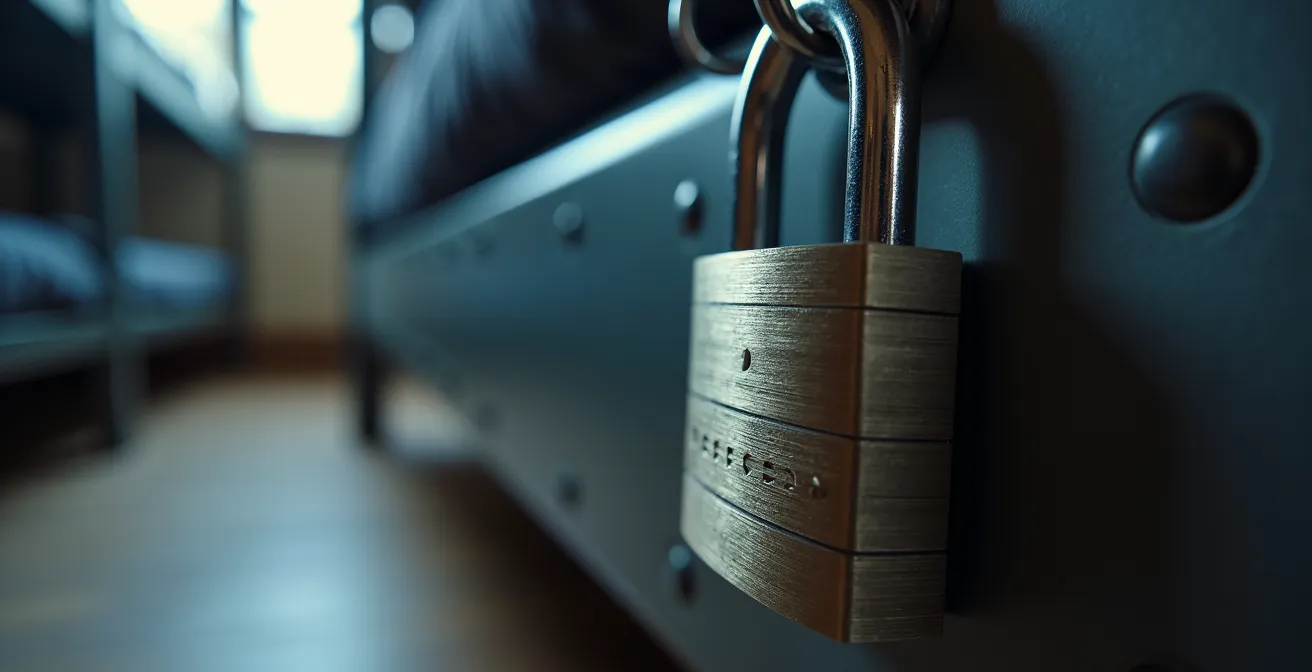
A good lock for your locker is the foundation. But what if the locker itself is broken into or if there isn’t one at all? This is where specialized systems come into play. A Kensington Lock secures the laptop directly to a fixed object like the bed frame, but it is only useful while you are in the room. For ultimate security, a steel wire mesh bag (Pacsafe) allows you to lock up your entire backpack, including your laptop, and attach it to a fixed object. This offers maximum protection but also means extra weight.
The choice of system depends heavily on your travel duration and your need for security. For a short city trip, a high-quality padlock is often sufficient. For a months-long world trip where your laptop is your work tool, investing in a steel wire mesh bag becomes essential for peace of mind. The following table gives you a clear overview:
| Security System | Advantages | Disadvantages | Recommended Use |
|---|---|---|---|
| Combination Lock | No key loss possible | Code can be observed | Short stays |
| Keyed Padlock (ABUS/Master) | Higher security | Key can be lost | Longer stays |
| Kensington Lock | Secure laptop directly | Only during use | While working |
| Pacsafe/Steel Wire Bag | Additional protection in locker | Extra weight | Maximum security |
How can you save 50% on food costs in Germany by using the hostel kitchen?
Eating out in Germany can quickly become expensive. Therefore, the hostel kitchen is not just a room for cooking, but the heart of your budget strategy and a central part of the social infrastructure. Here you can actually save up to 50% of your food costs if you do it cleverly. The key lies in combining strategic shopping at discounters with preparing simple but nutritious meals.
German discounters like Aldi and Lidl are a paradise for backpackers. A study of travel offers at discounters has shown that these often offer significant price advantages; an analysis of Aldi offers showed that they were cheaper than comparable offers in 8 out of 12 cases. This savings potential applies even more to grocery shopping. Plan your meals around cheap staples like pasta, rice, lentils, and seasonal vegetables. A week’s worth of groceries for one person can easily stay under 30 euros.

Focus on one-pot meals that require little effort and cleanup. A large portion of lentil soup costs only a few euros and lasts for several meals. Pasta with pesto and fresh vegetables is a classic that is ready in 15 minutes. Even more important is the social aspect: the communal kitchen is the best place to talk with other travelers. Offer to share some of your food or ask for local cooking tips. This is often where the best travel acquaintances and plans for joint excursions are made. Use the kitchen not just to save money, but also as a social springboard.
The warning sign in the bathroom that should make you change accommodations immediately
The shared bathroom is often the most honest place in a hostel. While the lobby may be tidy and the dorm beds freshly made, the state of the sanitary facilities reveals the true management quality and the priorities of the operators. A little mess is normal where many people come together. But there are clear warning signs that indicate deeper problems and require immediate action. These signals are part of the “invisible safety net”—or lack thereof.
Your gut feeling is a good guide here, but some defects are objective red flags that you should never ignore. They not only indicate a lack of hygiene but can also seriously endanger your health or privacy. If you notice any of the following problems, it’s time to talk to management and, if in doubt, change accommodations.
- Visible Black Mold: Dark, blotchy spots in tile grout, on the ceiling, or in shower curtains are not just unappealing, but a serious health risk. Mold spores can trigger allergies and respiratory diseases. This shows that cleaning is superficial and moisture problems are being ignored.
- Non-Lockable Doors: A bathroom or toilet door that cannot be locked from the inside is an absolute no-go. It is a massive violation of your privacy and sense of security, especially for solo female travelers. This is a sign of gross negligence on the part of management.
- Persistent Sewage Smell or Standing Water: A foul odor that won’t go away, or water that doesn’t drain in the shower or sink, points to serious problems in the plumbing system. This is more than just a cosmetic flaw; it is an indicator of systemic maintenance failures throughout the entire building.
These points are not trifles. They are indicators that the hostel is cutting corners on the most basic aspects: the health and safety of its guests. A hostel that fails here will likely have deficiencies in other, less visible areas as well.
Female Dorm or Mixed Dorm: Where do solo female travelers find safe connections faster?
For solo female travelers, the choice of room is often a trade-off between perceived safety and the desire for social contact. The common assumption is: a “Female Dorm” offers more safety and privacy, while a “Mixed Dorm” is more socially dynamic and makes it easier to find connections. However, the reality is often more complex and contradicts this simple formula.
The truth is: the social dynamic of a hostel depends less on the room type than on its entire social infrastructure. Hostels with inviting common rooms, an open kitchen, organized activities, or even simple board games in the lounge make it much easier to strike up conversations naturally. In such an environment, it almost doesn’t matter which room type you sleep in, because social life happens outside the dorm. Often, mixed dorms are even more relaxed, as the social interaction between genders can loosen up the group dynamics.
A female dorm can provide a sense of security, but it can also lead to a social dead end if everyone just wants their peace and quiet. The key to making safe connections quickly lies in your own proactive but unobtrusive behavior, combined with choosing a hostel with a good community atmosphere. The first hour after your arrival in the dorm is crucial.
Your Roadmap for Safe Connections in the First Hour
- Proactive Introduction: Don’t wait for someone to speak to you. A simple “Hi, I’m [Name] and I just arrived. Have you guys been here long?” immediately breaks the ice.
- Ask Open Questions: Ask for recommendations for the city or what the others have planned for the day. This shows interest and opens the door for shared plans.
- Use Common Rooms: Cook in the communal kitchen or sit in the lounge with a book instead of hiding in your bed. Visibility is the first step toward interaction.
- Suggest Shared Activities: Suggest something low-stakes, like a walk to the supermarket together, a free city tour, or cooking dinner together.
- Check Hostel Events: Many hostels offer pub crawls, movie nights, or cooking classes. These are the easiest opportunities to meet other travelers in a safe setting.
FlixBus or ICE: When is the longer travel time really worth the savings?
The choice between the cheap FlixBus and the fast ICE train is a classic dilemma for budget travelers in Germany. It’s a cost-opportunity calculation: is the extra time you spend on the bus worth the savings on the ticket price? The answer isn’t always as simple as it seems and depends heavily on the nature of your trip and the value of your time.
At first glance, FlixBus is almost always the clear winner on price. But when you factor in “hidden costs” and lost opportunities, the picture can change quickly. A decisive factor is the ability to be productive on the way. On the ICE, you usually have a table, a power outlet, and more stable Wi-Fi. You can use this time to work, plan your next leg, or just relax and watch a movie. On the bus, this is often only possible to a limited extent. This “gained” time on the train can justify the higher price, especially if you work as a digital nomad.
In addition, there are other factors: ICE trains stop at central main stations, while bus stations (ZOBs) are often located on the outskirts, causing additional costs and time for the “last mile.” Luggage allowance is also usually more generous on the train. The following comparison shows when which option is the better choice.
| Criterion | FlixBus | ICE | Advantage for |
|---|---|---|---|
| Base Price | 15-30€ | 29-89€ (Saver fare) | FlixBus |
| Working on the Go | Limited (no table, unstable Wi-Fi) | Table, outlet, stable Wi-Fi | ICE |
| Luggage Allowance | Limits, extra fees possible | Generous, free | ICE |
| Last-Mile Costs | Often decentralized bus station | Central main station | ICE |
| Spontaneous Booking | Prices explode with high demand | Super saver fares often still available | ICE |
Vacation Home or Hotel: What saves family peace during bad weather at the North Sea?
This guide focuses on hostels, but as an experienced traveler, you know: the best accommodation is always the one that fits the situation. For a family with children vacationing on the German North Sea and surprised by a week of continuous rain, the choice between a hotel and a vacation home can decide the peace of the entire family. Here, the invaluable value of space and autonomy becomes apparent.
In a hotel, during bad weather, you are limited to a single, often small room. Cabin fever is inevitable. Teenagers want their peace, toddlers want to romp, and parents long for a moment to themselves. A hotel room quickly becomes a pressure cooker for family conflict. You have to adapt, be quiet, and consider the needs of other hotel guests.
A vacation home, on the other hand, offers the luxury of spatial decoupling. It is more than just an accommodation; it is a private infrastructure for family peace. When it rains, family members can retreat to different areas. The teenagers can listen to music in their room, the little ones can conquer a play corner in the living room, and the parents can breathe a sigh of relief on the covered terrace with a cup of tea. As an analysis of the benefits highlights: in a vacation home “you are also allowed to be loud, while in a hotel you have to adapt so as not to disturb others.” This autonomy—the ability to live your own rhythm and prevent conflicts through spatial distance—is priceless in bad weather. It saves not just the day, but often the entire vacation.
The Essentials in Brief
- Choosing between DJH and a hostel is a decision about the degree of security and social interaction you desire.
- Your personal safety depends on a multi-layered approach: a good lock, the right room, and recognizing warning signs in the accommodation.
- Budget travel in Germany only becomes truly efficient through the smart use of infrastructure like hostel kitchens and the right choice of transport.
How to find authentic hip neighborhoods in Berlin and Hamburg before they get gentrified?
You’ve found the perfect accommodation and are ready to conquer the city. But you don’t want to go where all the tourists are. You are looking for the authentic, creative heart of Berlin or Hamburg—the neighborhoods that are just flourishing before they are overrun by glossy cafe chains and expensive boutiques. Finding these neighborhoods requires a trained eye for subtle signals, known as “authenticity indicators.”
The density of hostels is already an initial indicator. According to Hostelworld, Germany has 194 hostels in 59 cities, and their concentration often shows where young, creative, and international people are hanging out. But to get on the trail of truly up-and-coming neighborhoods, you have to dig deeper. Forget the guidebook and become a city detective. Gentrification often follows a pattern, and if you recognize the first signs, you are one step ahead of the crowd.
Pay attention to the small, independent shops that attract a creative scene before the big money arrives. These “Third-Wave Coffee Shops,” artist studios, and project spaces are the harbingers of change. The Schanzenviertel in Hamburg was once such a place; today it is already established. The true gems are often one or two S-Bahn stations further out. Here are the specific indicators you should look for:
- The “Third-Wave Coffee Shop” Indicator: Look for independent coffee roasters with minimalist design. Where good coffee is celebrated, creative agencies and galleries often settle next.
- Studio Density: Use Google Maps and search for terms like “atelier” (studio), “art supplies,” or “project space.” A cluster of these places in an area with low rents is a strong signal.
- The End-of-the-Line Strategy: Explore the neighborhoods at the end of U-Bahn and S-Bahn lines. Cheap rents attract creatives and students here, who slowly but surely transform the neighborhood.
- The Weekly Market Check: Visit the local weekly market on a Saturday morning. The mix of long-time residents and young people buying organic vegetables gives you an unadulterated look at the social structure of the neighborhood.
Ultimately, choosing the right accommodation and travel strategy is a very personal decision. Whether you prefer the structured security of a DJH youth hostel, the social dynamics of a private hostel, or the autonomy of a vacation home—the decisive factor is that you know your priorities. Analyze your travel style, your security needs, and your budget to choose the infrastructure that best supports you on your adventure through Germany.